

Internationalization
2 de December, 2025
Product strategy is not a fixed or isolated artifact
16 de December, 2025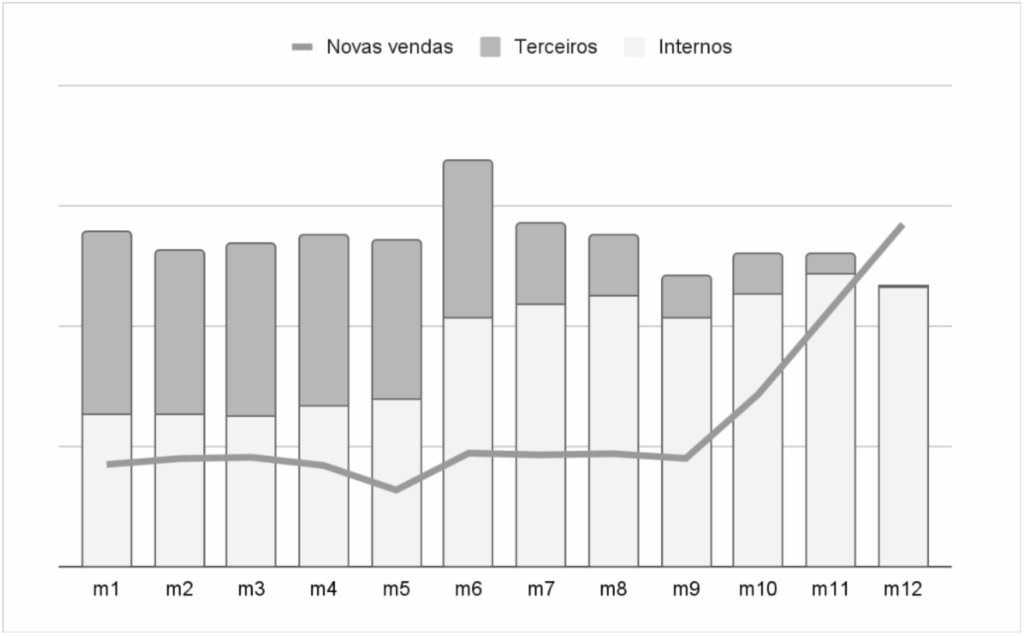
In the chapter on Result Delivery, I illustrated the difference in focus between outsourced teams and internal teams. Outsourced teams will always be interested in selling more hours. That’s the outcome these companies seek, allocating more hours to their clients, including you and your company, which is a different outcome than what you are looking for.
You and your company are not seeking to hire more hours of software development. You aim to achieve your strategic objectives while solving problems and meeting the needs of your customers. This misalignment of objectives is what leads me to advise against using outsourced teams. You can use them, provided that you have a clear understanding of this difference in objectives and know how to manage the effects it may cause.
The monthly accountability report, which comes with the invoice we must pay, includes a breakdown of the number of hours worked by each allocated professional and a list of delivered features. While I have seen some demonstrations of delivering results for the company or the client in reports from software development outsourcing companies, this is quite rare.
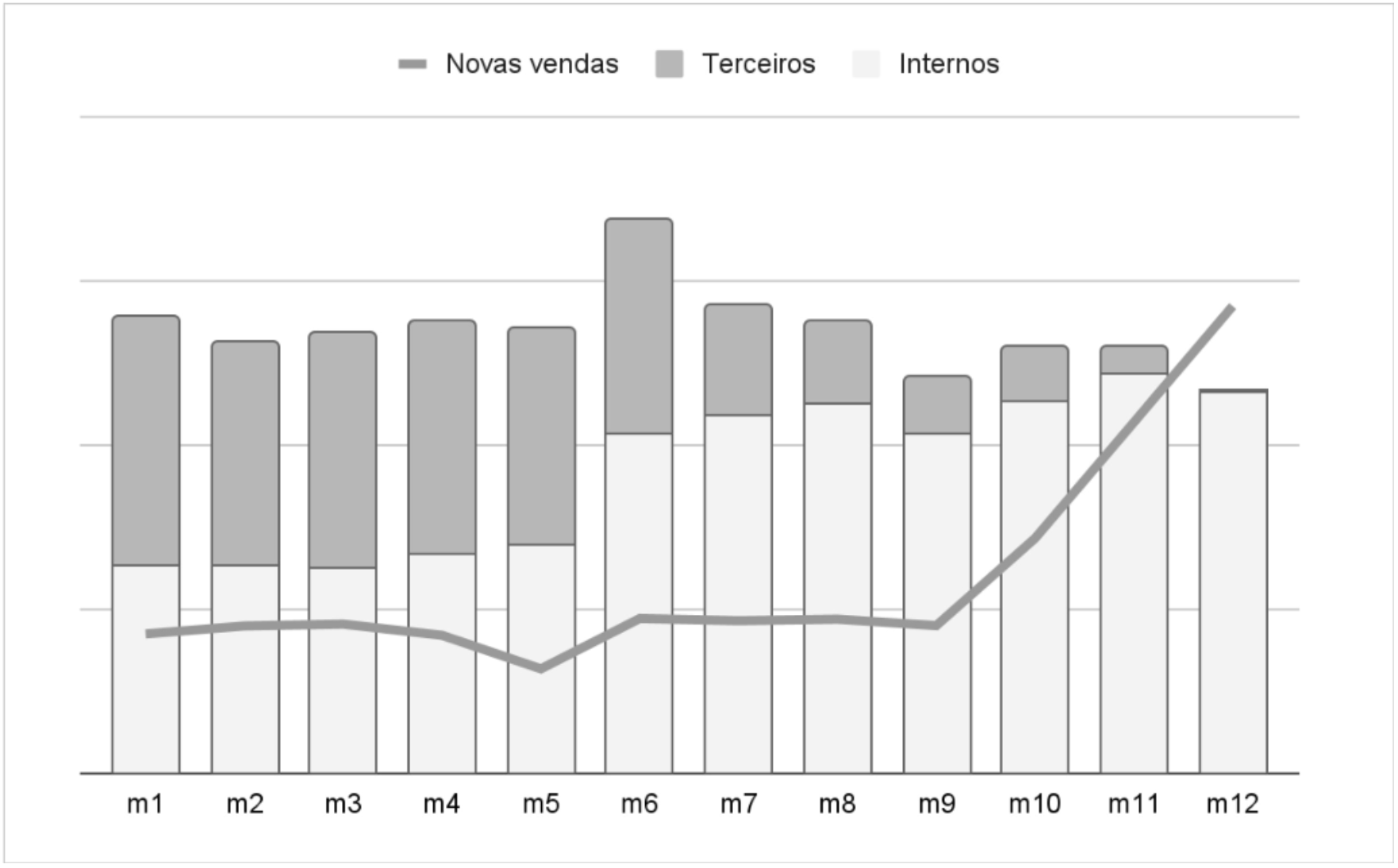
Once, I had the opportunity to help a client make the decision to switch from an outsourced team to an internal team. Since the average monthly cost per person for the product development team tends to be similar, the switch would be justified simply by having the people on the internal team highly aligned with business objectives. In this client, one of the business metrics we tracked was the number of sales generated by this product development team.
Outsourced team and sales
It is interesting to note that while the team was partially outsourced, the number of new sales did not increase, even though it was clear that this was one of the team’s main objectives. Only after a few months with the team being predominantly composed of internal staff did the metric of new sales begin to grow.
When I was at Lopes, I chose to bring in an outsourced team from a consulting company with extensive knowledge of software development, ThoughtWorks, to help me implement the principles I discussed in Part 2 of the book (Principles). It was a short-term project, lasting 7 to 9 months, with the objective and timeframe clearly defined from the beginning.
Digital transformation and product culture
This article is another excerpt from my newest book “Digital transformation and product culture: How to put technology at the center of your company’s strategy“, which I will also make available here on the blog. So far, I have already published here:
- About the book
- Part 1: Concepts
- Chapter 1: The so-called digital transformation – Project and Product
- Chapter 2: Uncertainty and digital transformation
- Chapter 3: Types of company
- Chapter 4: Type of company vs digital maturity
- Chapter 5: Business models
- Chapter 6: Agile, digital and product culture
- Part 2: Principles
- Chapter 7: Deliver early and often – Measuring and managing the productivity – Case study: Dasa Group – Case study: Itaú Unibanco
- Chapter 8: Focus on the problem – The Famous Product Discovery – Why the “business demands => IT implements” model does not work – Case study: Magazine Luiza
- Chapter 9: Result delivery – Outsource or internal team? – Case study: Centauro
- Chapter 10: Ecosystem mindset
- Part 3: Tools
- Chapter 11: Product Vision – Product vision examples
- Chapter 12: Product Strategy
- Chapter 13: Team Structure – Structuring effective product development teams – Structural teams – Team structure spreadsheet – Downsizing and layoffs – CTO + CPO – Internationalization – Outsource team
Workshops, coaching, and advisory services
I’ve been helping companies and their leaders (CPOs, heads of product, CTOs, CEOs, tech founders, and heads of digital transformation) bridge the gap between business and technology through workshops, coaching, and advisory services on product management and digital transformation.
Gyaco Podcasts
At Gyaco, we believe in the power of conversations to spark reflection and learning. That’s why we have three podcasts that explore the world of product management from different angles:
- Produto em Pauta: In the new season, titled “Beyond the Buzzwords”, Felipe Castro and I demystify product terms with real examples from our clients. Available on YouTube and Spotify. Recorded in Portuguese, with English subtitles on YouTube.
- Product Chronicles, the Brazilian Way: with Fábio Martinelli Duarte and Paulo Caroli — the Brazilian way of building products: stories, challenges, and lessons learned, featuring case studies from our clients. Available on YouTube and Spotify. Recorded in English, with Portuguese subtitles on YouTube.
- Beyond the Article, Expanded by AI: C.L.A.R.A. (Creative Language AI for Reflective Augmentation) chats with my AI clone, JocAI, expanding on my articles with new perspectives. Available on YouTube and Spotify. Thanks to AI, episodes are available in English, Spanish, and Portuguese.
Digital Product Management Books
Do you work with digital products? Do you want to know more about managing a digital product to increase its chances of success, solve its user’s problems, and achieve the company objectives? Check out my Digital Product Management books, where I share what I learned during my 30+ years of experience in creating and managing digital products:
- Digital transformation and product culture: How to put technology at the center of your company’s strategy
- Leading Product Development: The art and science of managing product teams
- Product Management: How to increase the chances of success of your digital product
- Startup Guide: How startups and established companies can create profitable digital products