

Product strategy is not a fixed or isolated artifact
16 de December, 2025
Who Owns What in the Product Management Playbook
2 de January, 2026
Every year-end invites reflection. But more than listing events, it’s worth trying to understand what became clearer after everything that was said, tested, promised, and (in)validated.
For me, 2025 was less about novelty and more about maturity — or the lack of it.
Some topics that had been discussed for years finally lost their hype gloss and began to demand real positioning.
AI stopped being a trend. It became infrastructure — a means to be more productive and to build better, more intelligent products.
In 2025, it became hard to take seriously any conversation about product that still treats AI as “something to explore in the future”.
AI became infrastructure.
Just like cloud, APIs, or mobile once did.
And that completely changes the question product teams and leaders need to ask. It’s no longer “should we use AI?”, but:
- what real problem are we trying to solve?
- what concrete value will this generate for customers and for the business?
- what impact will this have on how people work and on the team’s culture?
A practical example of this is Astro Lumi.

Astro Lumi: a conversational interface designed as the product’s foundation
It did not start as a traditional product that “added AI later.” From the very beginning, it was conceived as a product in which AI is not a feature, but a foundation. Astro Lumi is a virtual astrologer that not only generates a natal chart and a solar return chart, but also helps interpret them through a conversational interface. The goal is not to impress with technology, but to use technology to help people understand themselves through astrology.
This kind of approach changes everything: what gets built, how it gets built, and, most importantly, why it gets built.
One interesting detail was the choice of interface. I opted for a conversational experience not because “chat is trendy,” but because it made sense for a virtual astrologer to communicate by conversing. Form did not come before meaning.
The same reasoning applied to how we learned about the product. Instead of running a Sean Ellis survey as a standalone feature—sending emails to the user base and asking people to fill out a form—I chose to embed it directly into the conversation. The survey stopped being a separate artifact and became part of the experience itself.
This kind of decision may seem small, but it reveals an important shift: when AI is the foundation, product, learning, and experience stop being independent layers and start evolving together.
The most interesting products I saw this year were not the ones that “had AI,” but the ones that were designed around it—without turning it into a slogan.
Product culture remains the greatest differentiator—and the greatest challenge
Another point that 2025 reinforced is that frameworks continue to be overrated, while culture remains underestimated.
There is no shortage of well-designed roadmaps, organized rituals, or neatly structured squads. What is missing is:
- shared clarity around the problem, product vision, and strategy,
- autonomy with accountability,
- and the ability to say “no,” even when technology makes it easy to say “yes.”
Product culture remains more decisive than any method. And precisely for that reason, it is harder to build.
It cannot be implemented. It either emerges—or it doesn’t.
Vibe coding accelerates prototypes, not product maturity
Phenomena like vibe coding gained momentum in 2025 because they respond to a very real anxiety: the pressure for speed.
And there is nothing wrong with accelerating prototypes. Quite the opposite.
The problem begins when speed becomes a substitute for:
- deep understanding of the problem,
- conscious trade-off decisions,
- alignment between business, product, and technology.
Vibe coding is a symptom. A symptom of a market that confuses speed with progress and experimentation with strategy.
What all of this points to in 2026
Looking ahead, my bet is clear: 2026 will widen the gap between companies that know what they are building and companies that are merely able to build fast.
Those that stand out will increasingly be the ones that:
- use technology as a means, not an end,
- have clarity about the problem before scaling solutions,
- and are able to align business, product, and execution without relying on heroes.
None of this is new. But in a context where technology accelerates everything, the absence of these fundamentals comes at a higher cost, and much faster.
Perhaps this is the real challenge of the next cycle: it’s not about new tools, but about clarity around which problems we are solving, for whom, and why. Only then can we make better decisions and generate better results.
Workshops, coaching, and advisory services
I’ve been helping companies and their leaders (CPOs, heads of product, CTOs, CEOs, tech founders, and heads of digital transformation) bridge the gap between business and technology through workshops, coaching, and advisory services on product management and digital transformation.
Gyaco Podcasts
At Gyaco, we believe in the power of conversations to spark reflection and learning. That’s why we have two podcasts that explore the world of product management from different angles:
- Produto em Pauta: In the new season, titled “Beyond the Buzzwords”, Felipe Castro and I demystify product terms with real examples from our clients. Available on YouTube and Spotify. Recorded in Portuguese, with English subtitles on YouTube.
- Product Chronicles, the Brazilian Way: with Fábio Martinelli Duarte and Paulo Caroli — the Brazilian way of building products: stories, challenges, and lessons learned, featuring case studies from our clients. Available on YouTube and Spotify. Recorded in English, with Portuguese subtitles on YouTube.
Digital Product Management Books
Do you work with digital products? Do you want to know more about managing a digital product to increase its chances of success, solve its user’s problems, and achieve the company objectives? Check out my Digital Product Management books, where I share what I learned during my 30+ years of experience in creating and managing digital products:
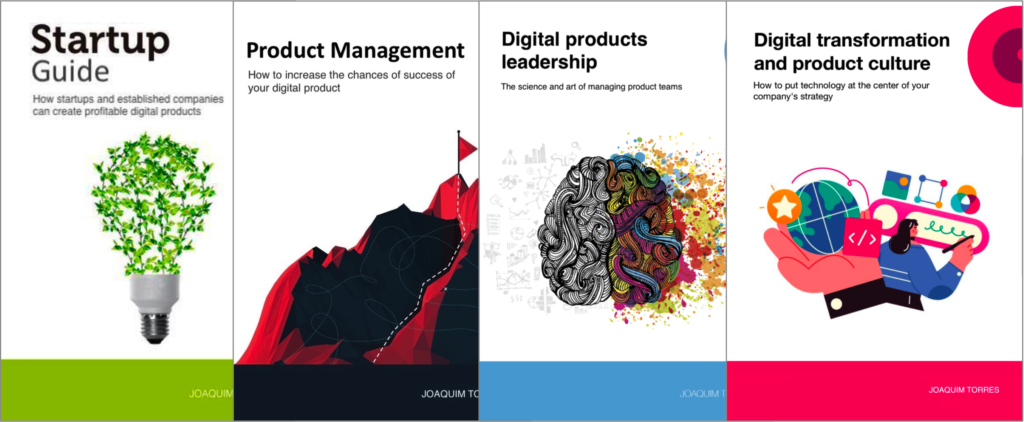
- Digital transformation and product culture: How to put technology at the center of your company’s strategy
- Leading Product Development: The art and science of managing product teams
- Product Management: How to increase the chances of success of your digital product
- Startup Guide: How startups and established companies can create profitable digital products