

What Became Clear in 2025 and What It Means for 2026
22 de December, 2025
Resistance to AI Isn’t Technical. It’s Cultural. And It Starts with Leadership.
12 de January, 2026
This is the time of year when we start executing what we planned for the new year. In some cases, teams are still putting the final touches on that plan — or even starting it now — since the end of the year was focused on hitting short-term targets.
A very common mistake I see product development teams make is to start this planning process by jumping straight into defining OKRs. The problem with this approach is that it leaves teams without the strategic context needed to define meaningful OKRs.
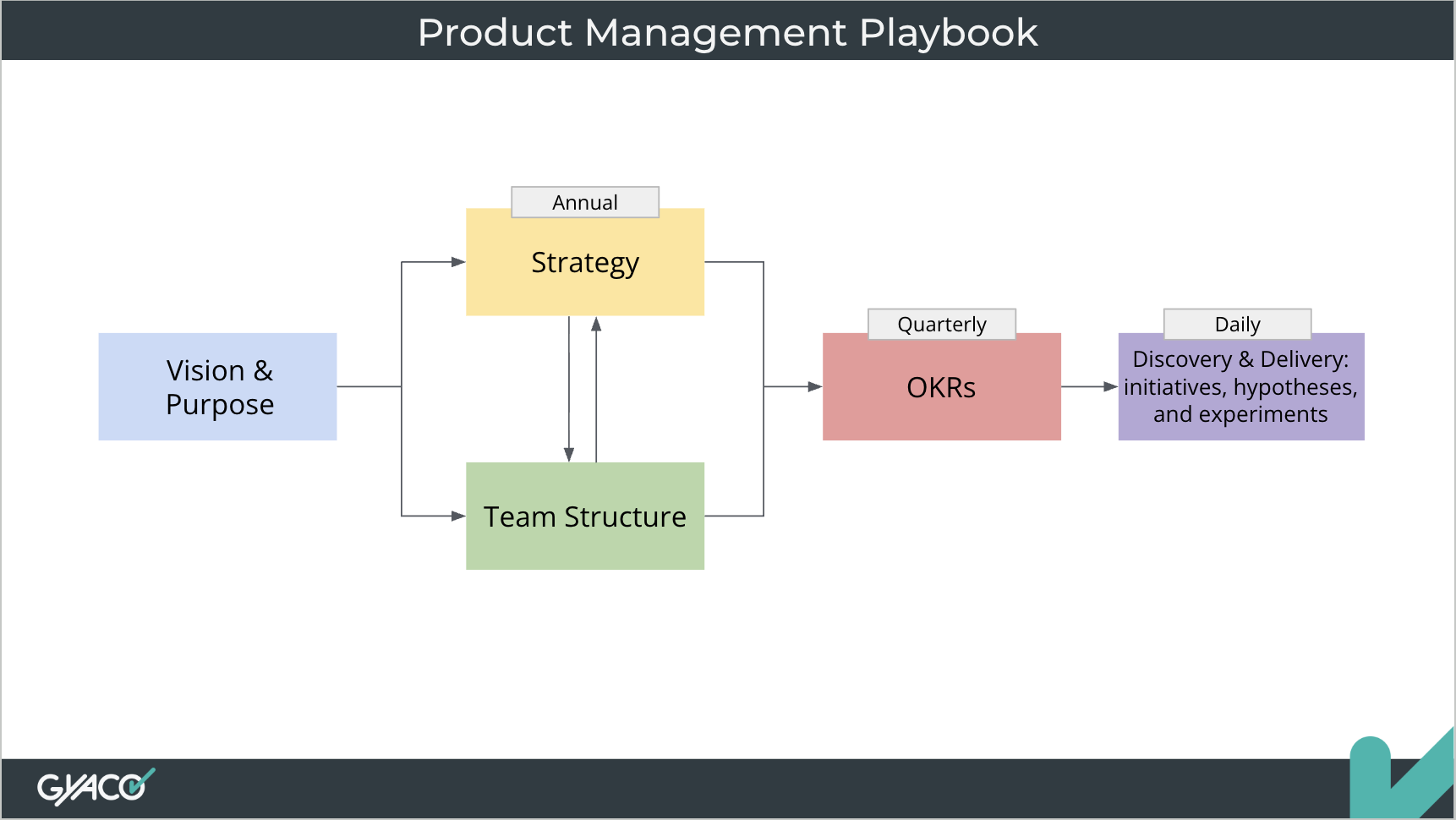
That’s why I use the Product Management Playbook:
Product Management Playbook
In this Playbook, it is clear that before defining OKRs, we need clarity on the product’s vision and purpose — the destination we want our product to reach. It describes what the product should become over the next two to four years.
Strategy is the path we take to reach that destination: what we will do to get there, which problems we will solve, and which opportunities we will pursue. Strategy is not fixed; it must evolve as we move forward and learn.
In parallel with strategy, we must define the team structure to ensure teams have what they need to execute it. With this context clearly defined, teams can then set their OKRs and carry out discovery and delivery on a daily basis to achieve their objectives.
Roles and responsibilities
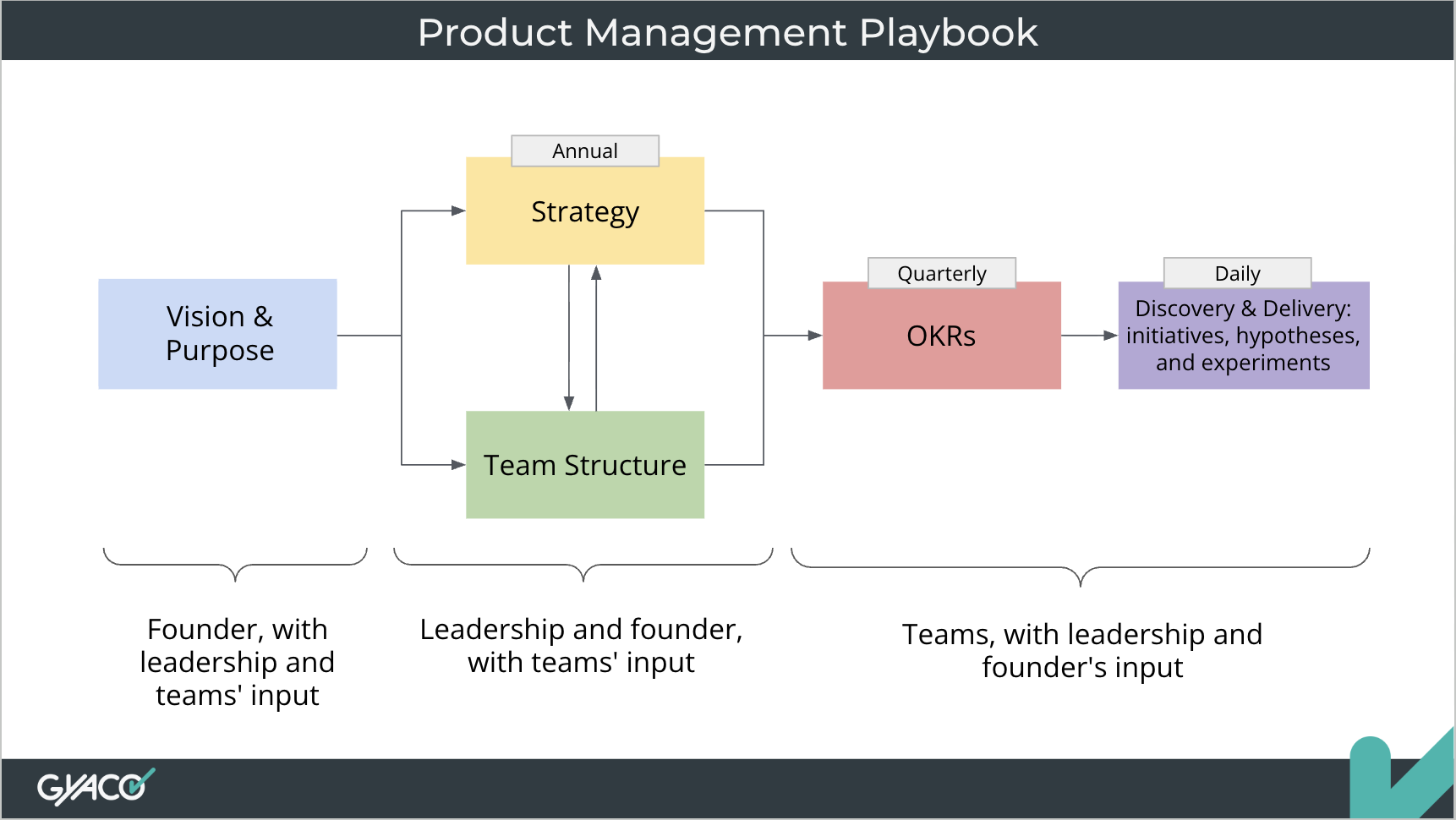
But who is responsible for each part of the Playbook? Who defines the vision and purpose? Who owns strategy and team structure? And what about OKRs, discovery, and delivery?
- The product vision and purpose must be defined by the founder. CPOs and Heads of Product can help articulate the vision, but accountability ultimately sits with the founder. Even in companies where the founder is no longer present, in organizations with multiple products, or even in public institutions, the product vision originally came from the founder and is later evolved by the company’s leadership. Leadership and teams can provide input, but responsibility lies with the founder.
- Strategy and team structure are the responsibility of leadership and the founder, with input from the teams.
- OKRs, discovery, and delivery are the responsibility of the teams, with input from leadership and the founder.
Below is the updated diagram showing roles and responsibilities in the Playbook:
Who Owns What in the Product Management Playbook
The Impact of AI on the Product Management Playbook
I recently came across the Jevons Paradox, introduced by William Stanley Jevons, a 19th-century British economist, which states that:
When a technology makes the use of a resource more efficient, total consumption of that resource tends to increase rather than decrease.
To illustrate the Jevons Paradox, imagine that over time cars have become increasingly fuel-efficient, consuming less gasoline per kilometer driven. The expectation would be that total gasoline consumption would decrease. However, as cars became more efficient, owning and using a car became cheaper. As a result, more people bought cars, and total gasoline consumption increased rather than decreased. In addition, existing infrastructure — gas stations, parking, streets, and highways — proved insufficient to support such a high number of vehicles.
The pattern looks like this:
- Something becomes more efficient
- The perceived cost decreases
- Usage expands
- Total consumption increases
- A new bottleneck emerges (attention, decision-making, strategy)
We can apply this same paradox to product development. AI is making product development increasingly cheaper. With AI, discovery and delivery are becoming easier, as is defining OKRs. But this is where the risk I mentioned at the beginning of this article comes into play: we cannot jump straight into OKRs, discovery, and delivery without first having clarity on the strategic context. What is the vision and purpose of our product? What strategy will we use to execute that vision? How should we structure our teams to increase the chances of successfully executing that strategy?
Looking again at the Jevons Paradox pattern:
- Product development is becoming more efficient thanks to AI tools
- The perceived cost of building products decreases
- Usage expands, as more people are able to turn ideas into reality
- Total consumption of computing power increases
- A new bottleneck emerges: without clarity about what we are building — in other words, without product vision and strategy — the chances of success decrease significantly
AI, combined with the Jevons Paradox, dramatically accelerates the symptoms of a lack of product vision. By making experimentation, solution generation, and execution much cheaper and faster, AI does not create a problem. On the contrary, it makes product development far more efficient and faster.
However, AI and the Jevons Paradox can expose symptoms of a lack of vision that were already there: feature factories, misaligned teams, and products with no clear identity. Without a shared north star, the lower cost of “doing” leads to a growing volume of disconnected initiatives, fragmented narratives across teams, and an accelerated dilution of the product’s value proposition in the market. Efficiency increases, but value does not keep up.
To mitigate this risk, leadership and founders must clearly define and communicate the strategic context through a well-established product vision and strategy, along with a team structure aligned with that direction.
AI makes teams move faster. Vision ensures they are moving in the right direction.
Workshops, coaching, and advisory services
I’ve been helping companies and their leaders (CPOs, heads of product, CTOs, CEOs, tech founders, and heads of digital transformation) bridge the gap between business and technology through workshops, coaching, and advisory services on product management and digital transformation.
Gyaco Podcasts
At Gyaco, we believe in the power of conversations to spark reflection and learning. That’s why we have two podcasts that explore the world of product management from different angles:
- Produto em Pauta: In the new season, titled “Beyond the Buzzwords”, Felipe Castro and I demystify product terms with real examples from our clients. Available on YouTube and Spotify. Recorded in Portuguese, with English subtitles on YouTube.
- Product Chronicles, the Brazilian Way: with Fábio Martinelli Duarte and Paulo Caroli — the Brazilian way of building products: stories, challenges, and lessons learned, featuring case studies from our clients. Available on YouTube and Spotify. Recorded in English, with Portuguese subtitles on YouTube.
Digital Product Management Books
Do you work with digital products? Do you want to know more about managing a digital product to increase its chances of success, solve its user’s problems, and achieve the company objectives? Check out my Digital Product Management books, where I share what I learned during my 30+ years of experience in creating and managing digital products:
- Digital transformation and product culture: How to put technology at the center of your company’s strategy
- Leading Product Development: The art and science of managing product teams
- Product Management: How to increase the chances of success of your digital product
- Startup Guide: How startups and established companies can create profitable digital products