

Dependencies between teams
27 de January, 2026
How to make a career change to product management?
10 de February, 2026This article is an excerpt from the book “Digital Transformation and Product Culture: How to Put Technology at the Center of Your Company’s Strategy”.
This is a question I’ve received a lot in my coaching sessions, so I imagine the answer might be of interest to more people. The short answer is “no and yes” — which, I know, doesn’t provide much clarity; it’s like the famous and not-so-helpful response “it depends,” often used to answer many product management questions.
With that in mind, I’ll elaborate on the “no and yes” response by providing some examples from my experience.
No, we should not have a dedicated innovation team
Sometimes we are tempted to create a dedicated innovation team because all our existing teams already have the day-to-day topics to take care of. They don’t have space in their agenda to innovate, so let’s create a separate team to focus on exploring innovations.
Well, that’s not the right mindset to have. All of our existing teams should not only have space to innovate, but their day-to-day work should be to explore innovations.
How? Please follow my reasoning. Product development teams are supposed to be problem-solver teams or, as Marty Cagan says, empowered product teams, i.e., they are given problems to solve and results to achieve and they do so by creating solutions to these problems. Given a problem to solve and a result to achieve, the team is free to experiment with different solution options, and that’s exactly how innovations are born.
If we force our product development teams to operate in a solution-implementer mode or, as Marty Cagan calls them, as feature teams, there’s no space to come up with innovations. They’ll be working on implementing solutions devised by other people, people that do not have enough experience and knowledge of what is possible to do with technology. So it’s very difficult to create innovations with teams operating in a solution-implementer mode.
So, to foster all your product development teams to innovate, they need to have an objective, a problem to solve, so they can test different solutions and maybe come up with new and unseen solution.
At Lopes, the biggest real estate company in Brazil, where I lead Lopes Labs, the technology and innovation team between 2020 and 2022, we used OKRs to define the objectives and key results we wanted to achieve, and tracked these objectives and key results weekly. The teams were free to define what to implement in order to achieve the key results.
We also had quarterly hackdays, 3 days in the beginning of the quarter when people from Lopes Labs formed new temporary teams to solve problems the teams proposed. Many interesting innovations were born during the hackdays. This is a technique I also used at Locaweb and at Gympass with very good results in terms of creating innovations.
Yes, we should have a dedicated innovation team
On the other hand, there may be some problems or opportunities that may need a dedicated team. Problems or opportunities that are not in the core domain of any of the teams and can be a distraction for them may require a new dedicated innovation team.
At Lopes we started to use a technique we borrowed from our friends at iFood called Jet Ski teams, to solve this type of problems that were not in the core domain of any of the teams. Jet Ski teams are small, dedicated teams temporarily assembled to tackle this kind of problems. We pick people with specific knowledge and experience to built the Jet Ski team, and leave them focused on solving the problem. Surely they’ll be missed in their original teams, and we need to account for that, i.e., certain objectives and key results of their original teams may not be hit, which needs to be taken into consideration when building Jet Ski teams. another aspect of consideration is, if the team is successful in creating and implementing a solution for the problem, who will take care of this solution when the Jet Ski team is disassembled and its members return to their original teams.
Another way to create a new dedicated innovation team is to create a business unit (B.U.) with a general manager and a few people in order to tackle an specific problem or opportunity. We used this approach at Gympass when we created in the 2nd half of 2019 3 new business units. One focused on selling Gympass to SMBs, another to create a marketplace of product and services for gyms and studios, and a third one, which I lead as the general manager, to explore the opportunity of creating a wellbeing apps marketplace that ended up becoming Gympass Wellness. This is normally a more permanent approach, so when deciding to create a new business unit it is always important to define how the people relocating to the new business unit will be replaced in their current positions.
Concluding
The answer to the question “should we have a dedicated innovation team?” is both no and yes.
No, because innovation should be part of the everyday work of product teams. They exist to solve problems and deliver outcomes, and it is precisely in that space that innovation emerges.
Yes, because some problems or opportunities do not belong to the core domain of any existing team and may require focused, dedicated attention.
If innovation only seems possible once a dedicated innovation team is created, it is worth pausing to reflect. The issue may not be the absence of innovation, but the way teams are organized, the problems they are asked to solve, and the autonomy they are given to do so.
Digital transformation and product culture
This article is another excerpt from my newest book “Digital transformation and product culture: How to put technology at the center of your company’s strategy“, which I will also make available here on the blog. So far, I have already published here:
- About the book
- Part 1: Concepts
- Chapter 1: The so-called digital transformation – Project and Product
- Chapter 2: Uncertainty and digital transformation
- Chapter 3: Types of company
- Chapter 4: Type of company vs digital maturity
- Chapter 5: Business models
- Chapter 6: Agile, digital and product culture
- Part 2: Principles
- Chapter 7: Deliver early and often – Measuring and managing the productivity – Case study: Dasa Group – Case study: Itaú Unibanco
- Chapter 8: Focus on the problem – The Famous Product Discovery – Why the “business demands => IT implements” model does not work – Case study: Magazine Luiza
- Chapter 9: Result delivery – Outsource or internal team? – Case study: Centauro
- Chapter 10: Ecosystem mindset
- Part 3: Tools
- Chapter 11: Product Vision – Product vision examples
- Chapter 12: Product Strategy
- Chapter 13: Team Structure – Structuring effective product development teams – Structural teams – Team structure spreadsheet – Downsizing and layoffs – CTO + CPO – Internationalization – Outsourced team – Tuckman model – Dependencies between teams – Should we have a dedicated innovation team?
Workshops, coaching, and advisory services
I’ve been helping companies and their leaders (CPOs, heads of product, CTOs, CEOs, tech founders, and heads of digital transformation) bridge the gap between business and technology through workshops, coaching, and advisory services on product management and digital transformation.
Gyaco Podcasts
At Gyaco, we believe in the power of conversations to spark reflection and learning. That’s why we have “Product in Focus” (Produto em Pauta in Portuguese), a podcast that explores the world of product management from different angles:
- Mentoring Sessions: In this series, I share real mentoring conversations with product people. One person’s questions are often the questions of many. Together, we explore concrete challenges and turn experience into practical insights you can apply to your own context.
- Beyond the Buzzwords: In this series, Felipe Castro and I demystify product terms with real examples from our clients.
Available on YouTube and Spotify. Recorded in Portuguese, with English subtitles on YouTube.
Digital Product Management Books
Do you work with digital products? Do you want to know more about managing a digital product to increase its chances of success, solve its user’s problems, and achieve the company objectives? Check out my Digital Product Management books, where I share what I learned during my 30+ years of experience in creating and managing digital products:
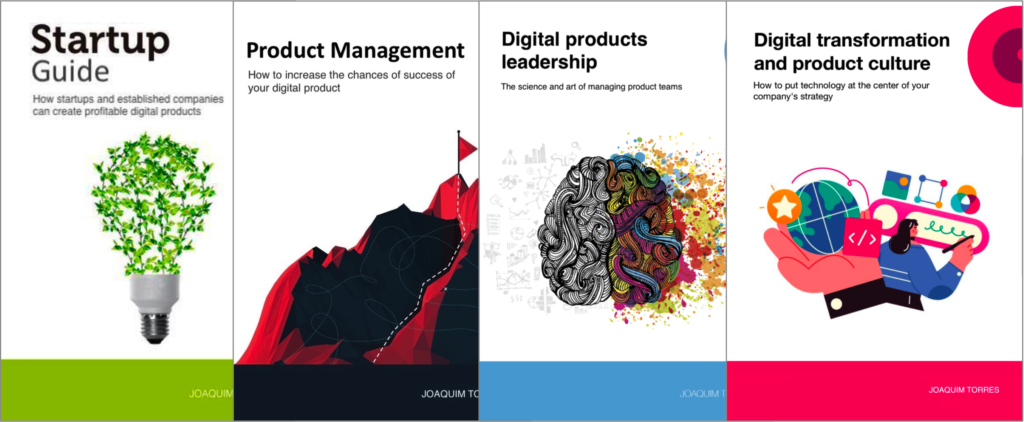
- Digital transformation and product culture: How to put technology at the center of your company’s strategy
- Leading Product Development: The art and science of managing product teams
- Product Management: How to increase the chances of success of your digital product
- Startup Guide: How startups and established companies can create profitable digital products