

Observations on how AI is impacting the organization of product teams
18 de February, 2026At the end of a recent session with technology leaders, someone asked me a very interesting question: if I’m a head of engineering, what is my role in building product vision and strategy?
Before getting to the answer, a bit of context. I hold a degree in Computer Engineering from ITA and I’m a cofounder of Dialdata, one of Brazil’s first internet service providers, where I served as CTO. Since then, throughout my career, I’ve often asked myself how I could be more strategic and take part in the conversations that define a company’s direction, not just its technical execution.
After Dialdata, I went on to lead both product and engineering in companies such as Locaweb, Conta Azul, Gympass, and Lopes. Across all these experiences, my focus remained the same: making sure technology and product had a real voice in strategic decisions. It was through these experiences that I built the answer I gave at that session.
My answer was direct: engineering must be involved from the very beginning. Not after the vision is already defined. If, as a head of engineering, you only get involved in product vision and strategy once they’re set, your team will tend to become either a feature factory or, worse, the “party pooper” that always shows up to say, “this can’t be done.”
In many companies, there’s still a belief that product vision and strategy belong exclusively to the product function. In practice, when engineering is only involved in execution, strategy risks becoming wishful thinking. When engineering participates in shaping it, the vision is more likely to be grounded in execution reality and in long-term technical choices.
When there is a product counterpart
The simplest situation is when there is a head of product, a CPO, or someone clearly responsible for product. In that scenario, the role of the head of engineering is not to take over vision creation, but to participate in building it.
This means being part of the discussions from the start, understanding the business model, challenging decisions, and ensuring that what’s being defined as direction is both executable and sustainable. It’s not about waiting for the vision to arrive ready-made. It’s about co-creating it.
When this partnership works well, product strategy doesn’t turn into a wish list or a document disconnected from technical reality. It’s ambitious, but also viable. Engineering isn’t just receiving a roadmap. It’s helping define the direction that guides that roadmap. After all, engineering understands what’s feasible and which technologies can move the product closer to its vision.
When engineering only joins at the execution stage, frustration tends to emerge on both sides. Product defines something hard to sustain. Engineering later explains why it won’t work. Involving engineering from the beginning reduces this friction and improves the quality of decisions, both about which strategies to pursue and about what kind of vision is actually worth building.
At the same time, it is the product leadership’s role to coordinate the creation of product vision and strategy. That includes extracting the vision from the founder or executive leadership and turning it into something clear, tangible, and aligned across the company, and then defining, together with engineering, the product strategy — in other words, what will and will not be done to move toward that vision.
If that clarity and alignment don’t exist, it is the responsibility of the head of engineering to demand it from the head of product. Otherwise, engineering becomes a factory of disconnected features.
When there is no head of product
The situation changes when there is no structured product leadership. This is more common than it may seem. In many companies, especially in earlier stages or more technical organizations, the vision lives in the founder’s or executive team’s head, but it hasn’t been organized or made tangible.
The vision exists. It’s talked about. But it isn’t clear enough to be shared and discussed.
In these cases, someone needs to help shape that vision. And often, the person best positioned to do that is the head of engineering.
What I recommend in this scenario is for the head of engineering to pragmatically take on that role of organizing what already exists implicitly. In several companies I’ve worked with, I’ve done exactly that. I listened carefully to the founder or executive leadership, understood how they saw the business and the product’s direction, and then organized that into something tangible — a diagram, a document, something that could be discussed.
With a first draft in a slide, I would ask: “Let me check if I understood this correctly. Is this what we’re building?” From there, the founder or executive would refine, adjust, and add nuance. This process transforms something that exists only in someone’s head into something shareable. The vision moves from implicit to explicit.
The next step is to broaden the conversation. Bring that draft to other leaders and validate it. Present it as an interpretation of what has been discussed and ask whether it makes sense. This gradually turns the vision into a shared agreement. It’s no longer individual. It becomes something built and recognized by the team.
Engineering as a partner in direction
Engineering should not position itself as a mere executor of the vision. When there is a product counterpart, it should act as a partner in shaping it. When there isn’t, it should act as a catalyst for organizing it.
In both cases, staying only in execution means giving up influence over the product’s direction. Participating in shaping the vision doesn’t mean engineering becomes the owner of product strategy. It means becoming co-responsible for defining it and making it real.
If you are a head of engineering and you sense that the vision is unclear, the role is not to wait for someone else to organize it. The role is to help bring clarity to product vision and strategy. This doesn’t replace the need for product leadership, but it helps the company gain direction while that function isn’t fully in place.
It may even make sense for you to take on that role more permanently, becoming a true product and engineering leader — someone who sits at the leadership table to discuss the future of the product and the company, not just someone who leads engineers. As a head of engineering, it can be more comfortable to focus on technical matters. But if you want to influence company strategy, working on product vision and strategy is one of the most effective ways to do it.
Participating in building the vision is not about stepping into product’s territory. It’s about taking ownership of the direction of what your team will build. Those who help shape the vision help shape the business. Those who don’t, simply execute.
Workshops, coaching, and advisory services
I’ve been helping companies and their leaders (CPOs, heads of product, CTOs, CEOs, tech founders, and heads of digital transformation) bridge the gap between business and technology through workshops, coaching, and advisory services on product management and digital transformation.
Gyaco Podcasts
At Gyaco, we believe in the power of conversations to spark reflection and learning. That’s why we have “Product in Focus” (Produto em Pauta in Portuguese), a podcast that explores the world of product management from different angles:
- Mentoring Sessions: In this series, I share real mentoring conversations with product people. One person’s questions are often the questions of many. Together, we explore concrete challenges and turn experience into practical insights you can apply to your own context.
- Beyond the Buzzwords: In this series, Felipe Castro and I demystify product terms with real examples from our clients.
Available on YouTube and Spotify. Recorded in Portuguese, with English subtitles on YouTube.
Digital Product Management Books
Do you work with digital products? Do you want to know more about managing a digital product to increase its chances of success, solve its user’s problems, and achieve the company objectives? Check out my Digital Product Management books, where I share what I learned during my 30+ years of experience in creating and managing digital products:
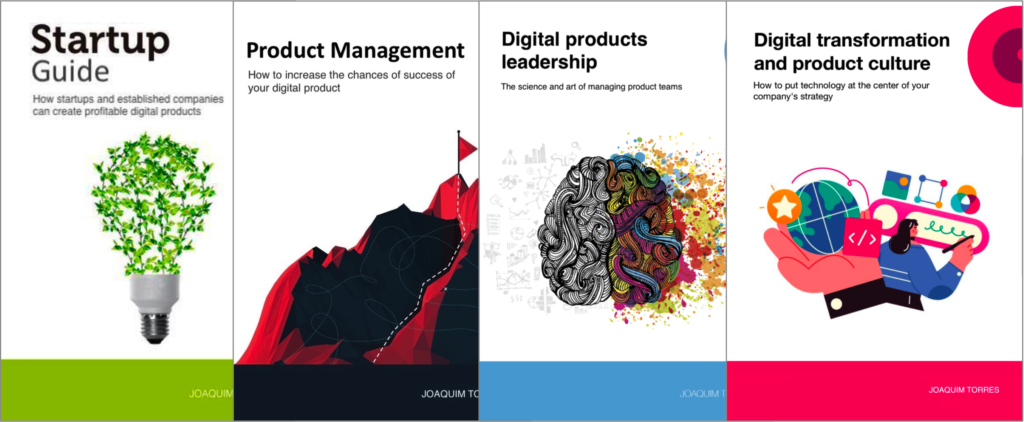
- Digital transformation and product culture: How to put technology at the center of your company’s strategy
- Leading Product Development: The art and science of managing product teams
- Product Management: How to increase the chances of success of your digital product
- Startup Guide: How startups and established companies can create profitable digital products