

The Still-Invisible Role of HR in Product Maturity
4 de March, 2026This is the second article in a series about the strategic role of HR in developing leadership and product maturity within organizations.
In the first article, I argued that product maturity is not only a technical matter. It is also a leadership issue and, therefore, it directly involves HR.
But there is an additional step that often makes a significant difference in organizations: when HR truly begins to understand how products actually work.
Product is not just a technical topic
For a long time, product has been seen as an essentially technical territory. Something related to engineering, technology, or more recently, to Product Managers. This perception is still common.
In many companies, when the conversation involves discovery, prioritization, or roadmap decisions, HR tends to stay at a distance. It often feels like a conversation that is too specialized, belonging exclusively to the product organization.
However, when HR decides to understand this language, something changes — and for the better. This does not mean becoming an expert in discovery or product metrics. It means understanding enough to participate in the conversations that truly define how the organization operates.
Understanding product changes HR’s place in the conversation
When HR starts to understand concepts such as outcomes, discovery, or team autonomy, its position inside the organization changes. Conversations stop being only about policies or programs. They begin to include discussions about how the company makes decisions, how it learns, and how it measures impact.
CTOs and CPOs begin to see HR differently at that point. Not as a support function, but as a partner capable of structuring the organizational mechanisms that sustain product practice.
This shift also changes the relationship with the CEO.
Digital transformation and the evolution of product maturity are often treated as technological agendas. But as organizations mature, it becomes clear that beyond technological questions, behavioral change is required.
And what changes behavior are leadership systems, decision-making criteria, and organizational incentives.
Where HR truly contributes
When HR understands the logic of product, it can directly contribute to decisions that shape how the organization operates.
For example:
-
How promotion criteria for product leaders are defined
-
How team performance is evaluated
-
How leadership development programs prepare managers to operate with autonomy and accountability for outcomes
These elements may appear peripheral when the conversation is centered only on technical structures. But in practice, they are precisely what sustain — or limit — product maturity.
An organizational agenda, not just a technical one
For this reason, in organizations that advance more consistently, HR does not merely participate in the product agenda. It begins to speak the language of product. Not to replace technical leadership, but to help build the leadership model the organization needs.
When this happens, product maturity stops being an initiative restricted to the technology organization. It becomes an organizational agenda.
And organizational agendas, by definition, always involve leadership and culture.
In the next article
In the third and final article in this series on HR and Product Culture, I will explore an aspect that rarely appears in this discussion: the cost of not developing product leaders.
Because in many organizations, that cost is already present — it just does not yet appear clearly in the spreadsheets.
Workshops, coaching, and advisory services
I’ve been helping companies and their leaders (CPOs, heads of product, CTOs, CEOs, tech founders, and heads of digital transformation) bridge the gap between business and technology through workshops, coaching, and advisory services on product management and digital transformation.
Gyaco Podcasts
At Gyaco, we believe in the power of conversations to spark reflection and learning. That’s why we have “Product in Focus” (Produto em Pauta in Portuguese), a podcast that explores the world of product management from different angles:
- Mentoring Sessions: In this series, I share real mentoring conversations with product people. One person’s questions are often the questions of many. Together, we explore concrete challenges and turn experience into practical insights you can apply to your own context.
- No Filters: In this series of episodes, Fabio Duarte, Paulo Caroli and I have candid conversations about product, technology and the real tensions we are seeing inside organizations.
- Beyond the Buzzwords: In this series, Felipe Castro and I demystify product terms with real examples from our clients.
Available on YouTube and Spotify. Recorded in Portuguese, with English subtitles on YouTube.
Digital Product Management Books
Do you work with digital products? Do you want to know more about managing a digital product to increase its chances of success, solve its user’s problems, and achieve the company objectives? Check out my Digital Product Management books, where I share what I learned during my 30+ years of experience in creating and managing digital products:
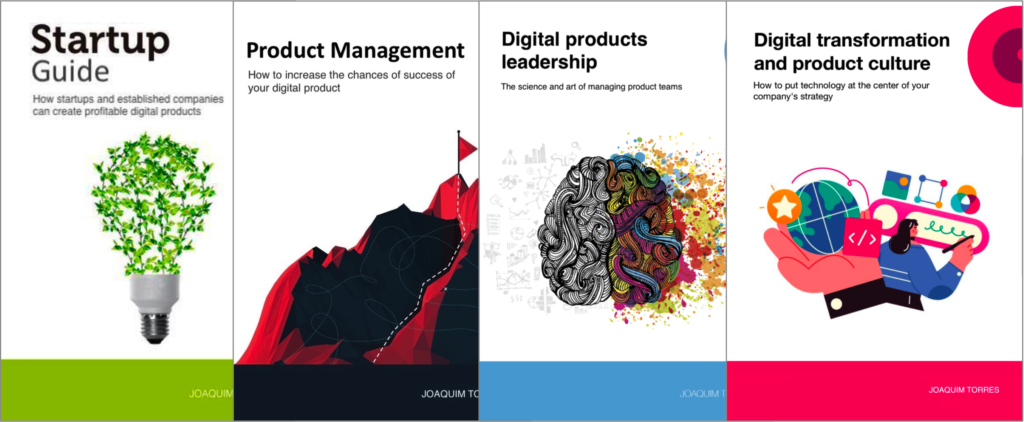
- Digital transformation and product culture: How to put technology at the center of your company’s strategy
- Leading Product Development: The art and science of managing product teams
- Product Management: How to increase the chances of success of your digital product
- Startup Guide: How startups and established companies can create profitable digital products