

When HR Speaks the Language of Product
10 de March, 2026This is the third and final article in a series about the strategic role of HR in developing leadership and product maturity within organizations.
In the first two articles, I argued that product maturity is not just a matter of methods or structure. It is, above all, a matter of leadership. And for that reason, HR has a much more central role in this agenda than is usually recognized.
In this final article, I want to explore a point that rarely appears in this discussion: the cost of not developing product leaders.
The symptoms of missing product leadership
This cost almost never appears explicitly in financial spreadsheets. But it is present in the day-to-day reality of many organizations.
It appears when teams deliver a lot, but the strategic impact remains below expectations.
It appears when a company invests in squads, agile methodologies, modern tools, and the hiring of more experienced Product Managers, yet the most important decisions continue to escalate to the C-level.
And it appears when the tension between business and technology persists, even after years of digital transformation.
The most common interpretation of these symptoms is technical. Lack of method. Lack of process. Lack of discipline in product management.
But most of the time, the problem lies elsewhere: it is a lack of product leadership.
What product leadership means
Organizations that operate with a product mindset need leaders who can make decisions with incomplete information, deal with ambiguity, and take responsibility for outcomes that do not depend solely on executing a plan.
This kind of leadership does not emerge spontaneously.
If promotion criteria continue to reward operational execution above all else, the people who move up in the organization will keep reproducing a project mindset.
If performance systems prioritize predictability and control over learning and adaptation, teams quickly realize that experimenting and learning are not truly expected behaviors.
And if leadership development programs remain focused on traditional management approaches, they will hardly prepare managers to operate in environments of high uncertainty, which is exactly the case in product development.
The result is a situation I see frequently in many organizations: modern structures coexisting with outdated mindsets.
Squads operating inside organizations that still make decisions as if they were executing projects.
Product Managers trying to operate with autonomy within leadership systems that, in practice, still centralize decisions.
This misalignment generates a significant cost for the organization, which appears in the form of:
- deliveries that generate little impact for either the customer or the business
- slower decision-making
- recurring conflicts between teams and departments
- frustration within product teams
- high turnover among product, design, and engineering professionals
This cost is rarely attributed to leadership development. But it should be.
The strategic role of HR
This is where HR reenters the picture.
Developing leaders capable of operating in product-oriented environments requires revisiting promotion criteria, leadership development programs, performance evaluation systems, and career models.
In other words, it requires changing the organizational mechanisms that shape leadership behavior.
Historically, this has been HR’s territory.
For that reason, in companies that make consistent progress in their product maturity, HR does not appear merely as a support function for the transformation. Instead, it actively participates in designing the leadership model that the transformation requires.
When this happens, product maturity stops being just a technology agenda and becomes an organizational leadership agenda.
And organizational leadership has always been — and will continue to be — one of the central responsibilities of People.
Conclusion of the series
Across this three-article series, I explored a topic that still appears too rarely in discussions about product: the role of HR in developing product maturity within organizations.
- In the first article, we discussed why this role is often invisible.
- In the second, we explored how HR’s position changes when it begins to understand the language and logic of product.
- In this third article, we examined the organizational cost of not developing leaders who can operate in this context.
If there is one conclusion that becomes clear in organizations that make progress in this agenda, it is this: product maturity is, first and foremost, leadership maturity. And leadership maturity is an agenda that rarely evolves without the active participation of HR.
Masterclass: Why Strategy Doesn’t Reach the Product
In this 3-hour masterclass, Paulo Caroli and I will present a practical model to connect product vision, strategy, OKRs, and discovery to the real work of product teams.
The goal is to understand how to translate strategic direction into real product decisions.
The Masterclass will be in Portuguese.
More information and registration:
Masterclass: Por que a Estratégia Não Chega ao Produto (com Paulo Caroli e Joca Torres)
Workshops, coaching, and advisory services
I’ve been helping companies and their leaders (CPOs, heads of product, CTOs, CEOs, tech founders, and heads of digital transformation) bridge the gap between business and technology through workshops, coaching, and advisory services on product management and digital transformation.
Gyaco Podcasts
At Gyaco, we believe in the power of conversations to spark reflection and learning. That’s why we have “Product in Focus” (Produto em Pauta in Portuguese), a podcast that explores the world of product management from different angles:
- Mentoring Sessions: In this series, I share real mentoring conversations with product people. One person’s questions are often the questions of many. Together, we explore concrete challenges and turn experience into practical insights you can apply to your own context.
- No Filters: In this series of episodes, Fabio Duarte, Paulo Caroli and I have candid conversations about product, technology and the real tensions we are seeing inside organizations.
- Beyond the Buzzwords: In this series, Felipe Castro and I demystify product terms with real examples from our clients.
Available on YouTube and Spotify. Recorded in Portuguese, with English subtitles on YouTube.
Digital Product Management Books
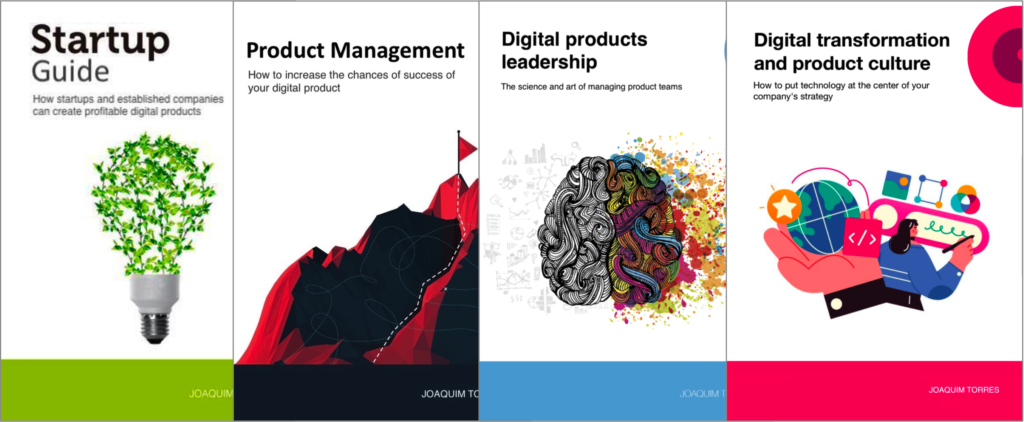
Do you work with digital products? Do you want to know more about managing a digital product to increase its chances of success, solve its user’s problems, and achieve the company objectives? Check out my Digital Product Management books, where I share what I learned during my 30+ years of experience in creating and managing digital products:
- Digital transformation and product culture: How to put technology at the center of your company’s strategy
- Leading Product Development: The art and science of managing product teams
- Product Management: How to increase the chances of success of your digital product
- Startup Guide: How startups and established companies can create profitable digital products