
Product Organization Mistakes #1: Serving Internal Departments Instead of Customers
31 de March, 2026This article is part of the Product Organization Mistakes series, which explores the most common dysfunction patterns in product organizations and what to do about them.
When Cesar Carvalho, founder of Gympass, invited me to join the company, it was clear what he had in mind: shared leadership, with a CTO taking care of engineering and me in the CPO role taking care of product. It was a pattern that VCs and mentors recommended, and one that made sense for where the company was at the time.
I said yes. Gympass was a great opportunity, a Brazilian company taking on the world, and I was very motivated to be part of that story. But before Gympass, I had always led the full product development team, including engineering, design, and product management. So during our conversations about me joining, I shared some concerns about the separate roles:
- Even with two leaders, it had to be one team. There could be no product team on one side and engineering team on the other. One product development team, full stop.
- The team would be called “product development team.” Not “product team” and “engineering team”. One area, one name.
- I wanted to be involved in hiring the CTO, to make sure we were aligned on how to lead. We had to be a good match.
- There would be no separate budgets, one for technology, one for product. One budget, two leaders accountable for it.
Why these concerns mattered
Throughout my career before Gympass, at Dialdata, Locaweb, and Conta Azul, I was responsible for both the technology and product teams. My background is in computer engineering, but I was always more interested in the P than the T. I was the one making the connection between what the technology team built and the needs of our customers and the business.
That single-leadership model was fairly common in the technology industry during the 1990s and 2000s. What I learned over time is that it only worked well when the person leading it understood both dimensions, technology and product. Many technology leaders were so focused on the T that they lost the P. And when that happened, the team turned into a feature factory: executing what the business requested, without questioning, without doing discovery, without being accountable for results.
The CPO role was born precisely from that gap, the need for someone to make the connection between business, customer, and technology. The role became increasingly relevant in the late 2000s, driven by the growth of large technology companies in Silicon Valley. Marty Cagan’s book Inspired, published in 2008, played an important role in spreading the idea. It was one of the first to clearly articulate the separation between product leadership and engineering leadership. In Brazil, the role arrived a few years later. The real explosion occurred between 2012 and 2016, when CPO became a common title, and VCs began actively recommending the dual leadership structure to their portfolio companies, alongside the growth of tech startups and the professionalization of the Brazilian technology ecosystem.
And with the emergence of this new C-level role, the CTO and CPO duo was born. The problem is that with two chiefs, many companies ended up with two separate areas. And that is where things go wrong.
The mistake is not having two chiefs
Having a CTO and a CPO is not the problem. The problem is when that leadership division turns into an area division: technology on one side, product (product managers and designers) on the other, each with its own budget, structure, and agenda.
Building products is the mission of a single area. To build good products, we need engineers, designers, and product managers working together, on the same team, toward the same objectives. Even with two leaders, it is one area.
When this is not clear, dysfunction appears quickly. The product area loses its connection to what engineering can actually build. Engineering loses its connection to the needs of the business and the customer. The two leaders start developing different agendas. And the team that should be focused on generating results is stuck in the middle, not knowing which direction to look.
What happened at Gympass
The alignment with the CTO worked well. So well, in fact, that we eventually expanded the leadership structure: we brought in a second CPO, with a marketing background, to focus on the B2C side. I stayed focused on B2B (companies, HR teams, and gym partners). We were three leaders, CTO, B2C CPO, and B2B CPO, running a single product development team. We operated that way for approximately one year.
After that period, each of us moved on to different things. The CTO left Gympass for another opportunity. The B2C CPO, who also served as CMO, shifted his focus exclusively to marketing. And I went on to lead a new initiative: Gympass Wellness, a marketplace of wellness apps that became crucial during the pandemic and eventually led the company to rename itself Wellhub.
When each of us moved on, we chose to bring in a single person to lead the entire product development team. The structure returned to single leadership, not because shared leadership had failed, but because it made sense for that moment. What mattered was alignment, not the org chart.
After Gympass, when I went to Lopes to lead their digital transformation, I returned to the model I had always known: responsible for all areas, product, and engineering together.
When leadership is a single person
Leaders who manage both product and engineering simultaneously need to be honest about where they are stronger and compensate for where they are weaker.
In my case, I am stronger in product than in engineering. So I have always looked for very strong engineering leaders. Recognizing that is not a weakness, it is what allows single leadership to work well.
I once helped a CTO who was facing exactly the opposite challenge. She had been working with a CPO, but the partnership was not going well. When the CPO left, the CTO and CEO decided not to hire another CPO. The CTO would become CPTO, taking on both roles.
The problem was that the CTO had no experience leading product. She was aware of this and reached out to me for help with the transition. One of the first things I noticed: of the six teams she led, only one had a leader with a product background. The other five had leaders with exclusively technology backgrounds.
This created a visible imbalance. Conversations gravitated toward the technical side. Product decisions lacked the necessary counterweight. The solution was not for her to become a product expert overnight. It was for her to bring in more leaders with product backgrounds to balance the team.
CTOs without a CPO partner need to understand the needs of their customers and the business, or they risk turning the team into a feature factory that executes requests from every department without questioning anything. An exclusive focus on technology, without someone making the connection to the business and the customer, reproduces exactly the anti-pattern we saw in the previous article: the internal department requests, the team delivers, and nobody is accountable for the result.
When CTO and CPO do not get along
The worst scenario, however, is not single leadership without product experience. The worst scenario is having a CTO and a CPO who are not aligned and do not work well together.
When that happens, the product area is almost always the first to fall. It starts to be seen as superfluous. Or worse, as an area that gets in the way, unable to connect the business and customer needs to what the engineering team is building. The CPO leaves or is let go. The product managers start reporting to the CTO.
And if the CTO does not make the effort to understand the P in their new role, the team completes the cycle back to the anti-pattern: engineering executing what the business requests, without discovery, without autonomy, without accountability for results.
The way out exists, but it requires awareness. Like the CTO who reached out to me for help with product topics, leadership needs to recognize where the gap is and act to close it, whether by bringing in leaders to report to her with the complementary profile, or by seeking outside help to navigate the transition.
Summary
- The mistake is not having a CTO and a CPO. The mistake is treating them as two separate areas, with separate budgets, structures, and agendas. Building product is the mission of a single team.
- Single leaders need to be honest about where they are stronger and compensate for their weaknesses, whether through strong leaders with the complementary profile or outside help.
- CTOs without a CPO partner who stay exclusively focused on technology risk turning the team into a feature factory, reproducing the anti-pattern of executing requests without questioning them.
- When CTO and CPO are not aligned, the product area is almost always dismantled, and the team returns to the cycle of executing what the business requests, without autonomy and without accountability for results.
- Leadership structure should follow strategy and people, not market convention. At Gympass, it worked with two chiefs, then three, then back to one. What mattered was alignment, not the org chart.
Masterclass: Why Strategy Doesn’t Reach the Product
In this 3-hour masterclass, Paulo Caroli and I will present a practical model to connect product vision, strategy, OKRs, and discovery to the real work of product teams.
The goal is to understand how to translate strategic direction into real product decisions.
The Masterclass will be in Portuguese.
More information and registration:
Workshops, coaching, and advisory services
I’ve been helping companies and their leaders (CPOs, heads of product, CTOs, CEOs, tech founders, and heads of digital transformation) bridge the gap between business and technology through workshops, coaching, and advisory services on product management and digital transformation.
Gyaco Podcasts
At Gyaco, we believe in the power of conversations to spark reflection and learning. That’s why we have “Product in Focus” (Produto em Pauta in Portuguese), a podcast that explores the world of product management from different angles:
- Mentoring Sessions: In this series, I share real mentoring conversations with product people. One person’s questions are often the questions of many. Together, we explore concrete challenges and turn experience into practical insights you can apply to your own context.
- No Filters: In this series of episodes, Fabio Duarte, Paulo Caroli and I have candid conversations about product, technology and the real tensions we are seeing inside organizations.
- Beyond the Buzzwords: In this series, Felipe Castro and I demystify product terms with real examples from our clients.
Available on YouTube and Spotify. Recorded in Portuguese, with English subtitles on YouTube.
Digital Product Management Books
Do you work with digital products? Do you want to know more about managing a digital product to increase its chances of success, solve its user’s problems, and achieve the company objectives? Check out my Digital Product Management books, where I share what I learned during my 30+ years of experience in creating and managing digital products:
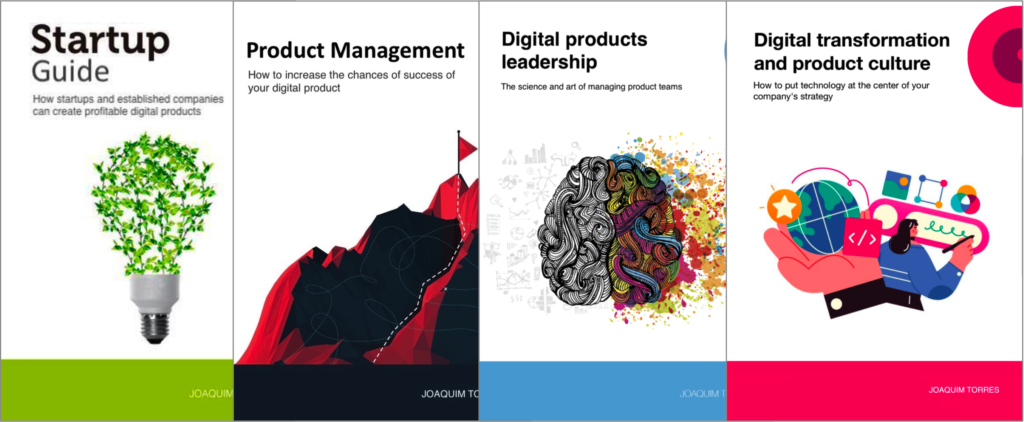
- Digital transformation and product culture: How to put technology at the center of your company’s strategy
- Leading Product Development: The art and science of managing product teams
- Product Management: How to increase the chances of success of your digital product
- Startup Guide: How startups and established companies can create profitable digital products