

The Role of Engineering Leadership in Product Vision and Strategy
25 de February, 2026When HR Speaks the Language of Product
10 de March, 2026This is the first in a series of three articles where I want to explore the strategic role HR can play in developing leadership and product maturity within companies.
When an organization decides to mature its product practice, the focus almost always falls on technology.
Teams are reorganized, squads are introduced, OKRs are implemented, more experienced Product Managers are hired. Companies invest in tools, frameworks and modern methodologies. A great deal of effort and energy goes into this agenda.
However, after some time, frustration begins to surface. Deliveries remain overly scope-driven. Squad autonomy is more rhetoric than reality. Strategic decisions frequently escalate to the C-Level. The tension between business and technology does not disappear.
The most common interpretation is a technical one: lack of method, lack of discipline, lack of seniority in the product organization.
Rarely does anyone look elsewhere.
Product maturity does not depend only on structure and process. It depends, above all, on leadership. And this is where an actor enters the picture whose impact is often essential, yet still underrecognized: HR.
Product maturity is leadership maturity
There is no product culture without leaders capable of operating with real autonomy, taking responsibility for outcomes, and making decisions even when not all the answers are available.
If leaders continue to be promoted based on operational execution rather than impact generation, the mindset does not change. If performance systems reinforce control and predictability over learning and adaptation, the organization will continue to operate with a project mindset — even while using the vocabulary of product.
These mechanisms are not technical. They are organizational.
They involve promotion criteria, career design, performance evaluation, succession, and structured leadership development.
And this has traditionally been the domain of People.
Why this role is still invisible
In many organizations, the product leadership agenda is treated as the exclusive responsibility of the CTO or the CPO. It makes sense that the technical area leads product practice. But leadership development does not emerge spontaneously within technology teams.
When HR keeps its distance from this agenda because it seems “too technical,” a gap is created. The technology organization then tries to solve on its own a challenge that is largely cultural and organizational.
The effects eventually appear in the indicators that HR itself monitors: high turnover in product, design and engineering; declining engagement in tech teams; difficulty retaining strategic talent; and increasing pressure from the CEO to demonstrate return on investment from leadership development.
At that point, it becomes clear that product maturity is not only a technical issue. It is also about how the organization develops and sustains its leaders.
Still, HR’s role in this process often remains behind the scenes. It shapes structures, influences criteria, and supports programs — but is rarely recognized as central to the evolution of product maturity.
What begins to change in more advanced organizations
In organizations that consistently advance in their product maturity, this role stops being invisible.
CTOs and CPOs continue to lead the technical practice. But HR explicitly assumes responsibility for helping shape the leadership model that sustains that practice.
This does not mean People teams must become experts in roadmaps or discovery. It means understanding the logic of product well enough to structure leadership development programs that fit this context, revisit evaluation criteria through the lens of outcomes, and align incentives with the behaviors that transformation requires.
When this integration happens, product maturity stops being merely a structural reorganization and becomes a real change in behavior.
And behavioral change is something no tool can solve on its own.
Perhaps HR’s role in product maturity is still invisible in many organizations. However, in the companies I’ve been working with that are making consistent progress, it has already become central — and clearly visible.
The real question is whether this transition will happen through intentional design, or only when the symptoms become too severe to ignore.
In closing
This was the first article in a series about the strategic role of HR in developing leadership and product maturity within organizations.
In the next article, I will explore why strategic HR needs to speak the language of product. In the final piece, we will look at the cost of not developing product leaders.
Workshops, coaching, and advisory services
I’ve been helping companies and their leaders (CPOs, heads of product, CTOs, CEOs, tech founders, and heads of digital transformation) bridge the gap between business and technology through workshops, coaching, and advisory services on product management and digital transformation.
Gyaco Podcasts
At Gyaco, we believe in the power of conversations to spark reflection and learning. That’s why we have “Product in Focus” (Produto em Pauta in Portuguese), a podcast that explores the world of product management from different angles:
- Mentoring Sessions: In this series, I share real mentoring conversations with product people. One person’s questions are often the questions of many. Together, we explore concrete challenges and turn experience into practical insights you can apply to your own context.
- Beyond the Buzzwords: In this series, Felipe Castro and I demystify product terms with real examples from our clients.
Available on YouTube and Spotify. Recorded in Portuguese, with English subtitles on YouTube.
Digital Product Management Books
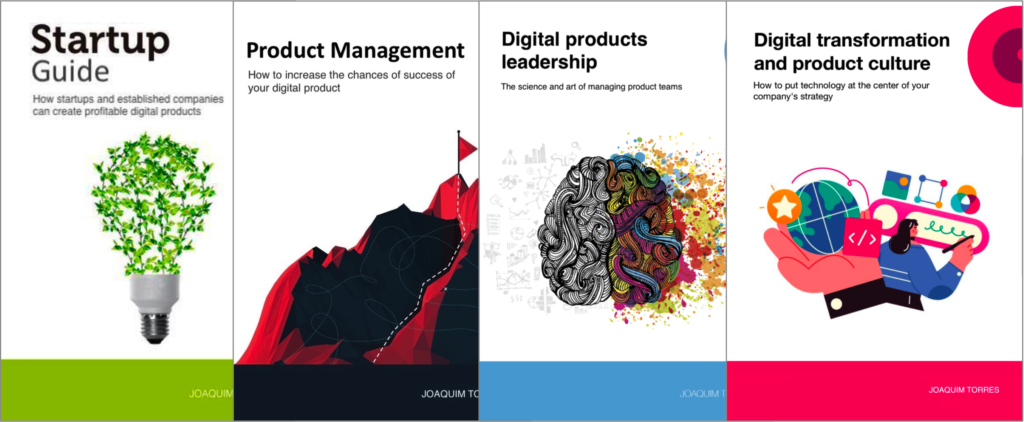
Do you work with digital products? Do you want to know more about managing a digital product to increase its chances of success, solve its user’s problems, and achieve the company objectives? Check out my Digital Product Management books, where I share what I learned during my 30+ years of experience in creating and managing digital products:
- Digital transformation and product culture: How to put technology at the center of your company’s strategy
- Leading Product Development: The art and science of managing product teams
- Product Management: How to increase the chances of success of your digital product
- Startup Guide: How startups and established companies can create profitable digital products