

The Invisible Cost of Not Developing Product Leaders
16 de March, 2026Product Organization Mistakes #1: Serving Internal Departments Instead of Customers
31 de March, 2026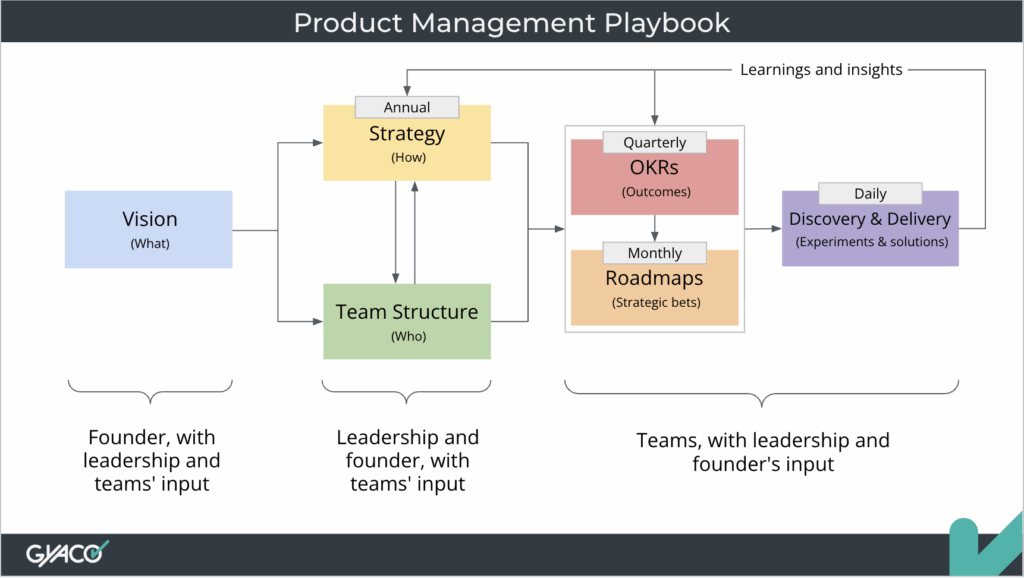
I created the Product Management Playbook to show my clients the steps and responsibilities involved in product development.
I’ve been talking about this playbook for a while. It’s part of my latest book, and I’ve been updating it as I collect feedback.
I believe I’ve reached a fairly complete version. And it all starts with Vision.
Vision
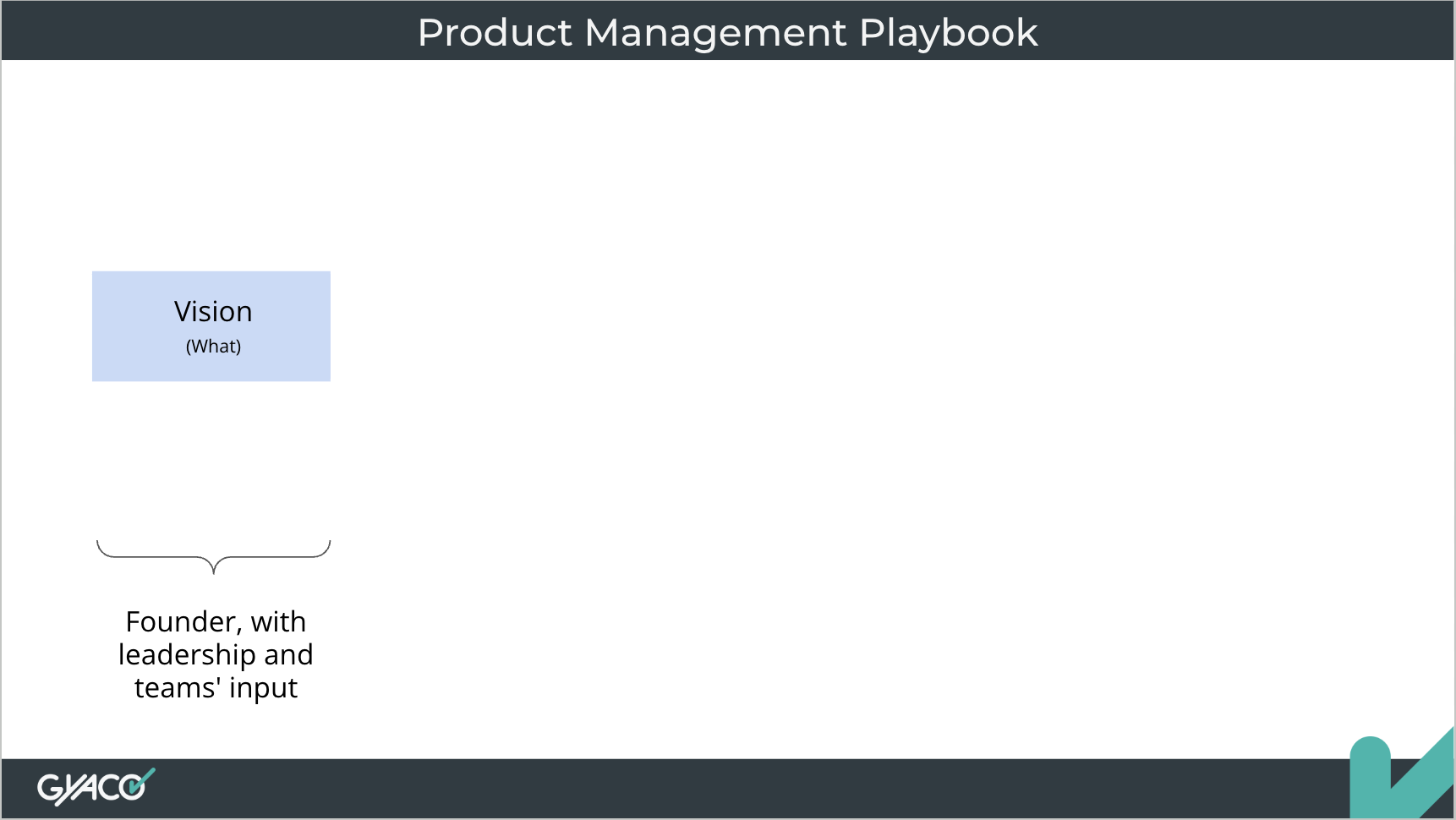
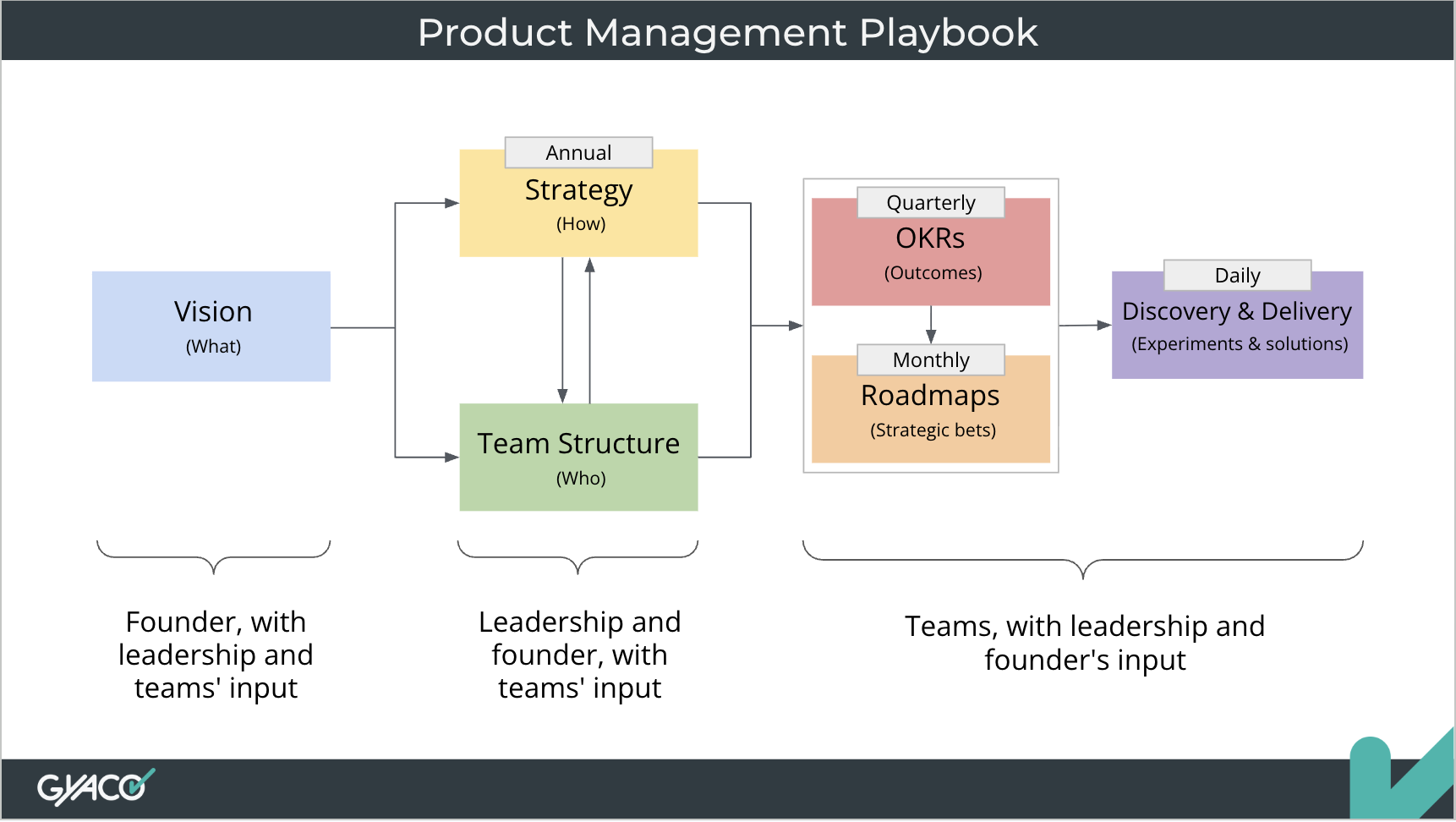
The first step is having clarity about Vision, which is a description of what we want to build. It’s where we want to take our product and why we should get there. It’s our destination and the motivation that drives us to reach it.
The person responsible for creating the Vision is the company’s founder, with input from leadership and the teams.
Product Management Playbook
Strategy and team structure
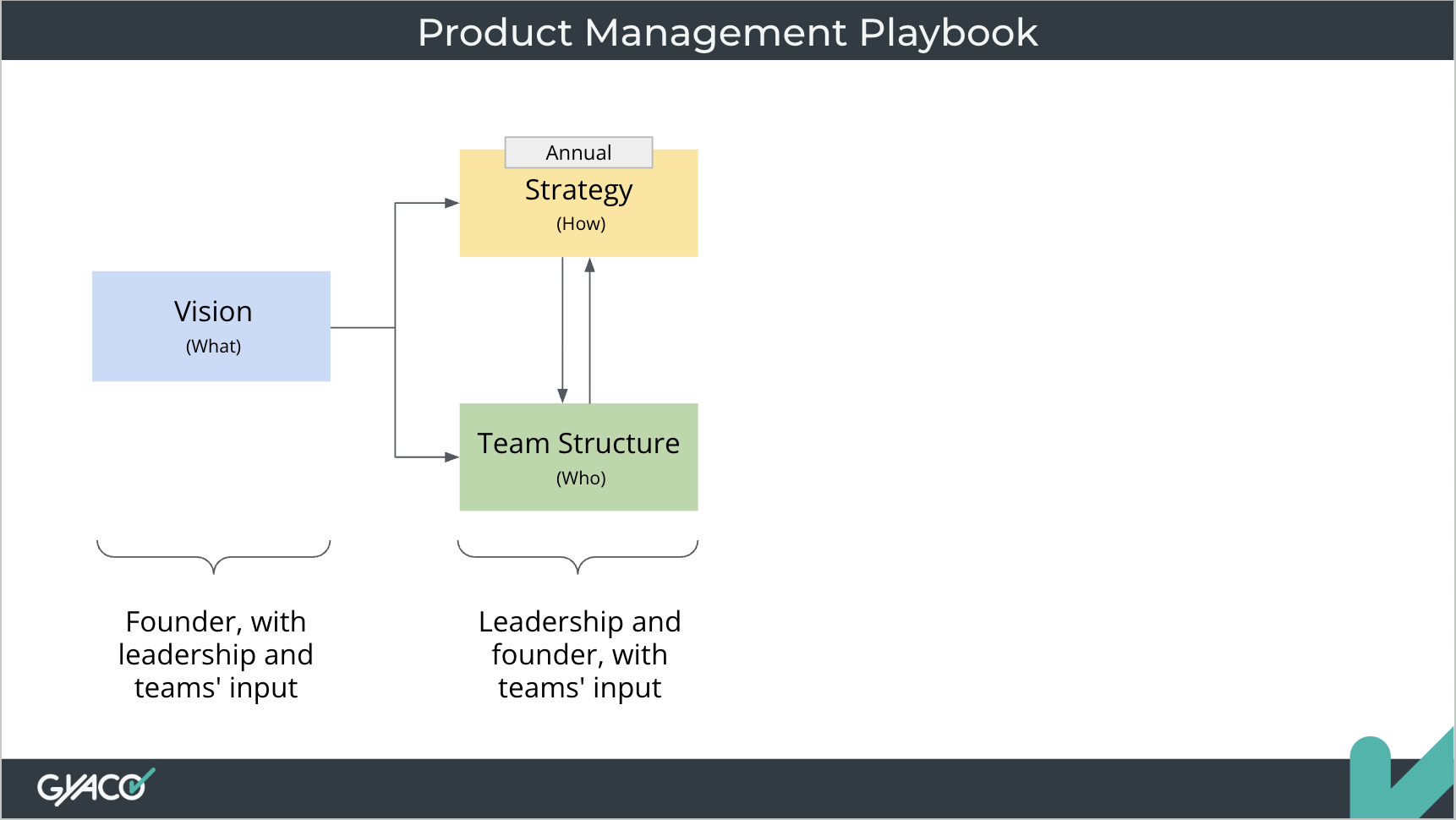
Once the Vision is defined, the destination we want to reach, the next step is to define the strategy, which describes how we’ll get there, and the team structure, which describes who will build that path. This is defined by leadership, together with the founder, and with input from the teams.
Product Management Playbook
OKR, Roadmap, Discovery and Delivery
With clarity on vision and strategy, teams define the objectives and metrics that show those objectives have been achieved (OKRs), identify the strategic bets to reach those objectives (Roadmap), and begin running experiments that guide the building of solutions (Discovery and Delivery), solutions that solve customers’ problems while generating results for the company. Leadership and the founder provide significant input, but the teams are the ones responsible for this part.
Product Management Playbook
Feedback loop and review
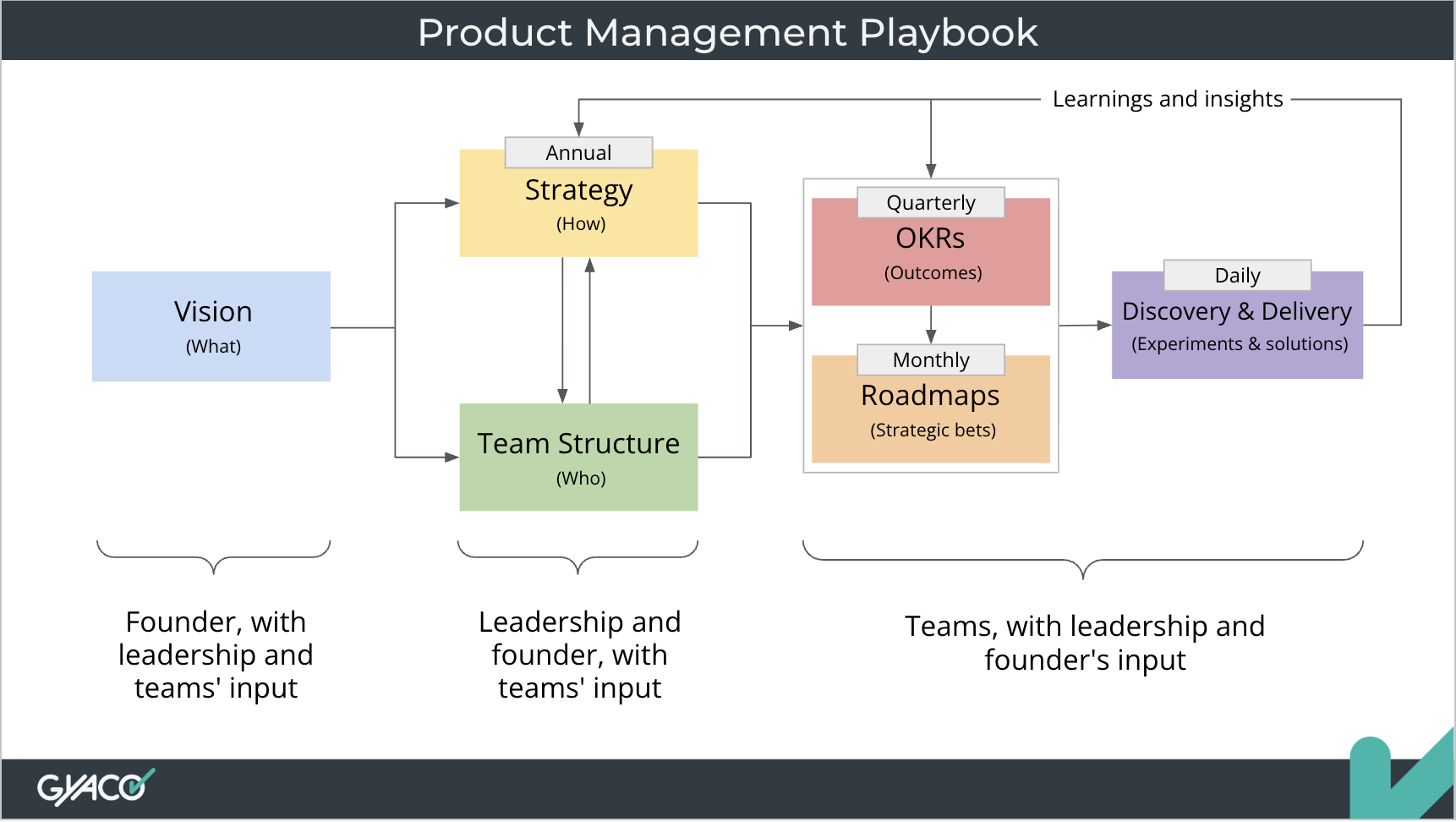
Daily discovery and delivery will generate many learnings that should feed into monthly roadmap reviews, quarterly OKR reviews, and annual strategy reviews. During the strategy review, it may also be worth revisiting the vision and team structure, though these shouldn’t change on a yearly basis.
Capturing these learnings in practice requires discipline and clear rituals. Day to day, this can be as simple as logging tested hypotheses and their results in a shared repository. In monthly roadmap reviews, the key question is: what did we learn that changes our bets? In quarterly OKR reviews: do the outcomes we’re pursuing still make sense? And in the annual strategy review: what have the market, our customers, and the data told us that we should take into account? Without these rituals, learning stays in people’s heads, and walks out the door when they do.
Product Management Playbook
Conclusion
With this, we have a complete playbook that brings together all the necessary tools, responsibilities, and review cycles to build products with a real chance of success.
More than a set of artifacts, the playbook is a way to align the entire organization around a common direction — from the vision the founder defines to the experiments teams run every day.
When each layer understands its role and the review cycles are working, strategy stops being a document and starts driving real decisions.
In practice, though, one of the biggest challenges I see in organizations is exactly this: the strategy exists, but it never reaches the product. That’s what Paulo Caroli and I will be discussing in the masterclass below.
Workshops, coaching, and advisory services
I’ve been helping companies and their leaders (CPOs, heads of product, CTOs, CEOs, tech founders, and heads of digital transformation) bridge the gap between business and technology through workshops, coaching, and advisory services on product management and digital transformation.
Gyaco Podcasts
At Gyaco, we believe in the power of conversations to spark reflection and learning. That’s why we have “Product in Focus” (Produto em Pauta in Portuguese), a podcast that explores the world of product management from different angles:
- Mentoring Sessions: In this series, I share real mentoring conversations with product people. One person’s questions are often the questions of many. Together, we explore concrete challenges and turn experience into practical insights you can apply to your own context.
- No Filters: In this series of episodes, Fabio Duarte, Paulo Caroli and I have candid conversations about product, technology and the real tensions we are seeing inside organizations.
- Beyond the Buzzwords: In this series, Felipe Castro and I demystify product terms with real examples from our clients.
Available on YouTube and Spotify. Recorded in Portuguese, with English subtitles on YouTube.
Digital Product Management Books
Do you work with digital products? Do you want to know more about managing a digital product to increase its chances of success, solve its user’s problems, and achieve the company objectives? Check out my Digital Product Management books, where I share what I learned during my 30+ years of experience in creating and managing digital products:
- Digital transformation and product culture: How to put technology at the center of your company’s strategy
- Leading Product Development: The art and science of managing product teams
- Product Management: How to increase the chances of success of your digital product
- Startup Guide: How startups and established companies can create profitable digital products