

Conclusion: it’s all about people
3 Nov 2026I’ve seen many product-related discussions suggesting that, now that delivery has become faster thanks to AI, discovery has become the new bottleneck. I disagree—and I’ll show that it’s possible to accelerate discovery, both with and without AI.
Accelerating discovery with AI
Yes, in terms of development, there are many tools—such as Claude Code, Cursor, and Copilot—that are speeding up software delivery. But there are also many tools that accelerate product discovery. As we know, discovery has two sides: problem discovery and solution discovery.
Solution discovery
Once we know which problem needs to be solved, it’s time to think about, evaluate, and test potential solution hypotheses. A highly useful tool for solution discovery is the prototype—something we create to present our proposed solution to potential customers and gather feedback. It’s something we build in order to learn. Back in the 2000s, we talked about paper prototypes. Today, using tools like Claude Code, Lovable, Replit, or similar platforms, we can create functional, navigable prototypes that could easily be mistaken for finished products.
Problem discovery
Understanding the problem, the customer’s motivation for wanting it solved, the context in which it occurs, and why solving it matters to the company—all of this is part of problem discovery. To grasp these various aspects, we need to do two things: collect information and analyze it.
AI tools are incredibly helpful when it comes to analyzing information. Imagine having to sift through dozens of customer interviews to uncover insights; a task that once took hours or days can now be completed in minutes with the help of AI. Whether dealing with structured or unstructured data, AI excels at identifying correlations, segmenting information, and spotting patterns—all with remarkable speed. To gather information, we typically engage in continuous listening—through interviews, surveys, and observation—while also leveraging existing data, such as support tickets, sales objections, usage analytics, and reviews. The tools we already use for these existing data sources are increasingly incorporating AI, allowing them to deliver deeper insights more quickly.
Accelerating and scaling this continuous listening process is the challenge that Anderson Borges and I set out to tackle with ReveLumi, an autonomous qualitative research agent. For instance, we created a survey to understand how people decide what to watch on Netflix; I shared the link in a few WhatsApp groups, and within two hours, we had 40 responses.
In short, we have AI-powered tools to assist us throughout both problem discovery and solution discovery. However, it is also possible to accelerate discovery without AI.
Accelerating discovery without AI
Using AI is not the only way to speed up discovery. I have been giving a presentation on “Discovery Misconceptions” at product conferences and for my corporate clients to help them conduct more effective product discovery. In this talk, I cover the four most common misconceptions I see product teams fall into—misconceptions that ultimately hinder the speed of their discovery efforts:
- Misconception #1: Believing that discovery is a process. It is not. Discovery is a collection of risk-mitigation tools combined with a specific mindset. Once we grasp this, we can select the right tool for each risk we need to mitigate, while remaining constantly observant—learning about our customers, the problems they face, and their underlying motivations for wanting those problems solved.
- Misconception #2: Believing that everything requires discovery. Not necessarily. Examples include well-understood topics, regulatory requirements, or urgent needs. By conducting discovery only when truly necessary, we save time.
- Misconception #3: Believing that discovery is solely about understanding the problem. Yes, but discovery is also about creating solution hypotheses. Failing to conduct solution discovery is the reason many products fail. Solution discovery is where the magic of innovation happens. By engaging in solution discovery, we gain the opportunity to identify solutions that are faster and cheaper to implement.
- Misconception #4: Believing that engineering should focus solely on delivery. Engineering is essential to solution discovery, working alongside Product and Design to create and test solution hypotheses in order to select the one that will yield results the fastest.
By consciously avoiding these four misconceptions—and utilizing AI tools as described above—we can accelerate product discovery to keep pace with our delivery, even now that delivery has become significantly faster thanks to AI. Furthermore, a positive side effect of faster delivery is that engineering now has more time to participate in solution discovery alongside Product and Design.
Scale your customer research
In a world where AI levels the playing field, deep customer knowledge is the one asset your competitors can’t copy. ReveLumi was built exactly for that. Learn more at revelumi.com.
Workshops, coaching, and advisory services
I’ve been helping companies and their leaders (CPOs, heads of product, CTOs, CEOs, tech founders, and heads of digital transformation) bridge the gap between business and technology through workshops, coaching, and advisory services on product management and digital transformation.
Gyaco Podcasts
At Gyaco, we believe in the power of conversations to spark reflection and learning. That’s why we’ve created “Produto em Pauta” podcast, with new episodes every Thursday.
The main series is called Mentorias: coaching conversations with product professionals, built on the idea that one person’s questions are often the questions of many others. We explore concrete challenges and turn experience into practical insights you can apply in your own context.
Available on YouTube and Spotify. Recorded in Portuguese, with English subtitles on YouTube.
Digital Product Management Books
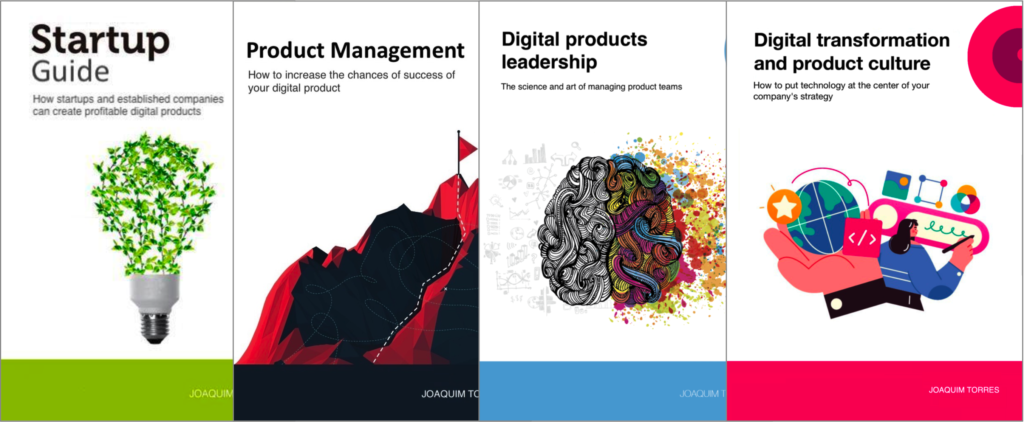
Do you work with digital products? Do you want to know more about managing a digital product to increase its chances of success, solve its users’ problems, and achieve the company’s objectives? Check out my Digital Product Management books, where I share what I learned during my 30+ years of experience in creating and managing digital products:
- Digital transformation and product culture: How to put technology at the center of your company’s strategy
- Leading Product Development: The art and science of managing product teams
- Product Management: How to increase the chances of success of your digital product
- Startup Guide: How startups and established companies can create profitable digital products