

Outsourced team
9 de December, 2025
What Became Clear in 2025 and What It Means for 2026
22 de December, 2025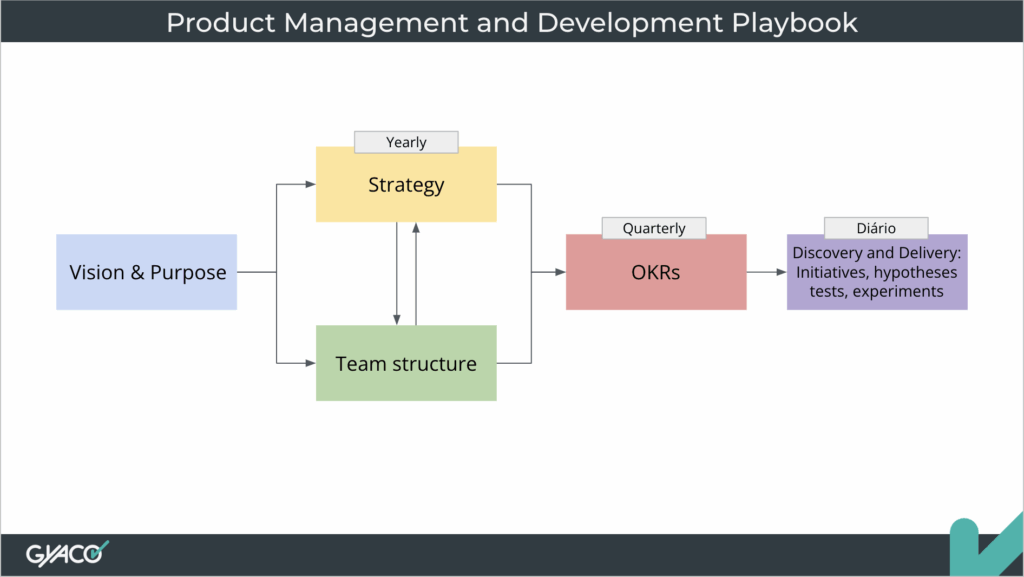
Last week, Product Camp 2025 took place, a Brazilian product management community event that brought together more than 3,000 people. During the conference, I had the opportunity to present my talk on the impact of AI on product vision and strategy, where I explored topics I’ve already discussed here before, including:
- AI Is Not Just About Productivity
- Not every feature needs AI
- Not Every AI Is Generative
- Not Every Interface Needs to Be Conversational
- AI-First and AI-Native: what’s the difference?
I also had the opportunity to attend several great talks and see how product teams are evolving and building better products with AI.
To close the event, Marty Cagan presented the Product Operating Model, the operating model used by the world’s leading technology companies, such as Google, Amazon, Netflix, and Apple, to build and scale product teams.
One of the key concepts Marty introduced was strategic context, illustrated below. It explains the context that product development teams need to build great products and deliver strong business outcomes.
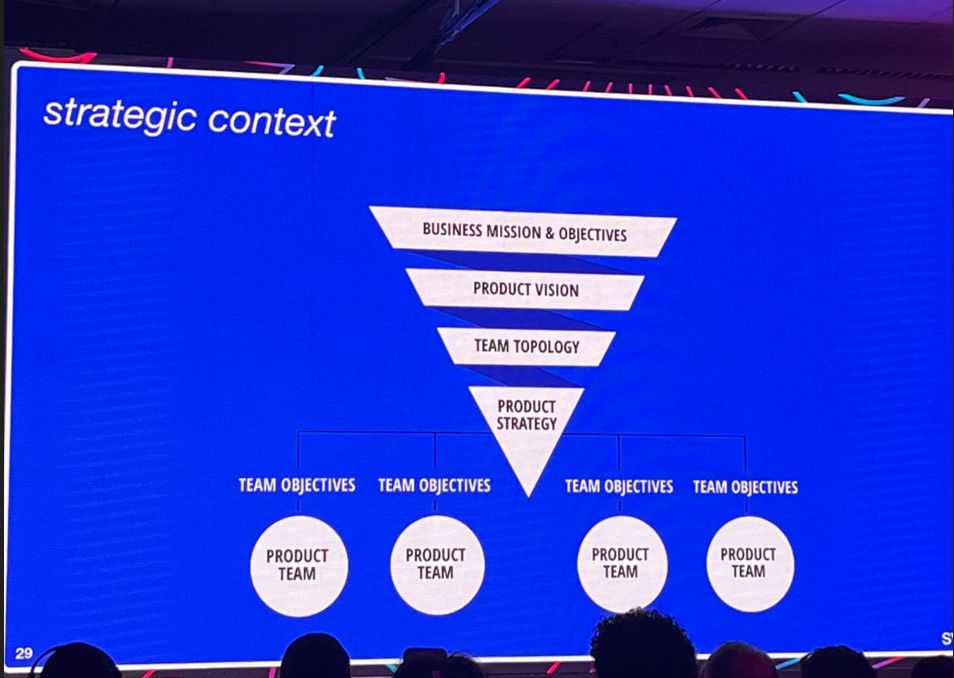
Strategic context
This strategic context immediately reminded me of the product management and development playbook I’ve been using for many years, both throughout my executive career and in my work with clients.
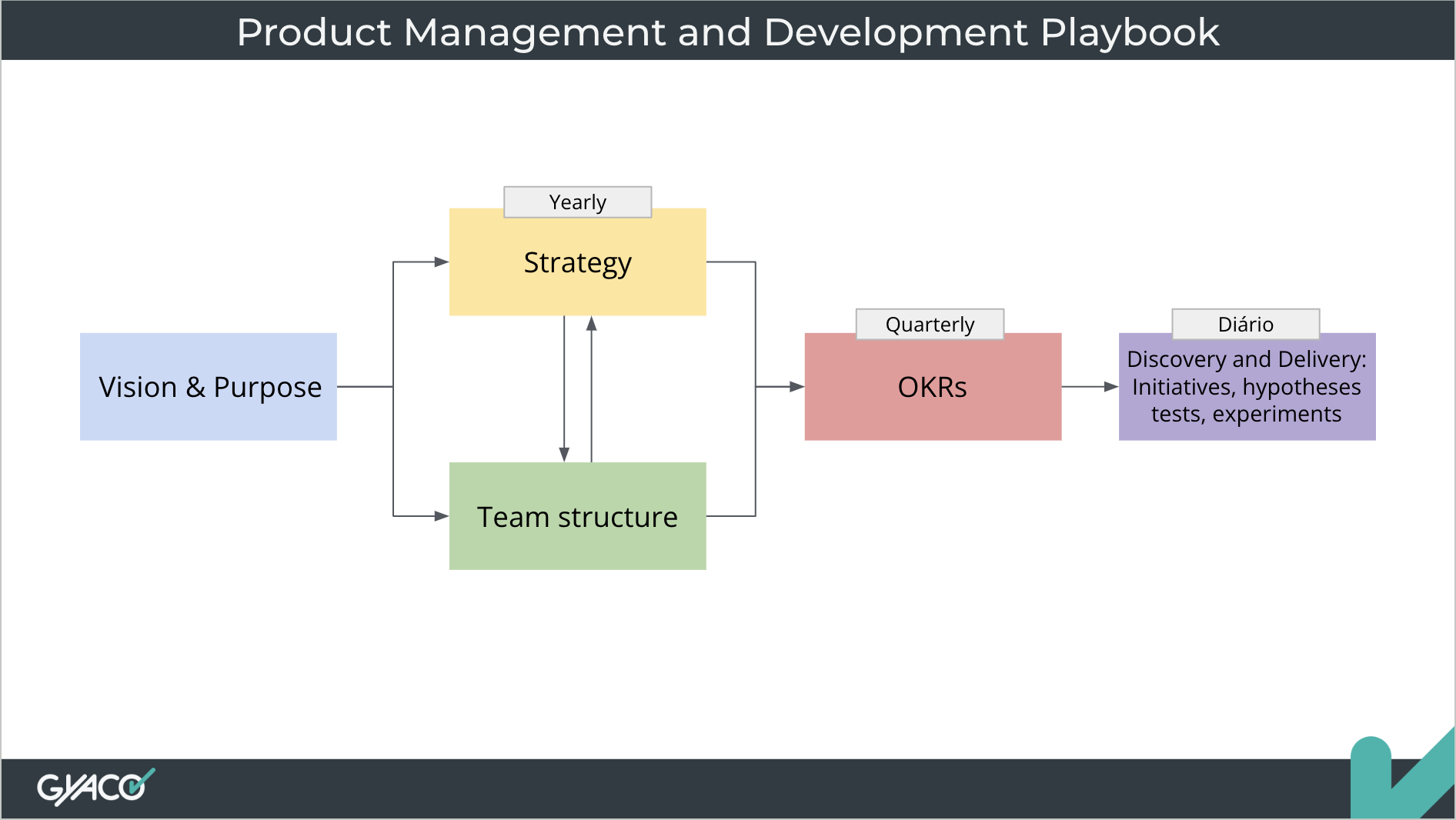
Product development and management playbook
The concept is simple, yet often overlooked: before we talk about structure, autonomy, team models, OKRs, discovery, or delivery, we need a clear strategic context:
- The company’s mission and objectives explain the why.
- The product vision defines where we are going.
- Structure and team topology show how we organize ourselves to reach that vision.
- Strategy is the path we choose to follow, knowing that we will learn and adapt along the way.
- This learning happens through each team’s objectives and key results — the OKRs.
- And objectives are only achieved through continuous discovery of both problems and solutions, combined with equally continuous delivery, which turns learning into real value.
There are two important points that can easily be missed when looking at this strategic context, and I believe they are worth highlighting:
- Product strategy is not fixed: Strategy is the path we take to reach our destination — the product vision. As we move along that path, we learn from our users, encounter obstacles, discover alternative routes, and must adapt our strategy to incorporate these learnings, overcome challenges, and assess whether new paths are worth exploring. Strategy should be reviewed periodically — at least annually — or whenever a significant event occurs, such as an external shock (like the COVID-19 pandemic) or a major internal event, such as an acquisition.
- Product strategy is not an isolated artifact: Strategy is one element of the broader strategic context. It derives from the product vision — the destination we want to reach — and represents the path we believe will take us there. It is defined together with the team structure required to execute it effectively. OKRs, discovery, and delivery are the mechanisms that enable continuous learning and inform strategic decisions over time.
In conclusion
At its core, the point is simple: product strategy is not a static artifact, nor something that exists in isolation.
It depends on a clear purpose, a well-defined vision, and teams organized to learn quickly. Strategy only makes sense when treated as a living mechanism — one that connects direction, choices, and continuous execution, adjusting the path as the organization learns through discovery and delivery.
When strategy becomes just a plan, it loses its most important function: guiding decisions in an environment of uncertainty.
Workshops, coaching, and advisory services
I’ve been helping companies and their leaders (CPOs, heads of product, CTOs, CEOs, tech founders, and heads of digital transformation) bridge the gap between business and technology through workshops, coaching, and advisory services on product management and digital transformation.
Gyaco Podcasts
At Gyaco, we believe in the power of conversations to spark reflection and learning. That’s why we have three podcasts that explore the world of product management from different angles:
- Produto em Pauta: In the new season, titled “Beyond the Buzzwords”, Felipe Castro and I demystify product terms with real examples from our clients. Available on YouTube and Spotify. Recorded in Portuguese, with English subtitles on YouTube.
- Product Chronicles, the Brazilian Way: with Fábio Martinelli Duarte and Paulo Caroli — the Brazilian way of building products: stories, challenges, and lessons learned, featuring case studies from our clients. Available on YouTube and Spotify. Recorded in English, with Portuguese subtitles on YouTube.
- Beyond the Article, Expanded by AI: C.L.A.R.A. (Creative Language AI for Reflective Augmentation) chats with my AI clone, JocAI, expanding on my articles with new perspectives. Available on YouTube and Spotify. Thanks to AI, episodes are available in English, Spanish, and Portuguese.
Digital Product Management Books
Do you work with digital products? Do you want to know more about managing a digital product to increase its chances of success, solve its user’s problems, and achieve the company objectives? Check out my Digital Product Management books, where I share what I learned during my 30+ years of experience in creating and managing digital products:
- Digital transformation and product culture: How to put technology at the center of your company’s strategy
- Leading Product Development: The art and science of managing product teams
- Product Management: How to increase the chances of success of your digital product
- Startup Guide: How startups and established companies can create profitable digital products