

Should we have a dedicated innovation team?
3 de February, 2026
Observations on how AI is impacting the organization of product teams
18 de February, 2026
This article was originally published in 2019 and updated in 2026 to include the use of vibe coding as a way to practice product management.
This is a question I receive quite often in my talks and in my inbox, so it seems to be an important topic. Here is my suggestion on how to make this career transition.
First step: Study
Even though product management is still a relatively new career, there are already some good courses you can take to better understand the world of digital product management. There are several product management courses available.
Product management courses dive deeper into the roles and responsibilities of a product manager. In a PM course, you will learn techniques to build product vision and strategy, structure product development teams, achieve product–market fit, prioritize and work with OKRs, discover problems and solutions, run analyses, understand product culture, and much more. Here in Brazil, I recommend two: Digital Product Leadership by Tera and the Product Management course by PM3. I teach some classes in PM3’s Product Management, Product Marketing, and Product Leadership programs. In the US and around the world, one of the best options is SVPG’s public workshops, usually taught by Marty Cagan, who was Senior Vice President of Product Management and Design at eBay, where he was responsible for defining products and services for the company’s global e-commerce site. I also offer live in-company product management workshops in English that can be customized to meet your company’s needs.
Besides a Product Management course, there are other courses that can be helpful:
- Lean Inception: a course where you’ll learn how to align people and build the right product. Even though the public agenda only shows courses in Brazil, you can ask Paulo Caroli for in-company training anywhere in the world.
- Certified Scrum Product Owner (CSPO): this course will give you the basics for working as the product owner on a software development team using agile methodologies. Normally, you learn this in Product Management courses, but if you want to go deeper, this course can be an option. There are many courses available all around the world. It is a 16-hour, in-person course that will help you understand how modern software development works and what’s the role and responsibilities of a product person in this process.
- SQL: data is a key tool to any product management role and knowing SQL will definitely help you master this tool enabling you to run your own analysis without depending on the data team to build you the reports you need. Probably an online course will do as an introduction to the topic. You can dive deeper later if needed.
- Finance: your product will help your company generate revenues and cut costs while generating costs from the product development process, so you should understand the financial dynamics of your company to better understand the impact of your work in your company. An online introductory course will do as a first step into this topic to understand terms like Gross Profit, EBITDA, assets, amortization, and others. You can dive deeper later as needed.
- Marketing: you will manage one of the 4 Ps of the famous “4Ps marketing mix“. However, it is very important that you know and understand the other 3Ps, promotion, price, and place. Again, an online introductory course will do as a first step into this topic. You can dive deeper later as needed.
Books are also a good source of knowledge, but if you have a chance to attend a course, I recommend doing so in addition to reading books. Some of the books I recommend on new product creation are:
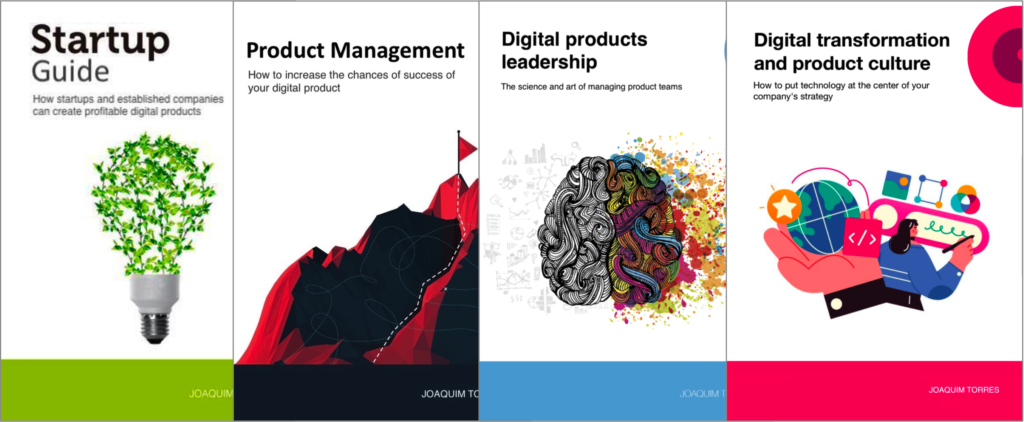
- Startup Guide: How Startups and Established Companies Can Create Profitable Digital Products
- The Mom Test: How to talk to customers & learn if your business is a good idea when everyone is lying to you
- Getting Real: The Smarter, Faster and Easier Way to Build a Successful Web Application
- Running Lean: Iterate from Plan A to a Plan That Works
- The Entrepreneur’s Guide to Customer Development: A cheat sheet to The Four Steps to the Epiphany
- The Lean Startup: How Today’s Entrepreneurs Use Continuous Innovation to Create Radically Successful Businesses
- Lean Inception: How to Align People and Build the Right Product
And about product management are:
- Product Management: How to increase the chances of success of your digital product
- Leading Product Development: The art and science of leading digital products
- Digital Transformation and Product Culture: How to put technology at the center of your company’s strategy
- Inspired: How to Create Tech Products Customers Love
- Empowered: Ordinary People, Extraordinary Products
- Agile Product Management with Scrum: Creating Products that Customers Love
- 42 Rules of Product Management: Learn the Rules of Product Management from Leading Experts around the World.
Alongside studying: practice
Studying is important, but getting your hands dirty is essential to apply what you’ve learned. If you don’t experience real product situations, it becomes very hard to:
- truly learn how to manage products, and
- demonstrate your knowledge in interviews.
One way to do this is by working on a personal project. For example, you could create and develop a website for your church or for a community you belong to. There are many tools available for building websites. Or you could launch and manage an e-commerce site to sell a product.
Since 2025, a new option has emerged: vibe-coding tools such as Lovable and Replit. These are agents capable of building complete applications, including authentication and databases. In practice, it’s like having an engineer and a designer available 24×7 to help you create products and bring ideas to life. These vibe-coding agents have evolved quickly to the point where you can discuss options with the agent before implementing new features. It’s an excellent way to practice being part of a product development team, having an “engineering partner” to explore ideas with, and then implement what you decide together.
Next step: career change!
Ok, now you’ve studied the craft, practiced a lot, built your product portfolio, and you’re ready to make this career transition, right? What’s the best way to do that?
The first piece of advice is that it is easier to make a career move in your current company. It’s quite difficult to change careers by moving to a different company, no matter what career you are in now, or the one you are moving into. People will hire you for the experience that you have. If you have no experience as a product manager, it will be quite hard for someone to hire you as a product manager.
To make this career change, the best option is to do so within your existing company. Before any move, you should discuss it with your manager. She may be able to help you in this transition.
If your company already has a well-established product management function, it may accept apprentices, i.e., someone with good experience in other areas and who is willing to move into product management. At Gympass, we call this position Associate Product Manager (APM), which has become a fairly common entry-level role in product management. It is valuable to have someone with strong experience in the business domain who is willing to make the move into product management.
However, if your company does not have a well-established product management function, there are two ways you can make this career change:
- The easiest way is to move to a company with a well-established product management team, but you should first move into your existing area (marketing, customer support, legal, finance, etc.) within that company, and once inside, move into product management. It’s quite rare for companies to hire someone from another area directly into a beginner product management role. Normally, for these beginner positions, companies prefer to move someone internally from another area where they already have good knowledge of the business.
- The other way to make this career move is not that easy, but it can be a great career opportunity. You can build the product management function in your existing company and be the very first product manager. You just need to apply the knowledge you acquired during your product management studies in your day-to-day, whenever you see an opportunity. For instance, if your company decides to build a new app, you can volunteer to be the project coordinator for this new endeavor and then apply your product management knowledge to manage the app development. Or your company may decide to build a new site or a new system. Again, you can volunteer to help manage this project and apply what you learned to it. After the project is successfully delivered, you can discuss with your leadership how you applied product management techniques to create this product, and maybe it is time to build a product management function within the company. In the case that leadership does not see the value in creating this area, at least now you have product management experience to include in your resume and to discuss when applying to product management opportunities.
Below, I’ll cite some people who made the career change from some other areas to product management, so you can see their profiles or even connect with them to talk about their career changes. Some of them even wrote about their career change challenges and learnings:
- Rafael Rosa, Marcelo Doni, and Karoline Morone, from software engineering to product management
- Paula Sato and Fernanda Passos, from product design to product management
- André Pimentel, from customer support to product management
- Maíra Castro, from investment analyst to customer support and operations, and then to product management
- Beatriz Costa and Cassio Scozzafave, from product marketing to product management
- Débora Appel, from finance to product management
- Paula Roschel, from legal to product management
- Vânia Amaral, from project management to product management
Workshops, coaching, and advisory services
I’ve been helping companies and their leaders (CPOs, heads of product, CTOs, CEOs, tech founders, and heads of digital transformation) bridge the gap between business and technology through workshops, coaching, and advisory services on product management and digital transformation.
Gyaco Podcasts
At Gyaco, we believe in the power of conversations to spark reflection and learning. That’s why we have “Product in Focus” (Produto em Pauta in Portuguese), a podcast that explores the world of product management from different angles:
- Mentoring Sessions: In this series, I share real mentoring conversations with product people. One person’s questions are often the questions of many. Together, we explore concrete challenges and turn experience into practical insights you can apply to your own context.
- Beyond the Buzzwords: In this series, Felipe Castro and I demystify product terms with real examples from our clients.
Available on YouTube and Spotify. Recorded in Portuguese, with English subtitles on YouTube.
Digital Product Management Books
Do you work with digital products? Do you want to know more about managing a digital product to increase its chances of success, solve its user’s problems, and achieve the company objectives? Check out my Digital Product Management books, where I share what I learned during my 30+ years of experience in creating and managing digital products:
- Digital transformation and product culture: How to put technology at the center of your company’s strategy
- Leading Product Development: The art and science of managing product teams
- Product Management: How to increase the chances of success of your digital product
- Startup Guide: How startups and established companies can create profitable digital products