

OKRs, Financial Bonuses, and How to Scale to Large Teams
10 de August, 2026New book on designing product organizations
25 de August, 2026This article is an excerpt from the book “Digital Transformation and Product Culture: How to put technology at the center of your company’s strategy”.
Now that we’ve covered product vision, product strategy, team structure, and OKRs, let’s explore how to measure your company’s digital and product maturity. Assessing your digital and product maturity can provide valuable insights for defining your strategy.
The digital and product maturity of your company can be evaluated based on its ability to apply the four principles we discussed in Part 2 (Principles) of the book.
Release early and often
The earlier we present the product to our users, the better, as we can receive feedback from real users who may use the product in their own context. To measure if the product development team is releasing early and often, we need to measure the number and frequency of deployments.
A company called DORA (DevOps Research and Assessment) https: //dora.dev/, acquired by Google in 2018, has been researching DevOps and SRE practices used by companies since 2015. They categorized software delivery and operational performance based on four factors:
- Deployment Frequency: How often does your organization deploy code to production and release it to end-users?
- Lead Time: What is your lead time for changes? How much time does it take to go from developed code to successfully running code in production?
- Time to Restore: How long does it typically take to restore service when a service incident or a defect affecting users occurs (e.g., unplanned outage, service deficiency)?
- Change Failure Rate: What percentage of changes in production or releases to users result in degraded service (e.g., time to deficiency or service interruption) and subsequently require remediation (e.g., requiring a hotfix, rollback, fix forward, patch)?
Based on the answers, it’s possible to have a software delivery performance metric, as detailed below:
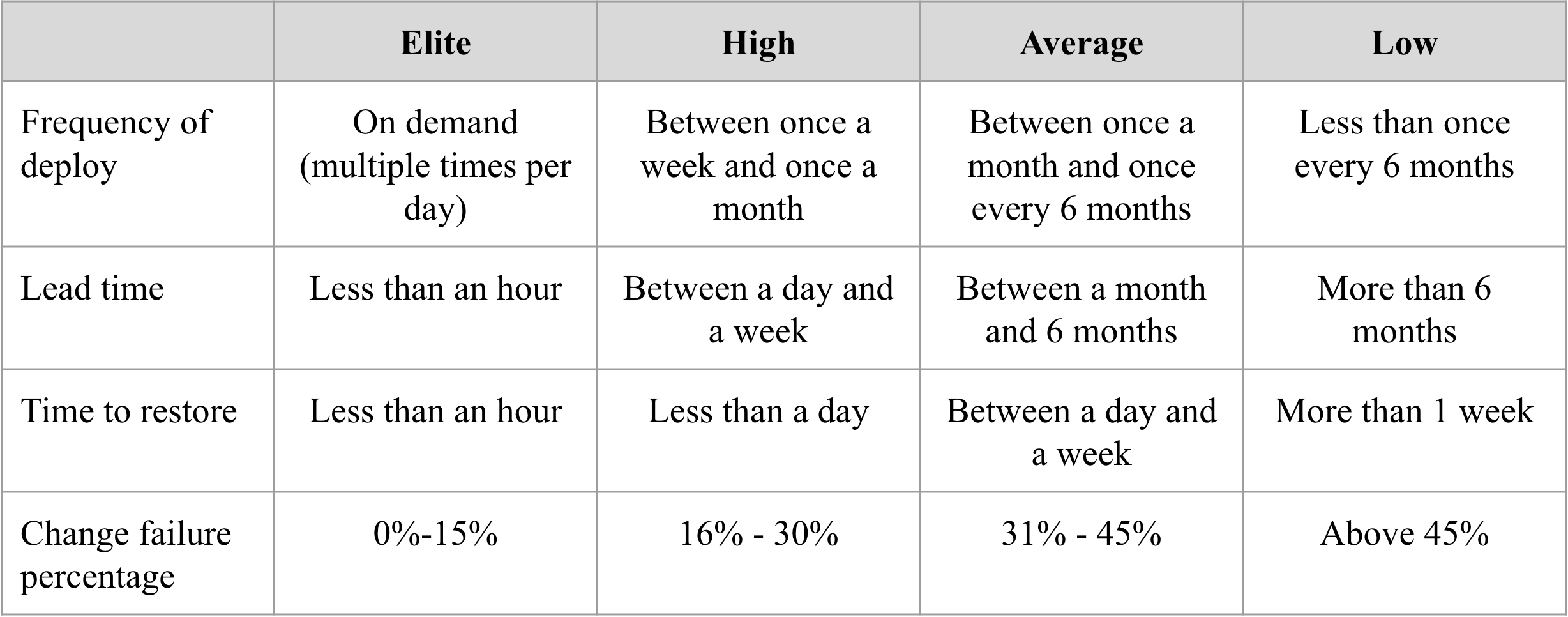
The closer a product development team gets to the elite level, the more digitally mature the company is in that value/behavior.
Focus on the problem
As explained in the chapter “Focus on the Problem,” a crucial step in creating a good solution is understanding the problem. When we hear about a problem, we often immediately start thinking about solutions. However, the more time we spend learning about the problem, the easier it becomes to find a solution, and the greater the chances that this solution will be simpler and quicker to implement than the initial solution we first thought of.
Implementation teams are teams that work on implementing a solution created by someone else. Problem-solving teams are teams that work to deeply understand the causes of the problem, the context, and the motivation people have to solve it. By doing this, they can implement the best solution for the specific problem at hand.
Having worked for some time in companies undergoing digital transformation or with individuals, including C-levels, unfamiliar with digital product development methods, one of the biggest chal- lenges is shifting from a mindset of “business demands → technol- ogy implements” to a mindset of “business brings problems/needs → technology works on understanding these problems/needs with the user, testing solution hypotheses, and implementing a validated solution hypothesis.”
How can we measure how much a product development team is focused on problems? My suggestion is to examine the last 10 to 20 features the team implemented and check how the need for each of these features reached the product development team. Did it come in the form of a feature request, or was it framed as a problem to be solved?
The more things reach the product development team as problems to be solved, the more digitally mature the company is in that value/behavior.
Delivery of results
In addition to being able to deliver early and frequently and being focused on problems, the product development team must deliver results—business results as well as results for the customer and product user. As discussed in the chapter on “Result Delivery,” delivering features is not a result. All features are a means that serves an end: achieving a business objective. It is crucial to have clear business objectives. Ideally, business objectives should be connected to the ultimate result, increasing revenue and/or reducing costs.
How can we measure how much a product development team is delivering results? My recommendation is to take a look at the OKRs of this product development team. The objectives and key results should be linked to the company’s results and customer outcomes. If we find OKRs that are merely tasks or metrics without a clear link to company and customer outcomes, it’s a sign that the product development team is not focused on delivering results.
Typically, a product development team has more than one objective and more than three key results. We can analyze all objectives and key results to verify their connection to the company’s and customer’s results as a yes or no. For each objective and key result, ask yourself if it is connected to increased revenue, cost reduction, increased customer numbers, or any other business outcome. Also, ask if it is connected to any customer problem or need—for example, in a real estate portal, am I helping the customer find the most suitable property? The more “yes” answers we find, meaning the more objectives and key results connected to the company’s and customer’s results, the more digitally mature the company is in that value/behavior.
Ecosystem mindset
This behavior means making decisions that create value for all participants in the ecosystem in which the company operates. These decisions should not harm any of the ecosystem participants. In the chapter on “Ecosystem Mindset,” I explained in detail with an example from Gympass the application of the ecosystem mentality in practice. If the company is a platform or marketplace, this behavior is relatively easy to understand, but it also applies if the business is neither a platform nor a marketplace.
If your business has a single type of customer, the ecosystem is formed by the customer and your business. This behavior means that you cannot make decisions that benefit the business but harm the customer or vice versa. You can make decisions that benefit the business without affecting the customer, but you cannot make decisions that harm the customer, and vice versa—you cannot harm the business for the benefit of the customer. This behavior is based on the customer-centric concept but expands it to include all different customers and the business itself in this mentality.
How can we measure if the company has an ecosystem mentality? My suggestion in this case is to analyze the last 10 to 20 decisions made and check who they added value to and if any of them had a negative impact on any of the ecosystem participants.
How to measure a company’s digital and product maturity?
Using the values and behaviors we’ve just discussed, we can evaluate how digitally mature a company is and, more importantly, define the areas of focus to improve its digital and product maturity.
Answer the following four questions to self-assess your digital and product maturity:
Rapid and Frequent Deliveries: After doing a quick check of DevOps from DORA (https://dora.dev/quickcheck) on the four factors (deployment frequency, lead time, time to restore, and change failure rate), how do you rate yourself?
(a) Elite
(b) High
(c) Medium
(d) Low
Problem Focus: How much of the development team’s deliveries originated from requests for implementing solutions?
(a) 0%
(b) Less than 5%
(c) Between 5% and 50%
(d) More than 50%
Results Delivery: How much of the development team’s OKRs are linked to the company’s objectives?
(a) All!
(b) More than 90%
(c) Between 50% and 90%
(d) Less than 50%
Ecosystem Mindset: How much of the last decisions negatively impacted one of the ecosystem actors?
(a) 0%
(b) Less than 5%
(c) Between 5% and 50%
(d) More than 50%
Now, for each (a) response, add 4 points; for each (b), add 3 points; for each (c), add 2 points, and for each (d), add 1 point. The total indicates your digital and product maturity:
- 13 points or more: High digital and product maturity. Congratu- lations! You have high digital and product maturity. This means your company has been investing in digital products to leverage its results, which have been greatly enhanced by digital efforts. Your focus should now be on continuously evolving your digital skills.
- Between 12 and 6 points: Medium digital and product maturity. You are on the right track. Your company is starting to invest in digital products to boost results, and you are beginning to see the impact of digital efforts on your company’s results. By answering these questions, I hope you now have a good understanding of where to focus to increase your digital and product maturity and, consequently, improve your results with digital products.
- 5 points or fewer: Low digital and product maturity. You are starting your digital journey. Your company is investing somewhat in digital products to enhance results, and you haven’t seen many results truly leveraged by digital efforts. The recommendation for you is to continue investing in building your digital product culture to achieve more results with your investment.
So there it is, a simple way to assess your digital and product maturity.
Real-life examples
I joined Gympass in mid-2018, and it became clear that there was room for improvement in our digital and product maturity. The same happened when I joined Lopes in mid-2020. In both cases, we focused on improving behaviors that could lead us to increasing digital and product maturity.
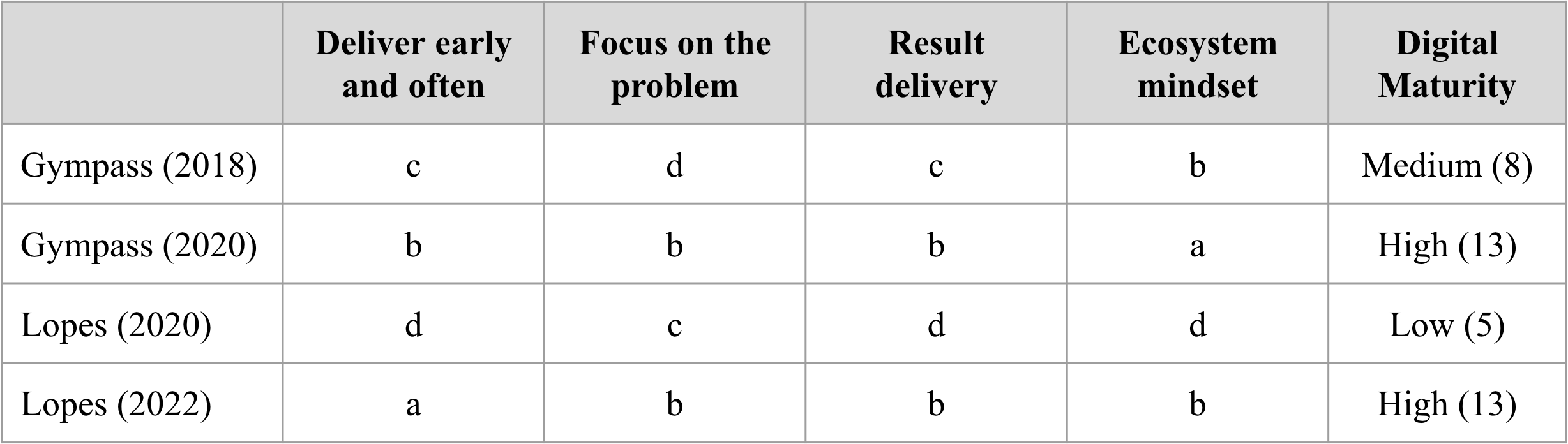
A few important final notes:
- The examples are based on my recollections from the time I worked at these companies. Ideally, this type of assessment should be conducted considering the current behaviors with input from the leaders of the company and the product devel- opment team. This evaluation should be done periodically, every 6 months or annually.
- It’s possible to have companies with the same digital and product maturity score but with different behaviors in terms of what to focus on to improve digital and product maturity, as illustrated in the examples of Gympass and Lopes.
Recommendation
Now that you are familiar with the principles and tools of vision, strategy, team structure, and OKRs, you can assess the digital and product maturity of your company. Understanding your maturity level can provide valuable insights for your digital transformation strategy, offering clarity on where to invest energy and resources.
More important than knowing your company’s digital maturity level or score is identifying the key areas where the company and the product development team should focus to improve.
Knowing and improving digital and product maturity is just a tool, not an objective. It is a tool to help a company extract more from its digital efforts. It is a tool to assist a company in achieving its goals and results.
Summing up
- The digital and product maturity of a company signifies how much the company has been investing in digital products to leverage its results and how much those results have truly been enhanced by digital efforts.
- Tomeasuredigitalandproductmaturity,weneedtoevaluate how the company stands on each of the four values and behaviors of its digital product culture: early and frequent delivery; problem-focused approach, result delivery, and ecosystem mindset.
- Knowing and improving digital and product maturity is just a tool, not an objective. It is a tool to help a company extract more from its digital efforts. It is a tool to assist a company in achieving its goals and results.
Scale your customer research
In a world where AI levels the playing field, deep customer knowledge is the one asset your competitors can’t copy. ReveLumi was built exactly for that. Learn more at revelumi.com.
Workshops, coaching, and advisory services
I’ve been helping companies and their leaders (CPOs, heads of product, CTOs, CEOs, tech founders, and heads of digital transformation) bridge the gap between business and technology through workshops, coaching, and advisory services on product management and digital transformation.
Gyaco Podcasts
At Gyaco, we believe in the power of conversations to spark reflection and learning. That’s why we’ve created “Produto em Pauta” podcast, with new episodes every Thursday.
The main series is called Mentorias: coaching conversations with product professionals, built on the idea that one person’s questions are often the questions of many others. We explore concrete challenges and turn experience into practical insights you can apply in your own context.
Available on YouTube and Spotify. Recorded in Portuguese, with English subtitles on YouTube.
Digital Product Management Books
Do you work with digital products? Do you want to know more about managing a digital product to increase its chances of success, solve its user’s problems, and achieve the company objectives? Check out my Digital Product Management books, where I share what I learned during my 30+ years of experience in creating and managing digital products:
- Digital transformation and product culture: How to put technology at the center of your company’s strategy
- Leading Product Development: The art and science of managing product teams
- Product Management: How to increase the chances of success of your digital product
- Startup Guide: How startups and established companies can create profitable digital products