

Is discovery the new bottleneck?
8 Nov 2026I’ve just finished writing my fifth book, “Designing Product Organizations: How to structure teams to empower strategy”. The launch will be at Product Camp in São Paulo, on December 8 and 9, with a talk that will work as a trailer for the book. The English and Spanish editions will be available in January 2027.
Here, first-hand, is the book’s “About the book”:
About the book
When I joined Gympass as CPO in 2018, the company already had 800 employees across 14 countries. It was growing fast, operating in a competitive global market, and had clear ambitions to become the world’s leading corporate wellness benefit.
The product development team (engineers, product managers, and designers) had 32 people. That alone was surprising. But what surprised me even more was how those 32 people were organized.
Three teams focused on end users: the employees of our corporate clients who used the platform to find and book gyms and wellness activities. One team handled integrations with partner gyms. And that was it.
No one was looking at the HR departments, which hired Gympass, signed the contracts, and decided whether to renew. No one was looking at the financial flow: how HR departments paid, how employees paid, and how Gympass paid gyms for each visit. Two of the most critical relationships in the business had no team dedicated to thinking about them.
The organization had been designed around the product as it existed, not around the strategy the business needed to execute.
This is not a story about a company that was doing poorly. On the contrary, Gympass was succeeding. The people were talented. The strategy was clear. But the structure was quietly working against the strategy, and no one had made that explicit.
The answer was to reorganize around the marketplace actors. We created a product development team dedicated to HR departments, which until then had no one thinking about their experience. A team for end users, our clients’ employees. A team for partner gyms, focused not only on integrations but on delivering a good experience for the gyms. And a cross-features team, responsible for the entire financial flow: payments received from client companies and their employees, and payouts to gyms. For the first time, every critical relationship in the business had a team responsible for it.
Over the past three decades, I have worked inside and alongside product organizations of many sizes and stages, from early-stage startups to large enterprises, and from founder-led companies to board-driven scale-ups. In all of them, I have seen this pattern repeat itself.
When performance drops or growth stalls, companies reorganize. Org charts are redrawn. Teams are merged or split. Reporting lines are adjusted. New roles are introduced. In many cases, these changes are well-intentioned and carefully planned.
Yet the underlying problems often persist.
In this book, when I refer to product organizations, I am not talking about reporting lines or management hierarchy. I am talking about how product teams, made up of product managers, designers, and engineers, are structured to build and evolve products.
This experience led me to look more deeply at the relationship between organizational structure and product success. Conway’s Law offers a powerful warning: system architecture mirrors communication structures. Team design is not neutral; it shapes both technical and business outcomes. But communication structures themselves are shaped by strategy.
SVPG’s work has been fundamental in shaping how the industry thinks about product organizations, addressing the importance of dedicated product teams, the role of strategic context in empowering them, and the key factors in structuring team topology. These mental models have helped my own practice in many companies over the past three decades. The publication of Team Topologies moved this discussion further by offering practical guidance on how to structure engineering teams to manage cognitive load and interaction complexity. Both contributions are important and lasting.
This book builds on these solid foundations to explore a specific question: how should customer problems and business strategy shape the design of product organizations?
In many of the organizations I have worked with, architecture was not the only constraint. There was a deeper one: strategy. Unclear product boundaries. Fragmented portfolio decisions. Misalignment between vision and execution. Lack of clarity about what the product should become.
In these contexts, refining team topology based only on system architecture is not enough. If the strategy lacks coherence, the organization will faithfully reproduce that incoherence, no matter how well the teams are structured from a technical point of view.
This book shifts the focus from engineering architecture to product strategy. It argues that organizational design in product companies should start with strategic context: vision, strategic positioning, and portfolio logic. Only once these elements are explicit does team structure become a meaningful design decision.
Organizational structure should not be the starting point of any business planning exercise. It is the consequence of strategic clarity. Teams exist to execute the strategy and move the product toward its vision. Their boundaries, autonomy, and interaction modes should reflect the product’s value creation logic for customers and for the business, not just its technical architecture.
The central thesis of this book is:
Product organizations should be designed first around strategy and then around system architecture. Strategy defines what needs to be built. Architecture defines how it can be built. Ignoring either one will work against you, but so will getting the order wrong.
By integrating team structure with product vision and strategy, this book aims to give leaders a systematic approach to designing product organizations capable of sustained performance.
Who this book is for
If you are a founder or CEO, this book will help you understand why your product organization may be struggling to execute your strategy, and what to change before the next reorganization makes things worse.
If you are a CPO, CTO, or head of product, this book offers a systematic approach to designing and evolving your organization as your product and strategy change.
If you lead HR or people operations, this book will help you understand what product organizations really need from a structural point of view, and why the design decisions made here have consequences far beyond the product team.
If you are a product manager, designer, or engineer, this book will help you understand the forces shaping the structure around you, and what good organizational design looks like from the inside.
How this book is structured
Part I: Why product organizations fail
We begin by examining why so many product organizations fail to deliver what they are capable of, and why the most common responses to this problem tend to make it worse.
The first chapter opens with one of the most costly and least visible mistakes in product organization design: structuring work around temporary, project-based teams instead of persistent, dedicated product teams. In this model, people are assigned to a project, deliver it, and move on to the next one. There is little ownership, little accumulated learning, and little opportunity to develop the deep expertise that makes teams truly effective. The organization is constantly rebuilding what it has just lost (institutional knowledge, unwritten rules, trust, deep understanding of users), things that only come with time, and it rarely notices the price it is paying.
The second chapter examines an equally common and equally damaging pattern: organizing teams around internal departments instead of customer problems. When a team exists to serve marketing, sales, or finance, it stops being a product team. It becomes a feature factory, implementing what it is asked to build, with no autonomy to question whether what was requested is really what should be built. The internal department defines the work. The team delivers. No one is accountable for whether it produced any results.
The third chapter examines what happens at the leadership level when the CTO and CPO run two separate areas instead of co-leading a single product development team. When this split becomes structural, with separate budgets, separate agendas, and separate cultures, the consequences spread across the entire organization. Product loses its connection with engineering. Engineering loses its connection with the customer. And when the tension becomes unsustainable, it is almost always the product function that gets dismantled, leaving the organization even more vulnerable to the feature factory dynamic described in the previous chapter.
From there, we examine how Conway’s Law shapes both system architecture and communication structures within teams, and why poor organizational design compounds over time.
Part II: Strategic context for product organization design
In this section, we introduce the strategic elements that shape how product organizations operate: product vision, product strategy, outcomes, strategic bets, and discovery and delivery. Together, these elements define how organizations translate strategic intent into product decisions and day-to-day work.
We also examine how organizations manage their product portfolio and why portfolio logic plays a critical role in organizational design. Products within a portfolio tend to play different strategic roles and to be at different stages of maturity, from early bets to growth engines, mature cash cows, and legacy products. Understanding these roles is essential because portfolio logic influences how organizations allocate investment, attention, and teams.
Part III: Designing product teams
With the strategic context established, we move on to team design. The central argument of this section is that product teams should be organized around one of four logics: product, user, journey, or objective. The choice among them is not arbitrary; it follows directly from the vision and strategy defined in Part II. We also examine structural teams, such as platform, data, and security, which support the broader product development environment without owning user-facing outcomes.
Part IV: Evolving the organization
Product organizations are not static. As products evolve, markets shift, and technologies advance, organizations must adapt their structures. In this final section, we explore how product organizations evolve over time. We start by looking inside the team: when it is worth splitting a function or a problem into a dedicated team, how to handle the dependencies that emerge between teams, and how to structure a career in product management, from the first role to leadership. Then we look at scale and at the decisions that come up as the organization grows: leadership structures such as CTO, CPO, and unified CPTO roles; business units; internationalization; outsourcing; and tracking team composition over time, including when it is necessary to shrink. We end by looking ahead, at the impact of AI on team structure, and return, in the book’s closing, to the simplest question of all: what makes a group of people behave as a team.
The goal of this book is not simply to describe organizational models. It is to help leaders design product organizations capable of turning strategy into sustained product success.
The Gympass story did not end with the diagnosis. After we reorganized the teams around the marketplace actors, delivery speed increased, especially for HR departments and gyms, which for the first time had dedicated teams thinking about their experience. With more satisfied HR departments and gyms, retention improved considerably. And with a better experience for end users, enrollment among employees grew even further. The structure had stopped working against the strategy and started accelerating it.
When the organization aligns with the strategy, teams stop fighting the structure and start accelerating impact for users and results for the business.
Want to see where this story goes? The English and Spanish editions will be available in January 2027. Subscribe to the newsletter to be the first to know.
If you are in Brazil, join us at Product Camp in São Paulo, on December 8 and 9, for the book launch talk (in Portuguese). Ticket sales end on November 24.
Scale your customer research
In a world where AI levels the playing field, deep customer knowledge is the one asset your competitors can’t copy. ReveLumi was built exactly for that. Learn more at revelumi.com.
Workshops, coaching, and advisory services
I’ve been helping companies and their leaders (CPOs, heads of product, CTOs, CEOs, tech founders, and heads of digital transformation) bridge the gap between business and technology through workshops, coaching, and advisory services on product management and digital transformation.
Gyaco Podcasts
At Gyaco, we believe in the power of conversations to spark reflection and learning. That’s why we’ve created “Produto em Pauta” podcast, with new episodes every Thursday.
The main series is called Mentorias: coaching conversations with product professionals, built on the idea that one person’s questions are often the questions of many others. We explore concrete challenges and turn experience into practical insights you can apply in your own context.
Available on YouTube and Spotify. Recorded in Portuguese, with English subtitles on YouTube.
Digital Product Management Books
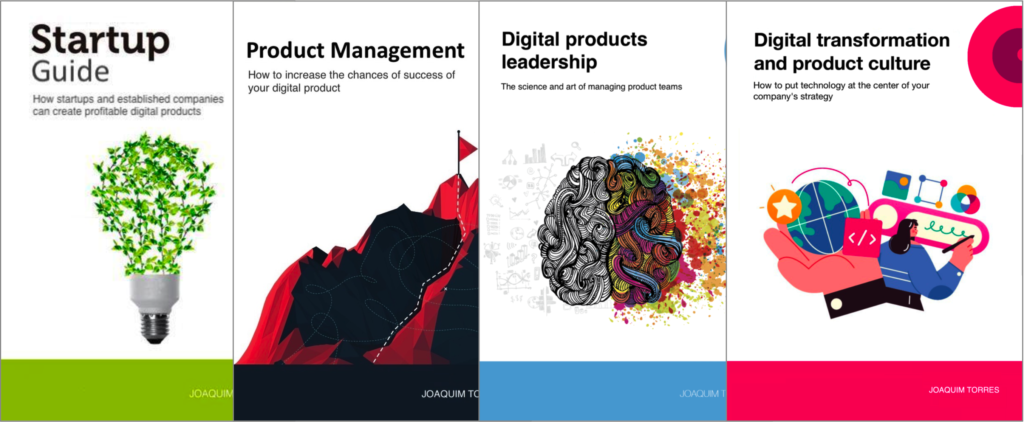
Do you work with digital products? Do you want to know more about managing a digital product to increase its chances of success, solve its users’ problems, and achieve the company’s objectives? Check out my Digital Product Management books, where I share what I learned during my 30+ years of experience in creating and managing digital products:
- Digital transformation and product culture: How to put technology at the center of your company’s strategy
- Leading Product Development: The art and science of managing product teams
- Product Management: How to increase the chances of success of your digital product
- Startup Guide: How startups and established companies can create profitable digital products