

Who Owns What in the Product Management Playbook
2 Jan 2026
Tuckman Model
20 Jan 2026
It’s curious how resistance to AI has been showing up more strongly in product and engineering teams.
This is a pattern I’ve seen in conversations with more than one client.
The discourse is usually technical: “this isn’t production-ready code,” “the quality is bad,” “it’s just for playing around.” But often, the real discomfort isn’t with the tool itself — it’s with the fear of losing work.
The irony is that AI doesn’t reduce the work of good product and engineering professionals. It increases it. The work changes: less execution, more decision-making and strategy, with much higher speed in testing and experimentation.
Culture and operating model
Culture is nothing more than the way a group of people reacts to situations and solves problems. It’s the operating model of a team.
When a team operates in project mode (a feature team), it receives solutions and executes what was requested. In this model, AI feels like a threat because it accelerates — and can even replace — exactly what the team does: delivery.
When a team operates in product mode (an empowered product team), it receives a problem to solve and an expected outcome. In this model, AI becomes an immediate ally, as it expands options, accelerates testing, and lowers the cost of experimentation.
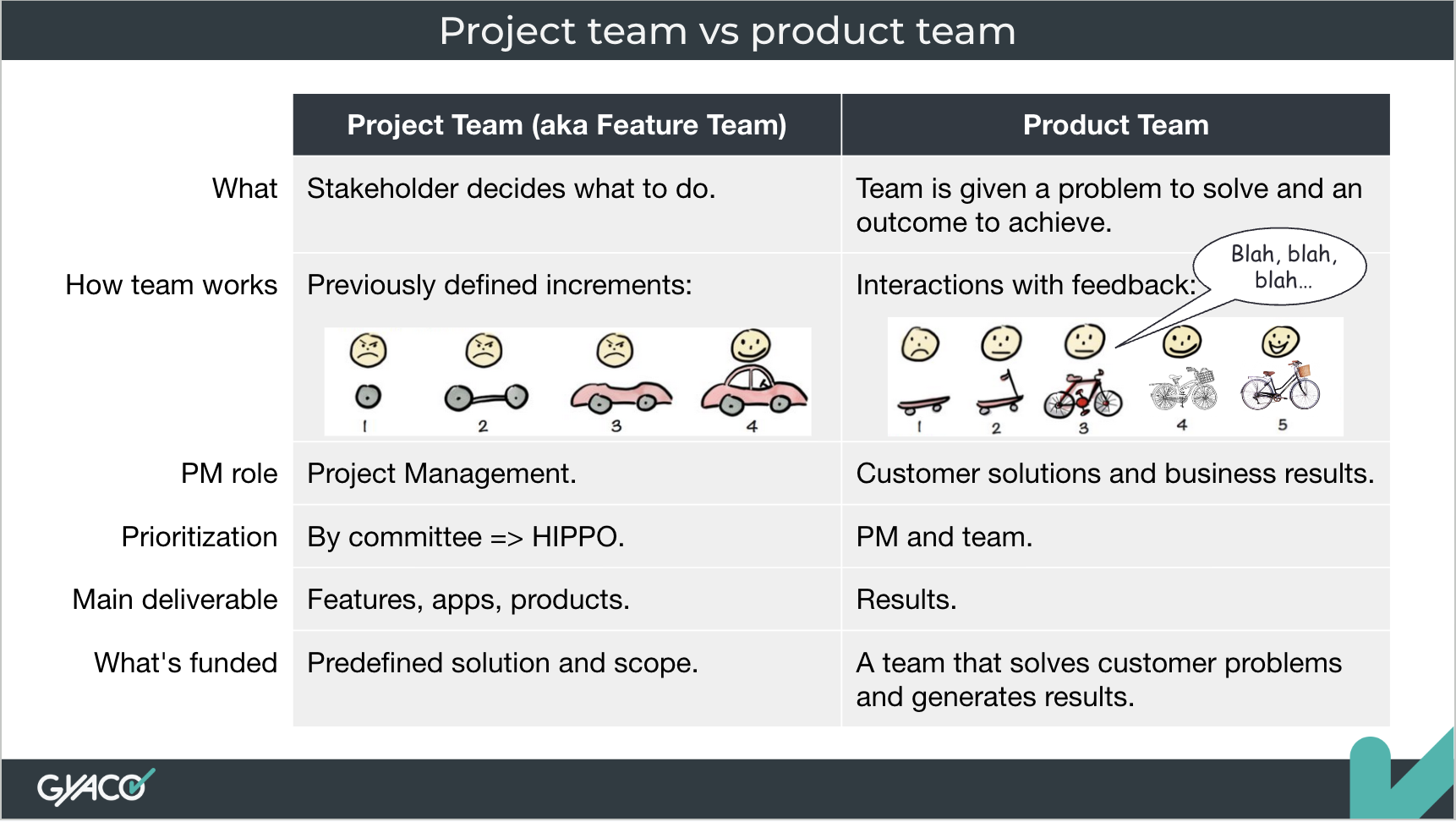
Project vs product
So the real question isn’t whether “the team is resisting AI.”
It’s whether “the team is operating in project mode or in product mode.”
And, more importantly: “is the team receiving the strategic context it needs (vision, strategy, and the problems to solve) to be able to use AI as a lever for better decision-making, experimentation, and results?”
The role of leadership
Anyone who thinks the role of leadership is just to encourage or set an example in using AI is missing the point. Of course, that matters a lot. I even like to mention a client of mine whose CTO and Head of Technology spent their weekends playing with vibe-coding tools and then shared their experiences with the whole team — a great way to encourage everyone to experiment with new tools.
But that’s not enough.
For a team to truly operate in product mode, it needs strategic product context. That means being clear about:
- what the product vision is and where we want to take the product;
- what the product strategy is, the problems we need to solve to move closer to that vision;
- how the team is organized, which roles and skills are needed, and how people should be structured to solve the problems that will bring us closer to the product vision.
That’s what the image below illustrates:
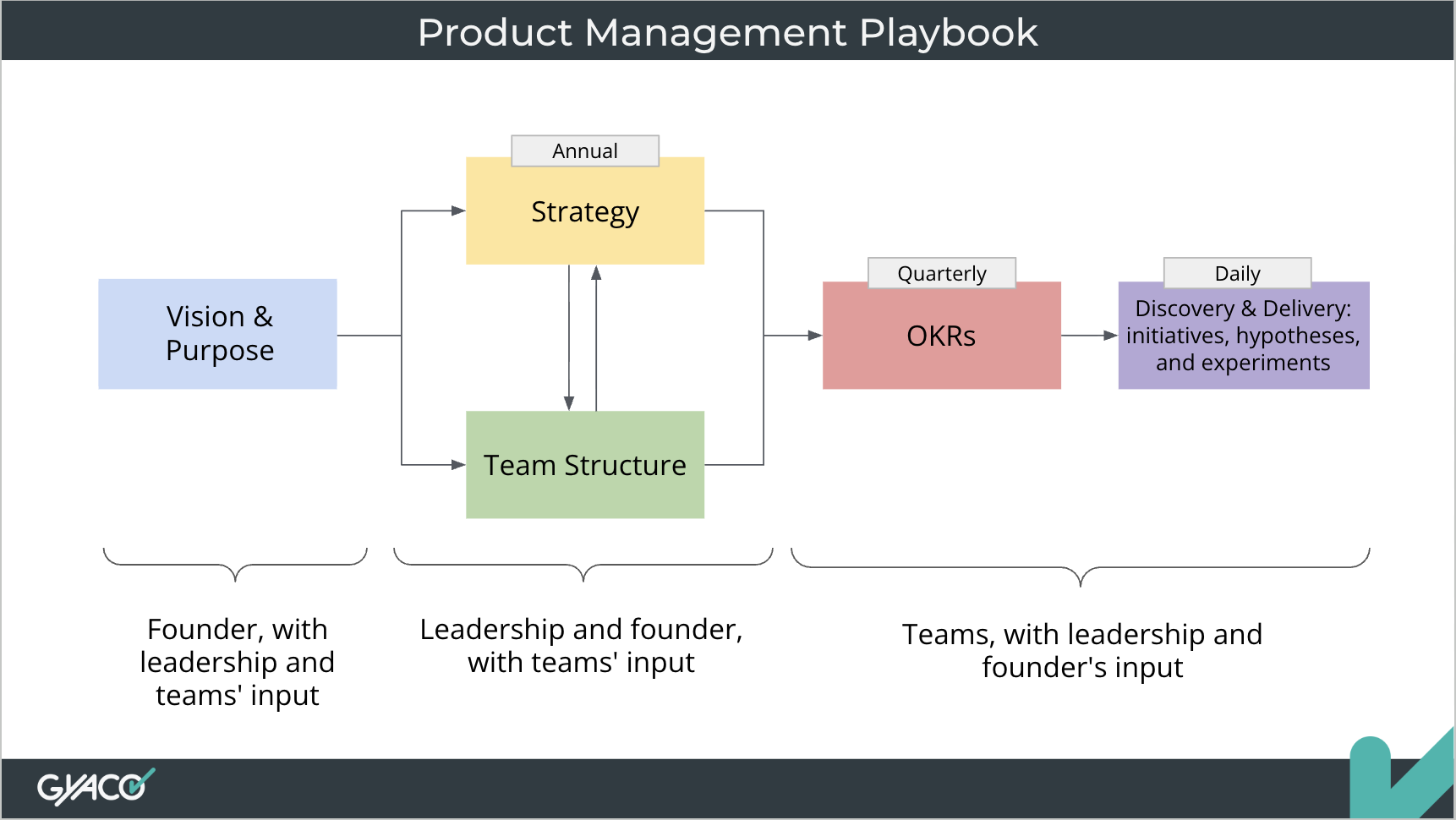
Who Owns What in the Product Management Playbook
In the end, adopting AI is not a technical decision. It’s a decision about the operating model. And that choice belongs to leadership.
In summary
- Resistance to AI in product and engineering is less technical and more cultural.
- Teams in project mode see AI as a threat. Teams in product mode see AI as a lever.
- Leadership should not impose AI. It should define and clearly communicate the product’s strategic context, providing vision, strategy, and problems to solve.
- In the end, adopting AI is not a technical decision. It’s a decision about the operating model — and it starts with leadership.
Workshops, coaching, and advisory services
I’ve been helping companies and their leaders (CPOs, heads of product, CTOs, CEOs, tech founders, and heads of digital transformation) bridge the gap between business and technology through workshops, coaching, and advisory services on product management and digital transformation.
Gyaco Podcasts
At Gyaco, we believe in the power of conversations to spark reflection and learning. That’s why we have two podcasts that explore the world of product management from different angles:
- Produto em Pauta: In the new season, titled “Beyond the Buzzwords”, Felipe Castro and I demystify product terms with real examples from our clients. Available on YouTube and Spotify. Recorded in Portuguese, with English subtitles on YouTube.
- Product Chronicles, the Brazilian Way: with Fábio Martinelli Duarte and Paulo Caroli — the Brazilian way of building products: stories, challenges, and lessons learned, featuring case studies from our clients. Available on YouTube and Spotify. Recorded in English, with Portuguese subtitles on YouTube.
Digital Product Management Books
Do you work with digital products? Do you want to know more about managing a digital product to increase its chances of success, solve its user’s problems, and achieve the company objectives? Check out my Digital Product Management books, where I share what I learned during my 30+ years of experience in creating and managing digital products:
- Digital transformation and product culture: How to put technology at the center of your company’s strategy
- Leading Product Development: The art and science of managing product teams
- Product Management: How to increase the chances of success of your digital product
- Startup Guide: How startups and established companies can create profitable digital products