

Why Individual Bonuses Don’t Work in Product Teams
18 May 2026What makes a group of people behave like a team?
2 Jun 2026Last Thursday, I hosted the Masterclass “Continuous Discovery at Scale: How AI Can Change User Research.” Over 1,000 people registered. It was one of the most interactive sessions I have ever run. If you missed it, it is available on YouTube (in Portugues, with English subtitles):
The topic is not new, but the moment is. And that is exactly what I explored in the Masterclass.
The Problem We Never Solved
Teresa Torres has been talking about continuous discovery for years. So has Marty Cagan. Everyone in product knows that talking to users regularly is fundamental. And yet, in practice, it rarely happens.
I asked in the registration form what the biggest challenge was for talking to users regularly. With over 600 responses, the results were clear: schedules that never align, difficulty recruiting the right people, lack of time in the day-to-day, and in larger companies, internal bureaucracy that prevents product teams from reaching customers directly.
The desire and willingness are there, but the structure for continuous, at-scale discovery is not.
What AI Already Solved, and What Was Still Missing
AI transformed Delivery. Copilot, Cursor, and Claude Code have dramatically accelerated software development. In Solution Discovery, tools like Lovable, Replit, and Bolt enable building prototypes and MVPs in hours. But what about Problem Discovery?
Planning the research, recruiting participants, conducting interviews, analyzing and extracting insights. That entire flow still depended almost entirely on human effort. A thirty-minute interview with ten users takes a full day. Twenty users, two days. On top of scheduling, recruiting, and manual analysis.
That is exactly the gap Anderson Borges and I decided to tackle with ReveLumi.
How the Idea Was Born
It started with AstroLumi, an astrology agent we built together. When I needed to understand why users who had shown interest were not buying the paid service, I did what I always recommend: I went to talk to them. Since I had their WhatsApp numbers, I did something I had done before — research over WhatsApp. It lets me talk to more people at the same time and is less disruptive to their routines. I collected the phone numbers and started the interviews manually.
It worked. But at some point I had 25, 30 conversations open simultaneously and could no longer remember who had said what. Once most of the conversations were done, I exported them and fed them into an LLM to analyze and extract insights. I was surprised by what the AI surfaced.
That is when the obvious question came up: why not automate this entire process?
That Is How ReveLumi Was Born
ReveLumi is a qualitative research agent via WhatsApp. You define the research objective, the hypotheses you want to validate, and the questions you want to ask. It plans, recruits, conducts the interviews, and delivers a report with the main drivers and suggested next steps, including a ready-to-use PRD.
In the Masterclass, I demonstrated all of this live with a research on how people choose what to watch on Netflix. During the session, 42 interviews ran simultaneously with the audience. The report surfaced something any Netflix user will recognize: distrust in the recommendation algorithm is real, and people turn to external sources to decide what to watch.
You can participate in this research right now and experience ReveLumi in practice:
- Portuguese: https://revelumi.com/c/06VP6MA2
- English: https://revelumi.com/c/06VP6MA2?lang=en
- Spanish: https://revelumi.com/c/06VP6MA2?lang=es
What This Changes in Practice
Talking to ten users next week does not have to be an event anymore. It can be a routine. With a contact base and a clear objective, you can run a research, get responses the same day, and make decisions based on what your users actually said.
This does not replace an in-person conversation or a deep research session. But it solves the problem we all have: discovery happens less than it should because it is expensive, slow, and labor-intensive. With ReveLumi, it no longer has to be.
If you want to learn more, visit revelumi.com. And if you already see how this can help your team, let’s talk.
Scale your customer research
In a world where AI levels the playing field, deep customer knowledge is the one asset your competitors can’t copy. ReveLumi was built exactly for that. Learn more at revelumi.com.
Workshops, coaching, and advisory services
I’ve been helping companies and their leaders (CPOs, heads of product, CTOs, CEOs, tech founders, and heads of digital transformation) bridge the gap between business and technology through workshops, coaching, and advisory services on product management and digital transformation.
Gyaco Podcasts
At Gyaco, we believe in the power of conversations to spark reflection and learning. That’s why we have “Product in Focus” (Produto em Pauta in Portuguese), a podcast that explores the world of product management from different angles:
- Mentoring Sessions: In this series, I share real mentoring conversations with product people. One person’s questions are often the questions of many. Together, we explore concrete challenges and turn experience into practical insights you can apply to your own context.
- Beyond the Buzzwords: In this series, Felipe Castro and I demystify product terms with real examples from our clients.
Available on YouTube and Spotify. Recorded in Portuguese, with English subtitles on YouTube.
Digital Product Management Books
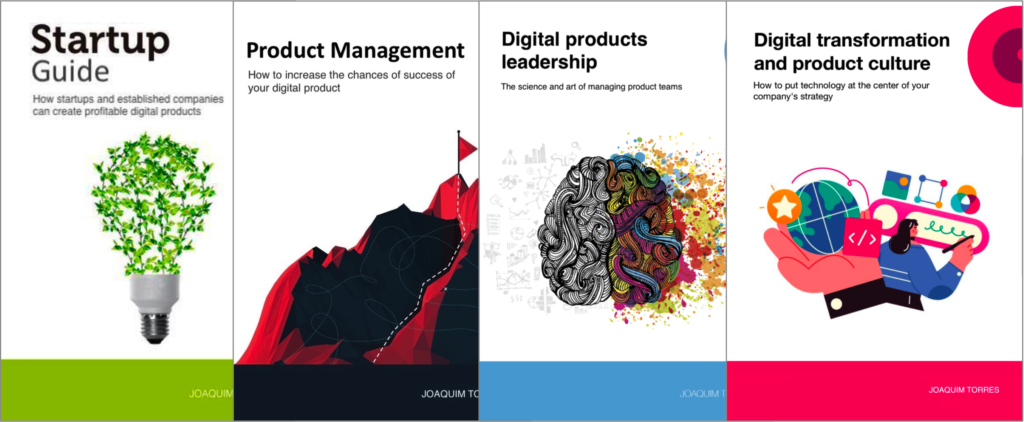
Do you work with digital products? Do you want to know more about managing a digital product to increase its chances of success, solve its user’s problems, and achieve the company objectives? Check out my Digital Product Management books, where I share what I learned during my 30+ years of experience in creating and managing digital products:
- Digital transformation and product culture: How to put technology at the center of your company’s strategy
- Leading Product Development: The art and science of managing product teams
- Product Management: How to increase the chances of success of your digital product
- Startup Guide: How startups and established companies can create profitable digital products