

Data tells you what. Customers tell you why.
16 de June, 2026What’s the ideal DISC for a PM? And for a head of product?
30 de June, 2026I had been noticing a pattern in the conversations I have with product teams. The people who feel the pain of not talking to customers are rarely the ones who hold the budget to fix it. I decided to test that intuition. Instead of guessing, I went to listen.
I ran a meta-discovery, a survey about how people do discovery. I posted a link in a few product communities, and the conversations happened asynchronously, over WhatsApp. The first one started at 11am. A few days later, there were more than 80 conversations, with none of them scheduled.
Three things became clear.
The pain is operational, and it is the same everywhere
People described the same difficulty over and over. Calendars that never line up. Recruiting that drags. People who do not show up. Emails that go unanswered.
“Plenty of willingness, but it is extremely hard to make it happen without all the scheduling work: booking, canceling, no-shows, showing up with no time.”
This was the majority view, by a wide margin. People know they should talk to users more. They just cannot, because operations eat the time.
“We do no continuous discovery. We interview users only when we are about to start building. It is rushed, and there is always rework.”
The budget decision lives far from the pain
The people who feel the pain are in product and design. The people who approve the budget are above them.
“The demand starts with product and design, the ROI has to be very well proven, and then a business case goes up that the CTO has to approve, as long as there is room in the annual budget.”
A product participant captured the misalignment in one line:
“Only product and design talk to customers. So only we feel this need.”
And another revealed the quietest consequence of it. When the person who feels the pain sees no solution, the pain never even reaches leadership:
“I do not speak for leadership. I do not take it to them myself, because there is no solution today.”
The person who feels the pain is not the person who decides the purchase. And sometimes does not even carry the pain forward.
Removing the barrier pays off in better decisions
When we asked what would change with continuous, direct access to users, the answers converged. Faster decisions, less noise, less rework.
“We would have faster decisions with less noise. Today the need reaches us already interpreted by other areas, and context gets lost along the way.”
The reward for solving an operational problem turns out to be strategic. And it can be measured.
The ROI, in two parts
Operational ROI:
- Running more than 80 qualitative conversations by hand (recruiting, scheduling, conducting, transcribing, analyzing, synthesizing) would take weeks of work.
- I had the first results in three hours, and the full synthesis in a few days, scheduling nothing.
Strategic ROI:
- Weeks of development saved for every bad hypothesis the team does not chase. And most hypotheses are bad. Ron Kohavi, who led experimentation at Microsoft and Airbnb, documented that about two thirds of product ideas fail to improve the metric they were meant to improve, and that in mature companies this rate reaches 80 or 90%.
- The cost of keeping the team chasing the wrong thing. A squad of six people costs around 200 thousand reais per month in Brazil, 80 thousand dollars in the US, 50 thousand euros in Europe. A month in the wrong direction is that entire amount burned.
- The cost avoided of building the wrong product. In 2010, at Locaweb, a conversation with customers led us to abandon a marketplace before writing a single line of code. The data said go ahead, the conversation revealed why not. We avoided the cost of building the wrong thing, and also of operating a product doomed from conception.
Talking to the customer first does not save hours. It saves the cost of a whole squad running in the wrong direction, and sometimes prevents the mistake you would only notice too late.
Data tells us what happened. Customers tell us why. The reason teams stop at the data is that the conversation is too hard to have. Remove that friction, and the why comes back.
I wrote the full version of this story, with the method behind the conversations and the behind-the-scenes of the research, on Listen to Decide, my newsletter about listening to customers to make better decisions.
Scale your customer research
In a world where AI levels the playing field, deep customer knowledge is the one asset your competitors can’t copy. ReveLumi was built exactly for that. Learn more at revelumi.com.
Workshops, coaching, and advisory services
I’ve been helping companies and their leaders (CPOs, heads of product, CTOs, CEOs, tech founders, and heads of digital transformation) bridge the gap between business and technology through workshops, coaching, and advisory services on product management and digital transformation.
Gyaco Podcasts
At Gyaco, we believe in the power of conversations to spark reflection and learning. That’s why we’ve created “Produto em Pauta” podcast, with new episodes every Thursday.
The main series is called Mentorias: coaching conversations with product professionals, built on the idea that one person’s questions are often the questions of many others. We explore concrete challenges and turn experience into practical insights you can apply in your own context.
Available on YouTube and Spotify. Recorded in Portuguese, with English subtitles on YouTube.
Digital Product Management Books
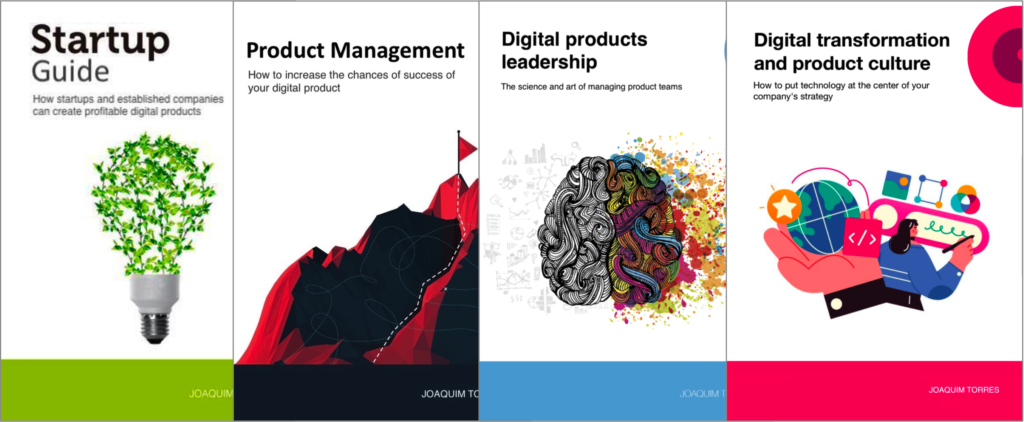
Do you work with digital products? Do you want to know more about managing a digital product to increase its chances of success, solve its user’s problems, and achieve the company objectives? Check out my Digital Product Management books, where I share what I learned during my 30+ years of experience in creating and managing digital products:
- Digital transformation and product culture: How to put technology at the center of your company’s strategy
- Leading Product Development: The art and science of managing product teams
- Product Management: How to increase the chances of success of your digital product
- Startup Guide: How startups and established companies can create profitable digital products