

The ROI of talking to customers
23 de June, 2026Killing the role doesn’t kill the mission
7 de July, 2026Last week I was with a Gyaco client, working on the Product Maturity Program. In one of the conversations, with the head of HR, we talked about a few people in the organization who could be moved into a product management role.
At one point in the conversation, she pulled up the DISC assessments of those people on screen and asked which DISC profile indicates that someone will perform well as a PM.
DISC is a personality test widely used by HR teams, organizing behavioral tendencies into four axes: Dominance, Influence, Steadiness, and Compliance. It traces back to studies by psychologist Marston in the 1920s, and the test, in the format we use today, was created by Walter Clarke in 1945.
- D (Dominance) measures how much a person seeks control, decisiveness, and quick results.
- I (Influence) measures how much they seek connection, enthusiasm, and persuasion.
- S (Steadiness) measures how much they seek consistency, patience, and cooperation.
- C (Compliance) measures how much they seek precision, structure, and rules.
Most people combine the four axes in different proportions, and the result shows which tendency carries more weight in day to day work.
Before answering what the best DISC profile for a product manager is, an important caveat: DISC doesn’t predict performance. It describes a behavioral tendency, not a competency.
A person with any combination of D, I, S, and C can be a good PM. What DISC shows is where the effort will be smaller and where it will be greater, and that already helps with a career decision and a development plan.
A PM lives on influence without formal authority. The person doesn’t manage anyone and needs to convince engineering, design, sales, CS to follow a direction. That requires plenty of I, because I is what sustains the ability to evangelize ideas and keep the team engaged around a vision.
A PM also lives on discovery. Listening to customers, tolerating ambiguity, resisting the urge to jump into building a solution before understanding the problem. That calls for S. Without S, the natural tendency is to skip listening and go straight to execution.
C comes in through analytical rigor and prioritization criteria. D matters too, just in a smaller dose than common sense expects. Decision making without formal authority, when it comes from very high D without I to back it up, tends to generate friction rather than buy-in.
In short, for a PM, it makes sense to look for moderate D, high I, moderate to high S, and moderate C.
For someone who will act as a head of product, the game changes. The scope becomes organizational. Vision, negotiation between leaders, prioritization trade-offs across squads, structural decisions that affect many people at once. That requires more D than an individual PM needs, because decision making at scale demands comfort with confrontation.
I remains important, and sometimes even more important, because a large part of a head’s work is communicating vision to the whole company, to the board, to investors. C is still relevant, but with less weight than for a PM, since a head works less in the operational detail.
The point that trips up a head the most is low S combined with high D. Whoever leads people needs to run 1:1s, develop PMs, retain talent, give hard feedback without destroying trust. High D without S solves the problem but loses the team along the way.
In other words, for a head of product, it makes sense to look for high D, high I, moderate to high S, and low to moderate C.
DISC, besides helping assess who is best suited for the role, should also be used to help develop people. For example, a PM with low I benefits from deliberate training on how to communicate ideas and influence people. A head with low S benefits from a fixed 1:1 ritual and from practicing empathy.
To close with a concrete example: I took the test on 123test.com, and here’s my DISC. D44, I15, S13, C28. Decisiveness and rigor seem to come naturally to me. Influence and listening, on the other hand, require deliberate effort, even after years as a CPO at large companies. Today, working as an advisor to companies and as a PM at ReveLumi, I still keep putting energy into my I and my S.
DISC doesn’t choose who becomes a PM or a head. It shows where you’ll need more discipline to develop what doesn’t come for free.
If you’re considering bringing someone from another area in to be a PM, or if you yourself are considering that career move, my recommendation is to look at the DISC profile expected of a PM and assess the need to develop those soft skills, in addition to the hard skills needed to be a PM, which you can learn in market courses on product management.
To develop those soft skills, what I recommend is deliberate practice with constant feedback. Courses won’t help much here. Look for mentorship from someone strong exactly where you are weak. It can be your manager or someone from another area of the company, who will be following you day to day, or someone from the market, who won’t follow your daily work but can bring an outside view. Expose yourself to situations you know are necessary but that make you uncomfortable: presenting to different audiences, conversations with customers, among others. Soft skills develop by doing, by failing, and by adjusting, with someone from the outside observing what you yourself can’t see.
Summary
- A person with any combination of D, I, S, and C can be a good PM.
- What DISC shows is where the effort will be smaller and where it will be greater, and that already helps with a career decision and a development plan.
- For a PM, it makes sense to look for moderate D, high I, moderate to high S, and moderate C.
- For a head of product, it makes sense to look for high D, high I, moderate to high S, and low to moderate C.
- DISC doesn’t choose who becomes a PM or a head. It shows where you’ll need more discipline to develop the soft skills that don’t come for free.
- Soft skills develop through deliberate practice and mentorship, not through courses.
Listen to more customers, with less effort
In a world where AI levels execution, deep knowledge of your customer is the one asset your competitor can’t copy. ReveLumi was built exactly for that. Check it out at revelumi.com.
This week’s article on Listen to Decide
That’s this week’s topic on my new newsletter, Listen to Decide, where I write about the importance of listening to customers, techniques for doing it better, and what we’re learning while building ReveLumi. All with one goal: making better decisions from real conversations.
Workshops, coaching, and advisory services
I’ve been helping companies and their leaders (CPOs, heads of product, CTOs, CEOs, tech founders, and heads of digital transformation) bridge the gap between business and technology through workshops, coaching, and advisory services on product management and digital transformation.
Gyaco Podcasts
At Gyaco, we believe in the power of conversations to spark reflection and learning. That’s why we’ve created “Produto em Pauta” podcast, with new episodes every Thursday.
The main series is called Mentorias: coaching conversations with product professionals, built on the idea that one person’s questions are often the questions of many others. We explore concrete challenges and turn experience into practical insights you can apply in your own context.
Available on YouTube and Spotify. Recorded in Portuguese, with English subtitles on YouTube.
Digital Product Management Books
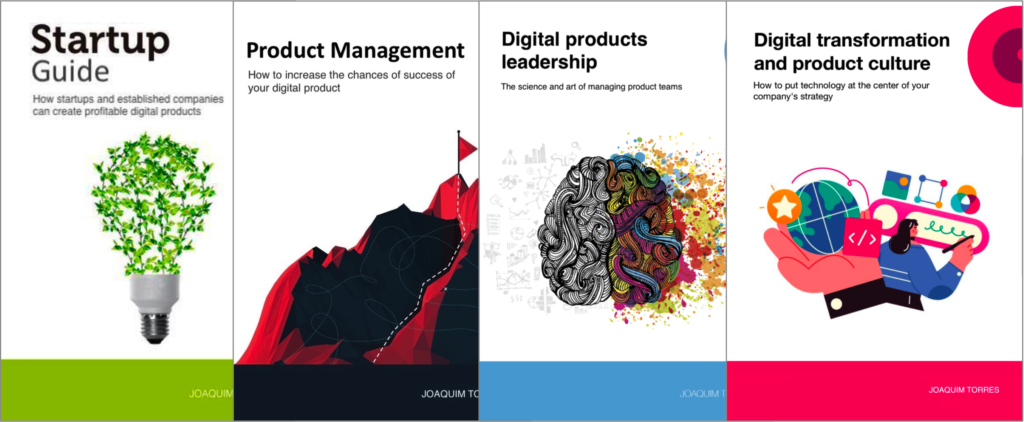
Do you work with digital products? Do you want to know more about managing a digital product to increase its chances of success, solve its user’s problems, and achieve the company objectives? Check out my Digital Product Management books, where I share what I learned during my 30+ years of experience in creating and managing digital products:
- Digital transformation and product culture: How to put technology at the center of your company’s strategy
- Leading Product Development: The art and science of managing product teams
- Product Management: How to increase the chances of success of your digital product
- Startup Guide: How startups and established companies can create profitable digital products