

Killing the role doesn’t kill the mission
7 Jul 2026Perverse Metrics, Leading Metrics, and Lagging Metrics
21 Jul 2026This article is an excerpt from the book “Digital Transformation and Product Culture: How to Put Technology at the Center of Your Company’s Strategy”.
Once you have clarity on your vision and strategy and have defined your team structure, the next step is to have a tool that helps track the progress your team is making in executing the strategy to get closer to your vision.
One widely used tool in technology companies is OKRs, which stands for Objectives and Key Results. It is a powerful tool that reinforces the four principles discussed in Part 2 (Principles) of this book:
- Deliver early and often.
- Focus on the problem.
- Delivery of results.
- Ecosystem mindset.
We use OKRs because products, features, technology, websites, apps, data, algorithms, projects, and processes are not objectives themselves, but rather means to achieve objectives and results!
OKR is a tool that originated at Intel, later adopted by Google, and then spread to Silicon Valley companies and eventually to tech- nology companies worldwide. Nowadays, even non-technology companies use OKR. Bono from U2, for instance, uses OKR in a non-profit organization called ONE, focused on combating extreme poverty and preventable diseases.
Here is an example of an OKR:
- Objective: Be healthier;
- KR1: Lose 2 kg;
- KR2: Reduce body fat by 5%;
- KR3: Exercise at least 3 times a week. Pretty simple, right?
Some precautions
Despite its simplicity, this tool requires careful consideration when defining and using OKRs.
Frequency
When we define our strategy, we set goals to be achieved over a pe- riod of 6 months to a year, as recommended for strategy review, as we discussed in the Product Strategy chapter. For OKR definition, I usually work with quarterly periods. I’ve seen some teams using a four-month periodicity, while others use a bi-monthly periodicity, but the most common is a quarterly periodicity.
A crucial aspect of OKRs is their monitoring frequency. I have been using a weekly frequency, and I’ve seen many teams following this frequency. Initially, it may seem too frequent to have this weekly check-in, and people might prefer to do it every two weeks or once a month. The advantages of doing this check every week include:
- Problems and impediments grow less within 1 week than within two weeks or a month.
- If there is any impediment, you will have 12 to 13 opportuni- ties within the quarter to understand what’s happening and resolve it.
- The follow-up meeting tends to be shorter.
The concern that arises when we do weekly monitoring is that some metrics are monthly, and consequently, they cannot be tracked weekly, such as the churn metric, for example. My rec- ommendation is to look for metrics that can be monitored weekly. Even monthly or yearly metrics can be broken down into weekly measurements. For example, if your goal is to have a monthly churn of 2%, what do these 2% mean in the number of customers lost? If your customer base is 1,000 customers, a 2% churn means losing 20 customers in a month, or 5 customers per week. There you go; you already have a weekly metric to monitor.
Digital transformation and product culture
This article is another excerpt from my newest book “Digital transformation and product culture: How to put technology at the center of your company’s strategy“, which I will also make available here on the blog. So far, I have already published here:
- About the book
- Part 1: Concepts
- Chapter 1: The so-called digital transformation – Project and Product
- Chapter 2: Uncertainty and digital transformation
- Chapter 3: Types of company
- Chapter 4: Type of company vs digital maturity
- Chapter 5: Business models
- Chapter 6: Agile, digital and product culture
- Part 2: Principles
- Chapter 7: Deliver early and often – Measuring and managing the productivity – Case study: Dasa Group – Case study: Itaú Unibanco
- Chapter 8: Focus on the problem – The Famous Product Discovery – Why the “business demands => IT implements” model does not work – Case study: Magazine Luiza
- Chapter 9: Result delivery – Outsource or internal team? – Case study: Centauro
- Chapter 10: Ecosystem mindset
- Part 3: Tools
- Chapter 11: Product Vision – Product vision examples
- Chapter 12: Product Strategy
- Chapter 13: Team Structure – Structuring effective product development teams – Structural teams – Team structure spreadsheet – Downsizing and layoffs – CTO + CPO – Internationalization – Outsourced team – Tuckman model – Dependencies between teams – Should we have a dedicated innovation team? – Should we have a team dedicated to fixing bugs? – Business Units – Why Individual Bonuses Don’t Work in Product Teams – What makes a group of people behave like a team?
- Chapter 14: What are OKRs and How to Get the Cadence Right
Scale your customer research
In a world where AI levels the playing field, deep customer knowledge is the one asset your competitors can’t copy. ReveLumi was built exactly for that. Learn more at revelumi.com.
Workshops, coaching, and advisory services
I’ve been helping companies and their leaders (CPOs, heads of product, CTOs, CEOs, tech founders, and heads of digital transformation) bridge the gap between business and technology through workshops, coaching, and advisory services on product management and digital transformation.
Gyaco Podcasts
At Gyaco, we believe in the power of conversations to spark reflection and learning. That’s why we’ve created “Produto em Pauta” podcast, with new episodes every Thursday.
The main series is called Mentorias: coaching conversations with product professionals, built on the idea that one person’s questions are often the questions of many others. We explore concrete challenges and turn experience into practical insights you can apply in your own context.
Available on YouTube and Spotify. Recorded in Portuguese, with English subtitles on YouTube.
Digital Product Management Books
Do you work with digital products? Do you want to know more about managing a digital product to increase its chances of success, solve its user’s problems, and achieve the company objectives? Check out my Digital Product Management books, where I share what I learned during my 30+ years of experience in creating and managing digital products:
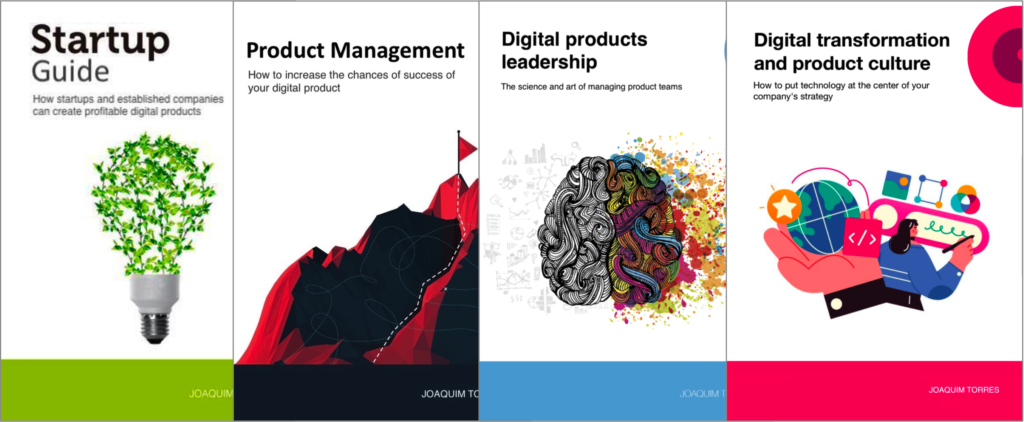
- Digital transformation and product culture: How to put technology at the center of your company’s strategy
- Leading Product Development: The art and science of managing product teams
- Product Management: How to increase the chances of success of your digital product
- Startup Guide: How startups and established companies can create profitable digital products