

The evolution from SaaS to SaS
28 de July, 2026OKRs, Financial Bonuses, and How to Scale to Large Teams
10 de August, 2026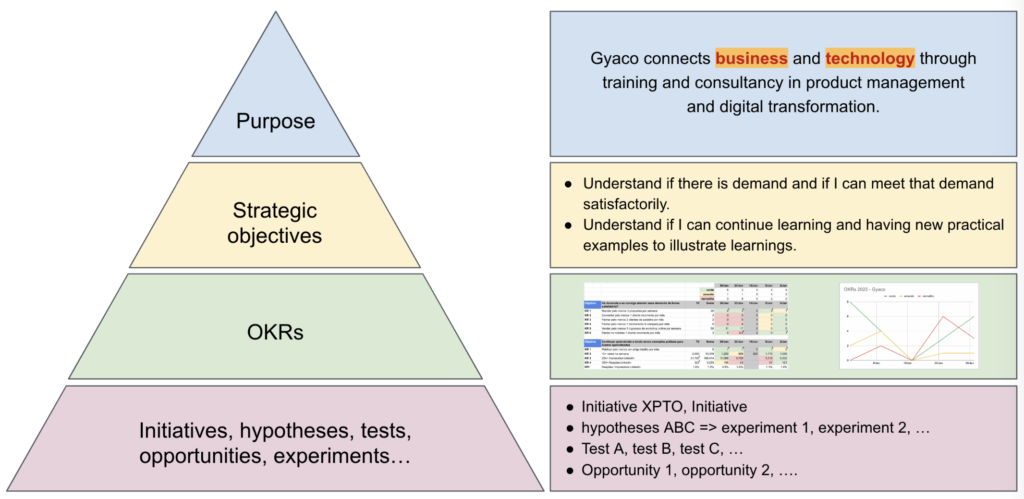
This article is an excerpt from the book “Digital Transformation and Product Culture: How to put technology at the center of your company’s strategy” .
Team = shared goals
The product development team is cross-functional, made up of people with different roles: product managers, designers, and engineers. The way to make sure this group behaves like a team is to define shared goals. They should be accountable for the same OKRs. Without shared OKRs, they’re not a team, just a group of people who, back when work was in-person, would sit together while each one chased their own individual objective.
There can be some function-specific OKRs, but they should be few, and they should have lower priority than the team’s OKRs.
Tracking initiatives (progress + confidence)
OKRs are a tool for tracking strategy execution through numbers, through leading and lagging metrics. In some situations, though, we may not have numbers to track, or the numbers may not update as often as we need for weekly monitoring, but it’s still important to track a given initiative on a weekly basis.
In those cases, my recommendation is to use the weekly OKR check-ins for a brief update, a line or two on how progress is going, using green, yellow, or red to signal confidence that the result will be reached by the end of the quarter.
For example, suppose that during a discovery process, you determined you need to implement three new types of reports in your product for your customers to use. Even though it’s a number (three new report types), that number likely won’t change much over the course of the quarter. Instead, you could report on it week by week like this:
- Week 1: Gathering requirements. Customer interviews scheduled to detail the reports. Yellow;
- Week 2: Running research. Yellow;
- Week 3: Research complete, scope defined. Starting development. Yellow;
- Week 4: In development. More detail on what’s being built is available at this link. Green;
- Weeks 5 to 7: In development. Green;
- Week 8: Wrapping up development. Validation starts next week. Green;
- Week 9: Starting validation. Green;
- Week 10: Small adjustments this week and next. Green;
- Week 11: Adjustments complete. Green;
- Week 12: Reports released to users. Green.
Types of metrics (internal, user, and business)
There are productivity and quality metrics that help us understand how the work process is going and where to focus energy to improve it. There are also metrics that help us understand whether people are happy working on the team, whether they’re aligned with the team’s and company’s culture and purpose. A fairly simple metric to track is monthly headcount inflow, outflow, and average tenure. If more people are leaving than joining, there may be a problem on the team. If people stay only a few months and then leave, that’s another warning sign. You can also run an NPS survey (Net Promoter Score) with the team periodically to understand whether they would recommend working on your team to others, and why. Using a human body analogy, these are metrics that help you understand whether everything is okay, like body temperature, cholesterol, glucose, and so on.
I typically classify metrics into three broad groups:
- Internal metrics: metrics that show how the product development team is doing and how it has evolved.
- User metrics: metrics that show your product is being used by your users, that it’s fulfilling its purpose. These are engagement and satisfaction metrics for your users. What would ideal user engagement with your product look like? At Conta Azul, we wanted the product to be the first window a user opened in their browser in the morning and the last one they closed at night. We tracked the number of invoices issued per user per week and, monthly, their total value. At Gympass, we tracked how many users went to the gym per month, their visit frequency, and so on. At Lopes, we tracked usage of the new CRM by real estate agents, which had both web and mobile versions. We wanted them to use it at least 4 times a week, and that was the number we tracked.
- Business metrics: metrics that show the product development team is actually delivering value to the business owner. What was the business owner’s goal for the product? Increased sales? Reduced costs? These goals vary depending on the type of company the digital product belongs to: a digital company, a traditional company, or a traditional company that was born digital. At Conta Azul, since the product sold was the digital product itself, user metrics and business metrics overlapped quite a bit. Users who engaged with the product multiple times a week were the ones most likely to keep paying their monthly subscription, and consequently keep generating revenue. At Gympass, a traditional company born digital, and at Lopes, a traditional company, revenue exists independently of the digital product. So the question becomes: what can the digital product do to increase revenue or reduce costs?
When defining OKRs, we should aim to have OKRs that cover these different types of metrics. We can’t look at just one aspect of the product: we need to track internal, user, and business metrics.
Where do OKRs come from?
First, we need to define our product vision. Without a clear vision of the product, of what we imagine the product will be in the future, a vision everyone agrees is the right one, it’s very hard to do everything else. With the product vision in hand, we can work on defining both the strategic objectives and the team structure. These can be defined in parallel, since progress on one feeds into the definition of the other, and vice versa. Once the strategic objectives and team structure are defined, it’s time to define the OKRs, which will be set by the teams that now know which strategic objectives they need to achieve.
In short, the flow is this: purpose and vision lead to defining, in parallel, the strategic objectives and the team structure (reviewed annually), which in turn feed into defining the OKRs (reviewed quarterly).
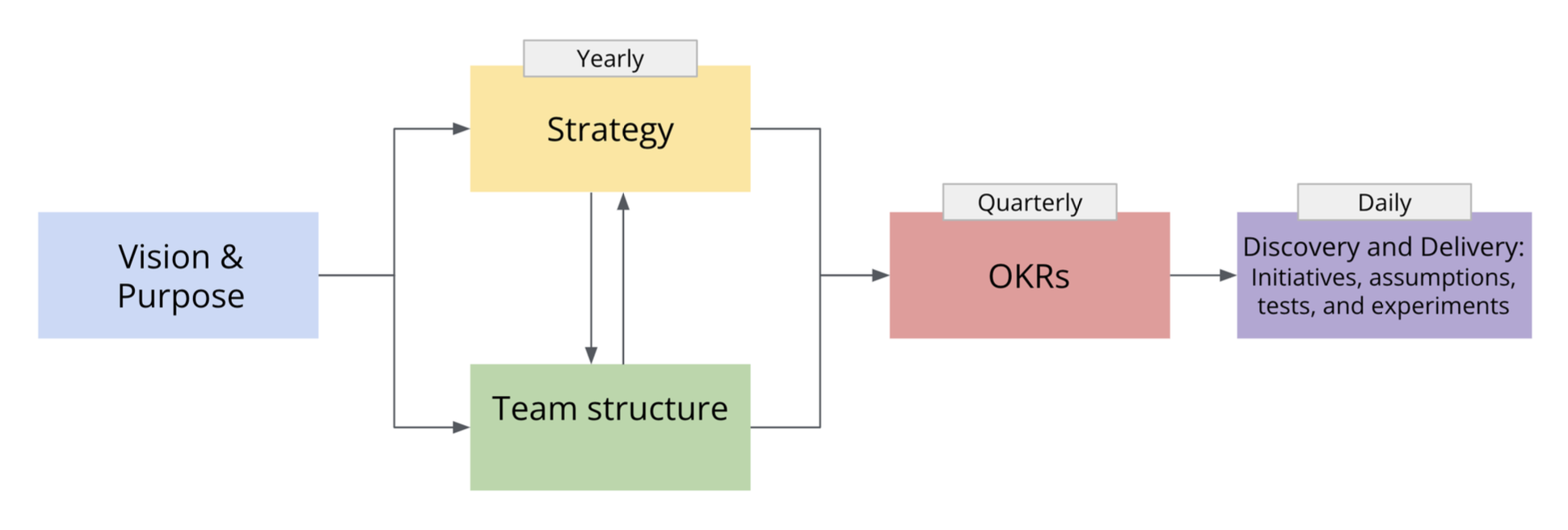
Process for defining vision, strategy, team structure, OKRs, discovery and delivery
Note: this diagram has evolved since the book was published. Today I call it the Product Management Playbook.
When to define, review, and communicate?
I’ve been refining this process since my time at Locaweb, and I’ve advised my clients to adopt a similar approach. I use it every time I join a new company, whether full-time or in an advisory capacity.
| Vision | Strategy and team structure | OKRs | |
|---|---|---|---|
| When to define? | As fast as possible! Without it, you can’t do anything else. | As soon as the vision is defined. | As soon as the strategy and team structure are defined. |
| When to review? | Annually, and whenever there are changes in the external or internal landscape. It shouldn’t change every year, but it’s important to review it annually. | Annually, between Q3 and Q4. Team structure shouldn’t change every year, unless there are significant changes in the strategic objectives. | Quarterly, two weeks before the quarter starts. |
| When to communicate? | In every conversation where reinforcing this alignment is useful. At least once a month, in all-hands meetings. | In every conversation where reinforcing this alignment is useful. At least once a month, in all-hands meetings. | Weekly check-ins to make sure blockers are identified as quickly as possible. |
The cobbler’s children have no shoes?
That’s a common saying used to describe someone who is skilled at something but doesn’t apply that skill to their own benefit.
One of the topics I discuss most with my clients is the importance of having a clearly defined vision and strategy, so that, with them, you can define your OKRs.
Even though I now work solo, I decided from the start to use vision, strategy, and OKRs to help guide my own day to day. To show that, in my case, the cobbler’s children do have shoes, here is Gyaco’s vision and strategic objectives, my product management and digital transformation consulting and training company:
Gyaco connects BUSINESS and technology through training and consulting in product management and digital transformation.
Gyaco’s strategic objectives for 2023
- Understand whether there is demand, and whether I can satisfy that demand. Metrics: customers, revenue, and recurrence;
- Understand whether I can keep learning and generating new practical examples to illustrate what I’ve learned. Metrics: new learnings, articles, and content (with positive engagement).
Since my company today is just me, meaning I handle marketing, sales, finance, collections, operations, support, and delivering the service to my clients myself, I assumed I wouldn’t need OKRs. But while helping a client build their OKRs, I decided to experiment and build my own OKR spreadsheet.
I built that spreadsheet in the week of January 23rd, 2023, and it was revealing. I started the year well, with almost all OKRs in green. The ones that weren’t green were yellow, close to where I wanted them. But by the following week, the picture had changed, with more yellows and a few reds appearing. The week after that was a week off I had taken; when I came back and updated the OKR spreadsheet, I saw that things really weren’t where I wanted them to be, and I put energy into improving that, which you can see reflected the following week.
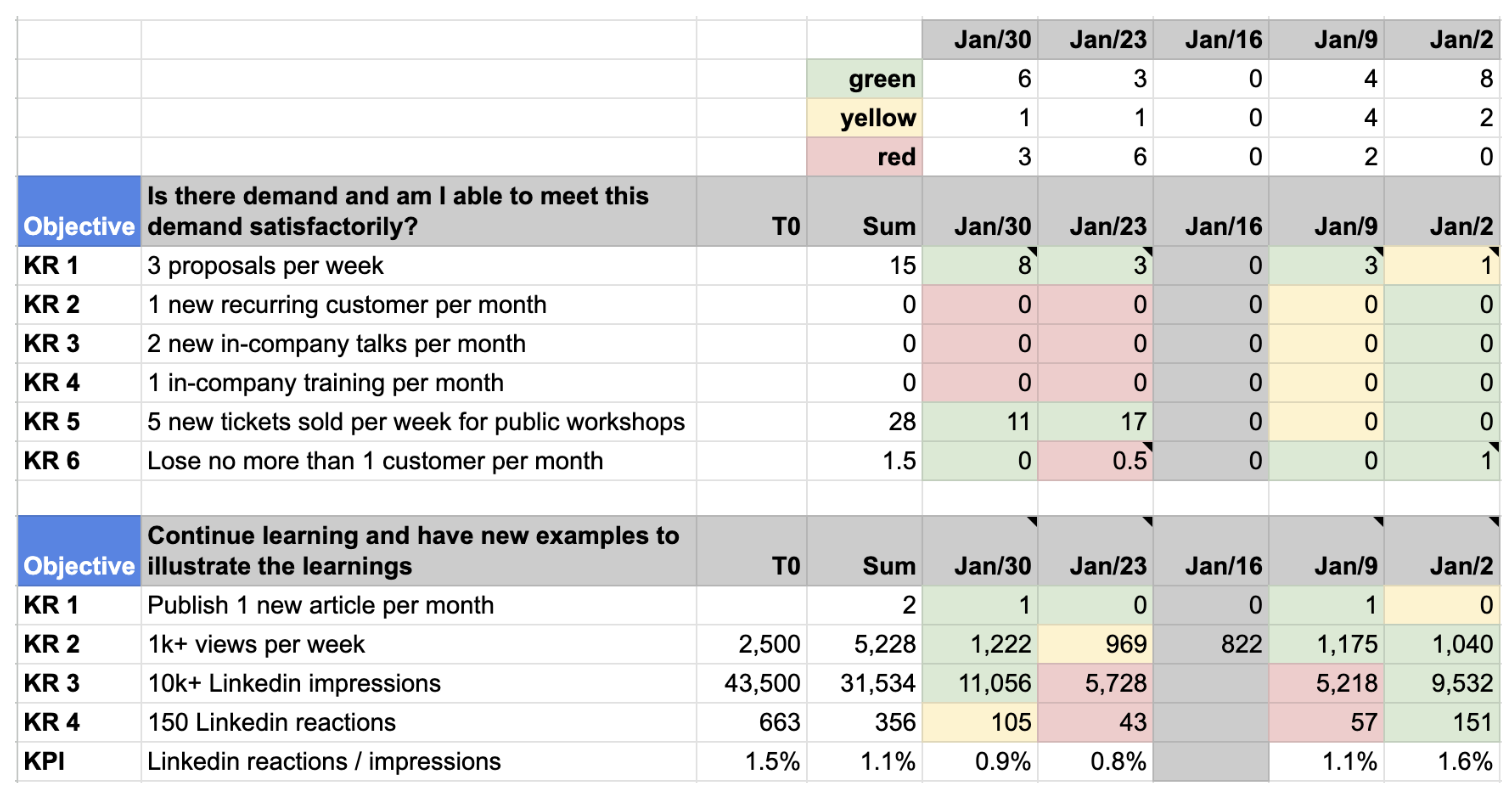
2023 Gyaco’s OKRs
Even for a one-person company, or a very small one, OKRs derived from your vision and strategic objectives are very useful tools to help you get where you want to go.
OKRs are tools
When implementing OKRs, it’s very common for people on teams to respond to any request to do something with something like:
“Well, if it’s not in the OKRs, I’m not going to do it.”
When we say “if it’s not in the OKRs, we’re not doing it,” we’re putting ourselves in the position of servants to the OKRs. The point is that OKRs exist to serve us: they’re tools for achieving the strategic objectives, which are themselves tools for achieving our purpose, our vision. OKRs serve us, not the other way around.
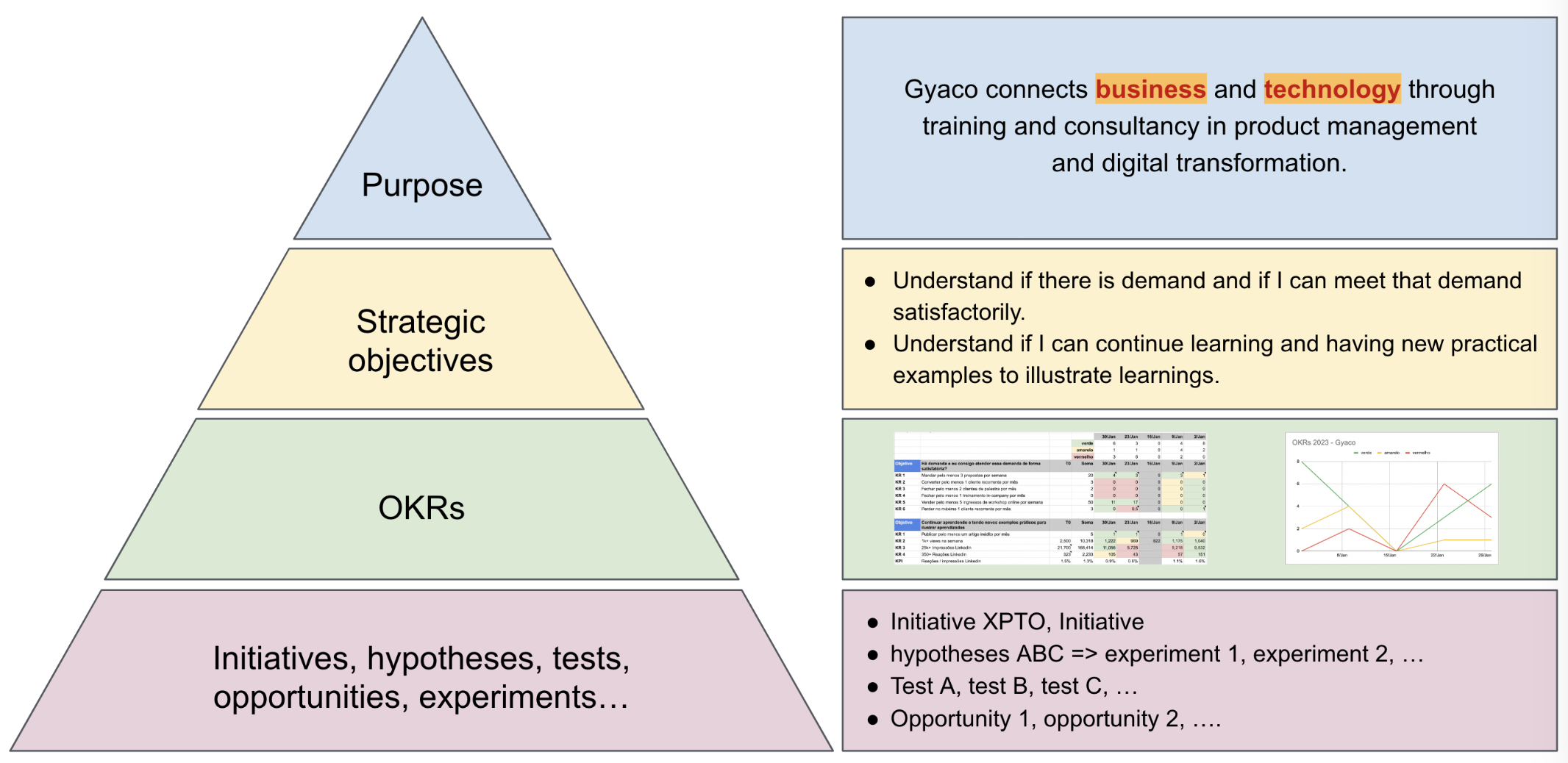
Tool hierarchy
This pyramid of tools also shows that, to help us reach our OKRs, we have initiatives, hypotheses, experiments, and tests. These are what help us define our OKRs.
Something may come up that isn’t in the OKRs but could help us get closer to our strategic objectives. So why not evaluate it? Something may also come up that isn’t in our strategic objectives, but could help us get closer to our vision. We should evaluate that possibility too.
Can you change OKRs mid-quarter?
Ideally, no! But there are situations where it can make sense to revisit OKRs:
- If a KR is achieved before the end of the quarter, it may be worth raising the target, or shifting focus to work on a different number;
- If something new comes up that helps achieve a strategic objective or brings us closer to the vision, we can consider whether to add a new OKR or replace one we’re currently working on;
- If a significant change in circumstances occurs, as was the case with COVID-19. I’m certain many OKRs and strategic plans had to be revisited at that moment.
As a reminder, OKRs are a tool! They exist to serve us, so we need to use good judgment and apply them in whatever way best helps us reach our strategic objectives and vision.
Digital transformation and product culture
This article is another excerpt from my newest book “Digital transformation and product culture: How to put technology at the center of your company’s strategy“, which I will also make available here on the blog. So far, I have already published here:
- About the book
- Part 1: Concepts
- Chapter 1: The so-called digital transformation – Project and Product
- Chapter 2: Uncertainty and digital transformation
- Chapter 3: Types of company
- Chapter 4: Type of company vs digital maturity
- Chapter 5: Business models
- Chapter 6: Agile, digital and product culture
- Part 2: Principles
- Chapter 7: Deliver early and often – Measuring and managing the productivity – Case study: Dasa Group – Case study: Itaú Unibanco
- Chapter 8: Focus on the problem – The Famous Product Discovery – Why the “business demands => IT implements” model does not work – Case study: Magazine Luiza
- Chapter 9: Result delivery – Outsource or internal team? – Case study: Centauro
- Chapter 10: Ecosystem mindset
- Part 3: Tools
- Chapter 11: Product Vision – Product vision examples
- Chapter 12: Product Strategy
- Chapter 13: Team Structure – Structuring effective product development teams – Structural teams – Team structure spreadsheet – Downsizing and layoffs – CTO + CPO – Internationalization – Outsourced team – Tuckman model – Dependencies between teams – Should we have a dedicated innovation team? – Should we have a team dedicated to fixing bugs? – Business Units – Why Individual Bonuses Don’t Work in Product Teams – What makes a group of people behave like a team?
- Chapter 14: What are OKRs and How to Get the Cadence Right – Perverse Metrics, Leading Metrics, and Lagging Metrics – From Vision to OKRs: Team, Initiatives, and the Metrics That Actually Matter
Scale your customer research
In a world where AI levels the playing field, deep customer knowledge is the one asset your competitors can’t copy. ReveLumi was built exactly for that. Learn more at revelumi.com.
Workshops, coaching, and advisory services
I’ve been helping companies and their leaders (CPOs, heads of product, CTOs, CEOs, tech founders, and heads of digital transformation) bridge the gap between business and technology through workshops, coaching, and advisory services on product management and digital transformation.
Gyaco Podcasts
At Gyaco, we believe in the power of conversations to spark reflection and learning. That’s why we’ve created “Produto em Pauta” podcast, with new episodes every Thursday.
The main series is called Mentorias: coaching conversations with product professionals, built on the idea that one person’s questions are often the questions of many others. We explore concrete challenges and turn experience into practical insights you can apply in your own context.
Available on YouTube and Spotify. Recorded in Portuguese, with English subtitles on YouTube.
Digital Product Management Books
Do you work with digital products? Do you want to know more about managing a digital product to increase its chances of success, solve its user’s problems, and achieve the company objectives? Check out my Digital Product Management books, where I share what I learned during my 30+ years of experience in creating and managing digital products:
- Digital transformation and product culture: How to put technology at the center of your company’s strategy
- Leading Product Development: The art and science of managing product teams
- Product Management: How to increase the chances of success of your digital product
- Startup Guide: How startups and established companies can create profitable digital products