

Business Units
12 de May, 2026Continuous Discovery at Scale: What Changed with AI
26 de May, 2026This article is an excerpt from the book “Digital Transformation and Product Culture: How to Put Technology at the Center of Your Company’s Strategy”.
It is reasonably common for the CTO or CPO to receive a request from the CEO to create some form of individual bonus for the product development team. I have heard this type of question quite frequently in some mentoring sessions I conduct. It goes along the lines of “we need to measure people and reward them based on their individual performance; I want to implement the AB ImBev culture.” Usually, this mention of Ambev comes from the reputation of its strong and aggressive culture of achieving results through individual goals.
Many CEOs I know have a background in sales. Those who don’t most likely have sales as a top priority. Sales team members are typically compensated with a base salary plus commission on sales, which is of an individual nature. It is straightforward, month by month, to identify the best and worst-performing salespeople based on their sales results, compensate the top performers individually through sales commissions, and address individuals with lower performance. Therefore, it is quite natural to think about using this dynamic of recognizing and individually rewarding based on these individual results for all employees in a company, including product development teams.
However, in product development teams, we have people with different roles, such as engineering, product design, and product management. This diversity of functions is essential for creating successful products. Therefore, the team’s result is the team’s; it is the outcome of teamwork. Individual results are incomplete. There’s no point in the product manager defining what will be done to achieve a certain result and solve a specific customer problem if the product designer doesn’t assist in this definition, bringing their knowledge of user experience and interaction design, and if the engineering team doesn’t assist in defining and building what was decided. For this reason, individual bonuses don’t make sense.
Even Ambev, which has always had a strong culture of achieving individual goals, has changed. In a 2017 interview with Época Negócios magazine, Fabio Kapitanovas, then Vice President of People and Management at Ambev, stated that:
“The company has sought to increase collaboration between employees — goals began to include variables that were collec- tive and not just individual. Today, the bonus depends on the individual, area and company results. We change that so that people are encouraged to collaborate more with each other.”
Source: Bigarelli, 2017 (Época Negócios).
In a conversation with Ricardo Okino, a sales specialist and consultant, co-founder of Escola Exchange, with experience at Linx, Conta Azul, and Vitta, he mentioned that some companies are also reevaluating their compensation plans for sales teams. The goal is to include team and company goals as part of the remuneration or as accelerators, in addition to individual commissions. This approach aims to reward individuals for their individual results while encouraging teamwork and collaboration.
So, how can we recognize and reward individuals in product development teams? In sales teams, it’s reasonably simple and objective to evaluate individual performance even when adopting team-based bonuses. However, in product development teams, results don’t solely come from individual efforts. Each team member must perform well for the overall result to be achieved. In such a situation, recognizing and individually rewarding each team member becomes more complex. First, it’s essential to understand how to evaluate individuals in a product development team. To do that, we need to look at two components: the “what” and the “how” – what result the team achieved and how the person contributed to achieving that result.
Analyzing the “what,” if a certain result is expected from the team, it may make sense to provide some form of bonus for the entire team if the achieved result surpasses the expected one. This type of bonus can be defined in two ways:
- Something equal for everyone, like a dinner, a trip, or even a cash reward. This type of bonus helps reinforce the sense of teamwork.
- A reward based on multiples of the salary. In this case, we are already providing some form of individual reward, considering that the salaries of individuals in a product development team are not equal.
When we analyze how each person in the product development team contributed to achieving the result, we have the opportunity to think about how to individually compensate each one. This compensation can be done through a salary increase, with or without a potential promotion to the next career step. This salary increase directly impacts any team bonus defined for the product development team. If a particular product development team has a bonus of two times the salary for achieving a specific result, someone with a salary of X will receive a bonus of 2X, while someone with a salary of 1.25X will receive a bonus of 2.5X.
The way to reward individuals in a product development team is through their career progression within the company. Individuals who contribute significantly to achieving results tend to advance more rapidly than those who contribute less.
Digital transformation and product culture
This article is another excerpt from my newest book “Digital transformation and product culture: How to put technology at the center of your company’s strategy“, which I will also make available here on the blog. So far, I have already published here:
- About the book
- Part 1: Concepts
- Chapter 1: The so-called digital transformation – Project and Product
- Chapter 2: Uncertainty and digital transformation
- Chapter 3: Types of company
- Chapter 4: Type of company vs digital maturity
- Chapter 5: Business models
- Chapter 6: Agile, digital and product culture
- Part 2: Principles
- Chapter 7: Deliver early and often – Measuring and managing the productivity – Case study: Dasa Group – Case study: Itaú Unibanco
- Chapter 8: Focus on the problem – The Famous Product Discovery – Why the “business demands => IT implements” model does not work – Case study: Magazine Luiza
- Chapter 9: Result delivery – Outsource or internal team? – Case study: Centauro
- Chapter 10: Ecosystem mindset
- Part 3: Tools
- Chapter 11: Product Vision – Product vision examples
- Chapter 12: Product Strategy
- Chapter 13: Team Structure – Structuring effective product development teams – Structural teams – Team structure spreadsheet – Downsizing and layoffs – CTO + CPO – Internationalization – Outsourced team – Tuckman model – Dependencies between teams – Should we have a dedicated innovation team? – Should we have a team dedicated to fixing bugs? – Business Units – Why Individual Bonuses Don’t Work in Product Teams
Scale your customer research
In a world where AI levels the playing field, deep customer knowledge is the one asset your competitors can’t copy. ReveLumi was built exactly for that. Learn more at revelumi.com.
Workshops, coaching, and advisory services
I’ve been helping companies and their leaders (CPOs, heads of product, CTOs, CEOs, tech founders, and heads of digital transformation) bridge the gap between business and technology through workshops, coaching, and advisory services on product management and digital transformation.
Gyaco Podcasts
At Gyaco, we believe in the power of conversations to spark reflection and learning. That’s why we have “Product in Focus” (Produto em Pauta in Portuguese), a podcast that explores the world of product management from different angles:
- Mentoring Sessions: In this series, I share real mentoring conversations with product people. One person’s questions are often the questions of many. Together, we explore concrete challenges and turn experience into practical insights you can apply to your own context.
- Beyond the Buzzwords: In this series, Felipe Castro and I demystify product terms with real examples from our clients.
Available on YouTube and Spotify. Recorded in Portuguese, with English subtitles on YouTube.
Digital Product Management Books
Do you work with digital products? Do you want to know more about managing a digital product to increase its chances of success, solve its user’s problems, and achieve the company objectives? Check out my Digital Product Management books, where I share what I learned during my 30+ years of experience in creating and managing digital products:
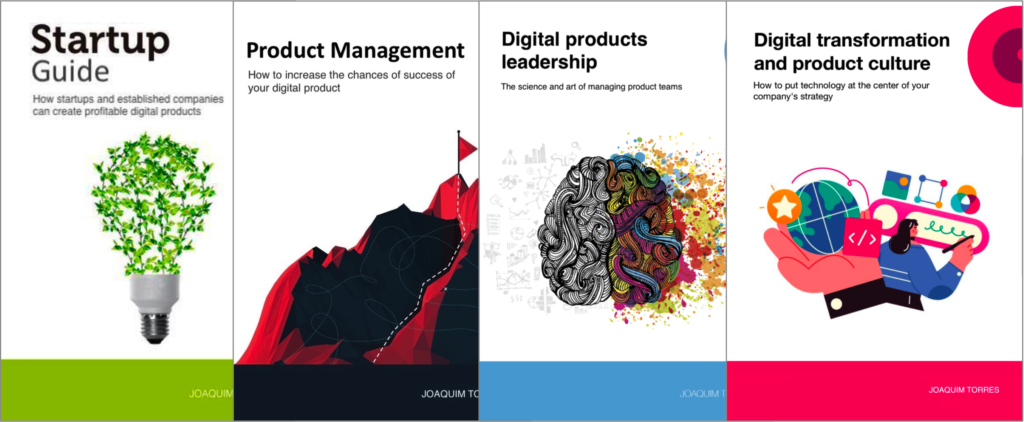
- Digital transformation and product culture: How to put technology at the center of your company’s strategy
- Leading Product Development: The art and science of managing product teams
- Product Management: How to increase the chances of success of your digital product
- Startup Guide: How startups and established companies can create profitable digital products