

Hacks to help in the digital transformation journey
2 Sep 2026Hack 3: What is the problem?
15 Sep 2026This article is an excerpt from the book “Digital Transformation and Product Culture: How to put technology at the center of your company’s strategy“.
When a new release becomes available, sales teams often want to offer it to all potential new customers. This situation is common at Gympass and can pose challenges due to the premise of “early and frequent releases” explained earlier. Initial versions of a feature or product are often somewhat clumsy, lacking certain functionalities and malfunctioning in specific use cases. Customer feedback is crucial for improving the product in future versions. The issue arises when potential customers become early adopters of these initial versions and end up frustrated because the product or feature doesn’t work seamlessly in certain scenarios, leading to a suboptimal experience.
Another common problem associated with rapid and frequent releases is the impact on the customer support team. They have to handle and provide assistance to customers who rightfully com- plain that the new feature or product is not functioning correctly. At Conta Azul, the product development team frequently received complaints from the customer support team that we were releasing unfinished features and products. They were correct, as this is a natural consequence of the principle of early and frequent deliveries.
During training sessions or internal presentations on early and frequent releases—a common practice among successful product teams—some people argue that their businesses are too high-risk to afford mistakes. For instance, a bank dealing with clients’ money or a hospital responsible for patient health may argue that errors are not acceptable. Therefore, they believe they cannot launch an incomplete product and need to release a fully-featured product with all the necessary functionalities. Some people even say:
“It’s easy for a startup, with no customers, to launch the first minimal (and embarrassing) version of their product and evolve from there. We are a large company, with hundreds of thousands of customers, we cannot afford to make mistakes.”
They are correct; making mistakes in front of thousands of cus- tomers is not a wise behavior. That’s why I introduced what I call Hack #2 to foster and reinforce a digital product culture at Gympass. We started using the terminology alpha, beta, and go-live to explain in which stage a product or feature is.
In the alpha stage, the product may not function correctly. If it’s in alpha, it should only be offered to customers who understand the challenges of using a new product and can handle these issues without major difficulties. Therefore, the number of customers in the alpha phase will be small, at most around 5, not more than that.
In the beta stage, the main issues of the product are fixed, but errors may still occur, and the user experience can and will improve. At this stage, it’s possible to offer the product or feature to dozens of customers.
Later, when all known errors are fixed, and the user experience is working correctly, it’s time to move the product to the go-live stage, where the product can be offered to all existing and potential customers. This certainly helps the sales and customer support teams understand the new feature and product release cycle and in which stage the product or feature is.
I use the following slide to present this terminology to the company. Feel free to use it in your company. This slide was created by my good friend Luiz Figueira:
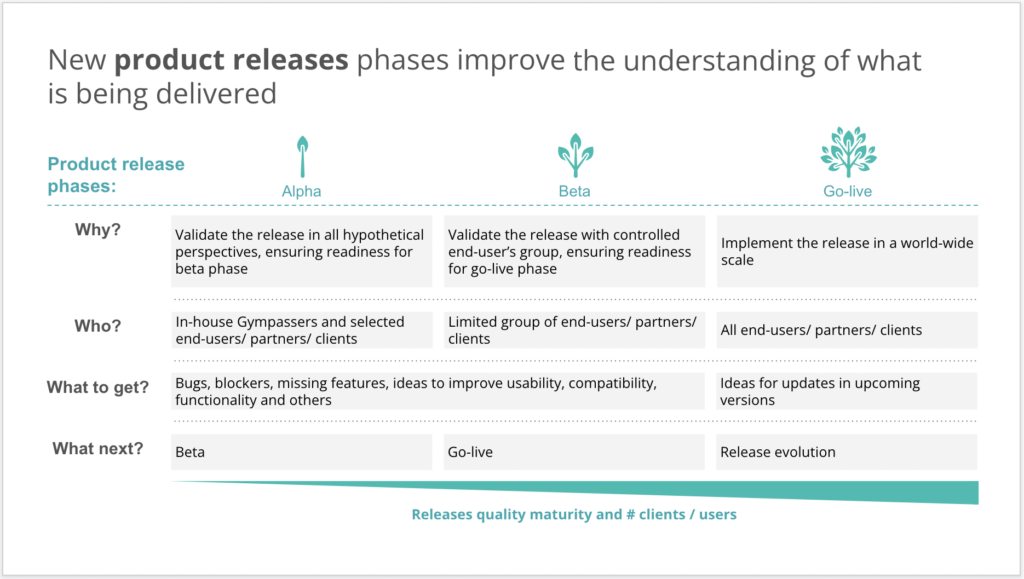
Slide explaining the alpha, beta and go-live stages of product launch.
Next we will talk about the third hack, what is the problem?
Digital transformation and product culture
This article is another excerpt from my newest book “Digital transformation and product culture: How to put technology at the center of your company’s strategy“, which I will also make available here on the blog. So far, I have already published here:
- About the book
- Part 1: Concepts
- Chapter 1: The so-called digital transformation – Project and Product
- Chapter 2: Uncertainty and digital transformation
- Chapter 3: Types of company
- Chapter 4: Type of company vs digital maturity
- Chapter 5: Business models
- Chapter 6: Agile, digital and product culture
- Part 2: Principles
- Chapter 7: Deliver early and often – Measuring and managing the productivity – Case study: Dasa Group – Case study: Itaú Unibanco
- Chapter 8: Focus on the problem – The Famous Product Discovery – Why the “business demands => IT implements” model does not work – Case study: Magazine Luiza
- Chapter 9: Result delivery – Outsource or internal team? – Case study: Centauro
- Chapter 10: Ecosystem mindset
- Part 3: Tools
- Chapter 11: Product Vision – Product vision examples
- Chapter 12: Product Strategy
- Chapter 13: Team Structure – Structuring effective product development teams – Structural teams – Team structure spreadsheet – Downsizing and layoffs – CTO + CPO – Internationalization – Outsourced team – Tuckman model – Dependencies between teams – Should we have a dedicated innovation team? – Should we have a team dedicated to fixing bugs? – Business Units – Why Individual Bonuses Don’t Work in Product Teams – What makes a group of people behave like a team?
- Chapter 14: What are OKRs and How to Get the Cadence Right – Perverse Metrics, Leading Metrics, and Lagging Metrics – From Vision to OKRs: Team, Initiatives, and the Metrics That Actually Matter – OKRs, Financial Bonuses, and How to Scale to Large Teams
- Chapter 15: Measuring Digital and Product Maturity
- Chapter 16: Hacks to help in the digital transformation journey – Hack #1: Start small – Hack 2: Alpha, beta, and go-live terminology
Scale your customer research
In a world where AI levels the playing field, deep customer knowledge is the one asset your competitors can’t copy. ReveLumi was built exactly for that. Learn more at revelumi.com.
Workshops, coaching, and advisory services
I’ve been helping companies and their leaders (CPOs, heads of product, CTOs, CEOs, tech founders, and heads of digital transformation) bridge the gap between business and technology through workshops, coaching, and advisory services on product management and digital transformation.
Gyaco Podcasts
At Gyaco, we believe in the power of conversations to spark reflection and learning. That’s why we’ve created “Produto em Pauta” podcast, with new episodes every Thursday.
The main series is called Mentorias: coaching conversations with product professionals, built on the idea that one person’s questions are often the questions of many others. We explore concrete challenges and turn experience into practical insights you can apply in your own context.
Available on YouTube and Spotify. Recorded in Portuguese, with English subtitles on YouTube.
Digital Product Management Books
Do you work with digital products? Do you want to know more about managing a digital product to increase its chances of success, solve its user’s problems, and achieve the company objectives? Check out my Digital Product Management books, where I share what I learned during my 30+ years of experience in creating and managing digital products:
- Digital transformation and product culture: How to put technology at the center of your company’s strategy
- Leading Product Development: The art and science of managing product teams
- Product Management: How to increase the chances of success of your digital product
- Startup Guide: How startups and established companies can create profitable digital products