

ReveLumi’s vision, our co-founder, and a request
19 Oct 2026Now that we’ve explored the concepts, principles, and tools that can increase your chances of success in digital transformation, this final chapter of this section will focus on two essential tools that can help incumbent companies compete with technology startups. When properly managed, these tools can significantly enhance your competitiveness and improve the likelihood of success in your digital journey.
There are many cases of traditional companies being disrupted by startups introducing new technology and innovative business models, often completely transforming the incumbent’s market. One of the best-known cases is that of Netflix and Blockbuster. In a period of just over 10 years, Netflix bankrupted Blockbuster:
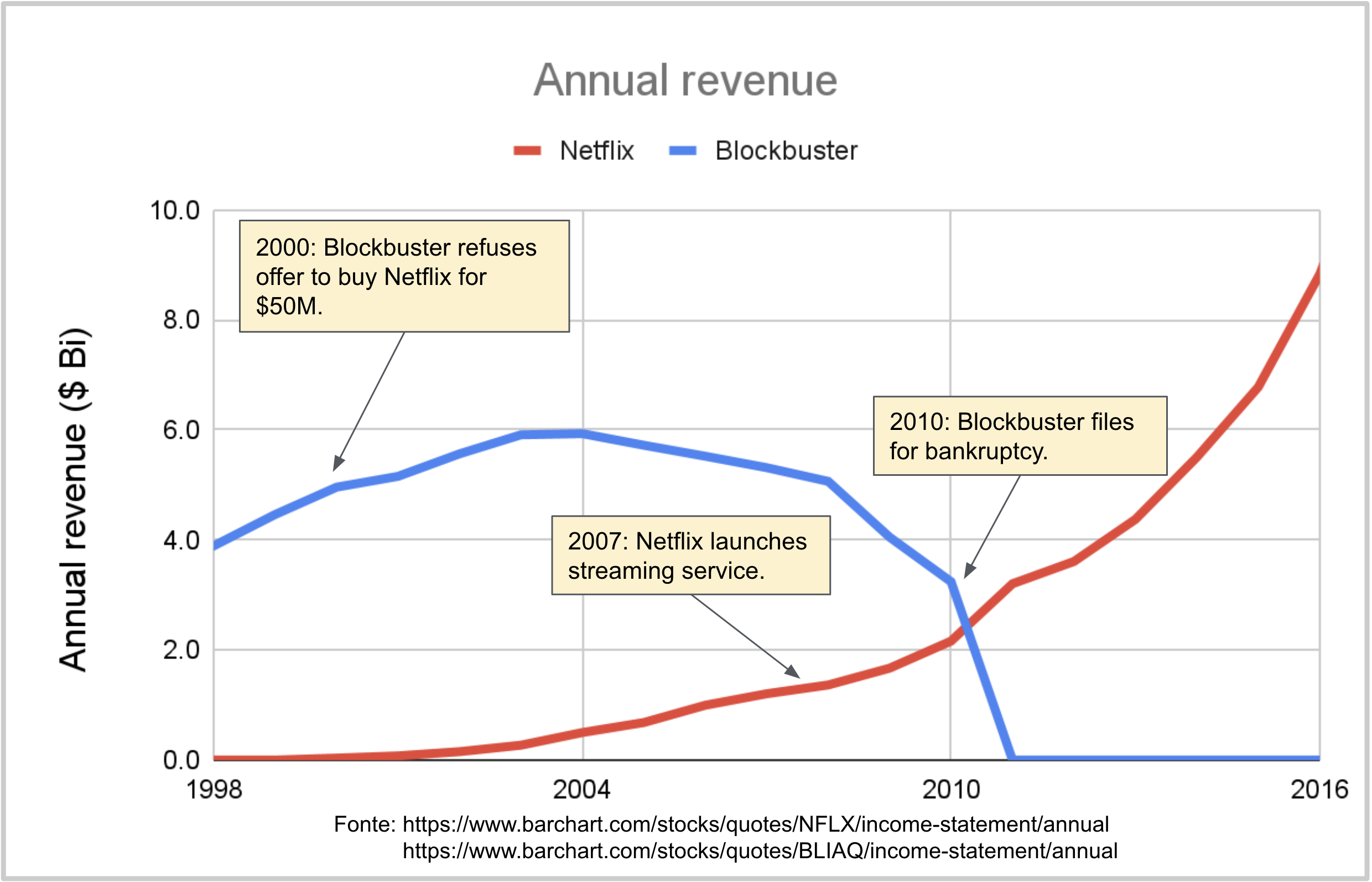
Netflix and Blockbuster revenue between 1998 and 2016.
On the other hand, Disney, another major media and entertainment company, successfully faced competition from Netflix:
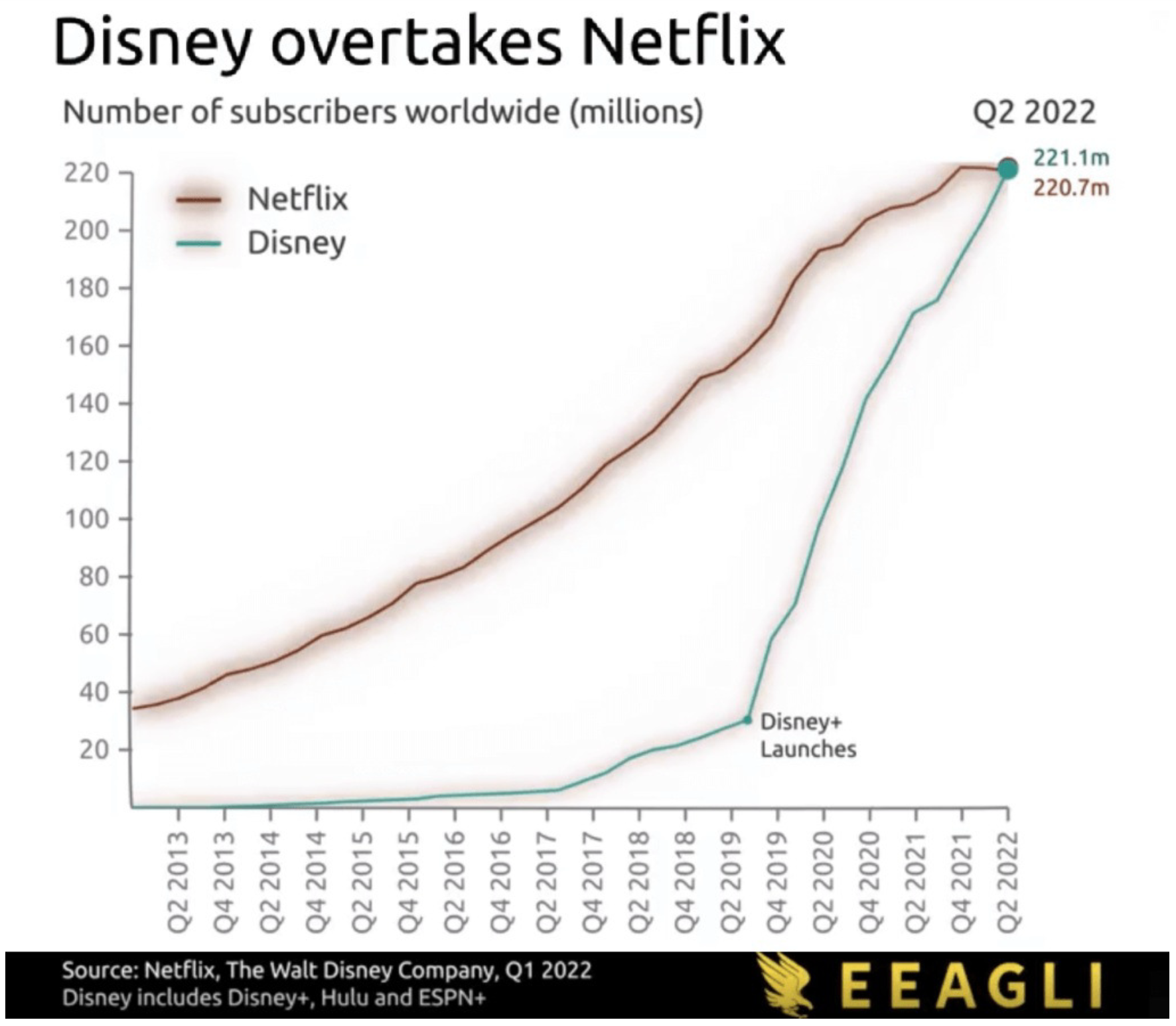
Number of Disney and Netflix subscribers. Adapted from: James Eagle, 2022.
Figure 91. Number of Disney and Netflix subscribers. Adapted from: James Eagle, 2022.
Incumbents have two tools with great potential to help them face technology startups entering the market causing disruption. I say they have potential because, like any business asset, these two tools must be well managed; otherwise, they may not become strengths and could even turn into disadvantages. Let’s go to them.
First tool: Data
Due to their long-standing presence in the market, incumbents possess and generate significantly more data than startups. For perspective, according to Loft’s 2020 data, its total annual sales equaled just ten days of Lopes’ sales.
This is a significant advantage: having access to vast amounts of data enables a deeper understanding of both customers and the business, leading to better decision-making and improved services.
At Lopes, we used to say that we were going beyond digital trans- formation, committed to making a transformation based on data and artificial intelligence. Understanding this enormous potential of our database, which was not only large but was updating with new data at a very fast speed, we decided in 2021 to make a strong investment in creating a data-driven culture. We had a team we called Big Data that was organized into three functions: data engineering, to create and manage the infrastructure and tools for data management; data analysis, for report creation and management; and data science, to look for patterns and insights from our data.
Along with this Big Data team we had a data product manager. This team spearheaded several initiatives to build a strong data culture and fully leverage this strength:
- We created training on data and artificial intelligence applied to business that was open to the entire company, not just people on the digital team, with the aim of showing what data science and artificial intelligence are and what their potential is for Lopes.
- We created in-depth technical training so that everyone on the product engineering team, not just the Big Data team, could work with data and eventually create and maintain algorithms for the products they worked on.
- The team developed solutions based on data and artificial intelligence that generated great results for Lopes and customers. Among the solutions, we have: the similarity algorithm, which managed to increase the coverage of similar properties from 72% to 99.5% in Lopes’ property inventory, which generated an increase in interest, measured by the number of clicks on similar properties , 106%; intelligent segmentation of contact lists for brokers, which achieved a 100% increase in the rate of successful contacts; implementation of RPA (Robotic Process Automation, or robotic process automation), which allowed us to increase the frequency of updating data between Lopes and developers (which was from days to a few hours) and leads (which was updated once a day and now has real-time updates). Lopes Avalia, a product launched in 2000, is an intelligent property appraiser that is based on Lopes’ inventory base and was created through the development of property pricing models using machine learning.
- HackatAI was a hackathon focused on data science and artificial intelligence. At Lopes Labs, we had a habit of having hackathons every beginning of the quarter, so that people on the teams could get together to work on different problems than those they worked on day to day. In 2021, we held a completely data-driven edition of the hackathon. There were 9 groups working on very interesting problems in the real estate market, such as: tagging and identifying items in property images; improving image quality; recognition of duplicate properties in the database; classification of properties based not only on the description, but also on the content of the property’s images; detection of properties that could be potential opportunities, among others.
On the other hand, the startup can grow and become the same size or even bigger than the incumbent, as happened with Netflix and Blockbuster. Here in Brazil we have the case of Nubank, which, according to data from the Central Bank, already occupies the position of 4th largest bank in Brazil in terms of number of customers in the ranking for the 2nd quarter of 2023.
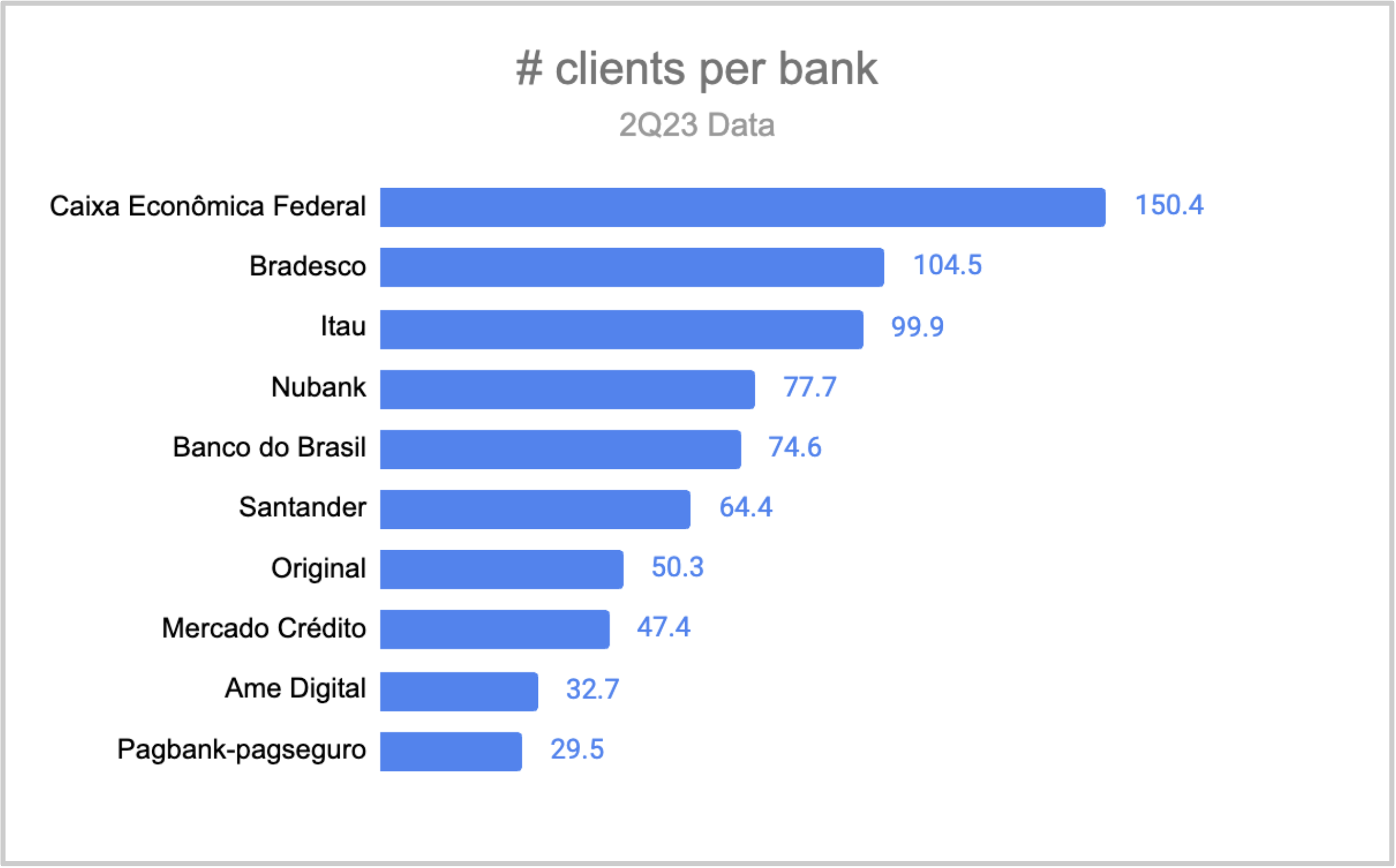
Ranking of Brazilian banks by number of customers. Source: Ferrari, 2023.
Second tool: Domain knowledge
Incumbents possess deep domain knowledge, including market dynamics and industry best practices. For example, Disney was founded in 1923 and has a LOT of experience in the media and entertainment market. Having the ability to combine that business experience with technology expertise is a sure path to good results, as it was for Disney in its streaming efforts.
Lopes was founded in 1935 and is facing competition from two very well-funded traditional born-digital companies, QuintoAndar and Loft. Lopes has a lot of experience in the real estate market, having been intermediating the purchase, sale and rental of properties throughout Brazil for over 85 years. Both QuintoAndar and Loft had to acquire this experience in the real estate market. In 2021, QuintoAndar acquired Casa Mineira, a well-known real estate agency in Belo Horizonte, and Loft acquired, also in 2021, Foxter, a very important real estate agency in Porto Alegre. In 2023, QuintoAndar entered into a commercial partnership with Lopes in which the two companies began to share the portfolio of properties for sale and lease.
However, this deep domain expertise can sometimes lead to com- placency, making incumbents blind to opportunities brought by new technology. Blockbuster was born in 1985, exploring the nascent videotape movie rental market. At the end of the 1990s, it was the absolute leader in this market. In 2000, Netflix’s founders knocked on Blockbuster’s door with an offer to be acquired for $50 million, an offer that Blockbuster turned down. And what happened: today Blockbuster no longer exists.
Recommendation
If leveraged effectively, these two tools—data and domain knowledge—can be powerful assets in competing against startups that enter the market with innovation and, often, substantial venture capital funding.
To make the most of these tools, it’s critical to change the way people in your company operate. Throughout this book, we’ve looked at concepts, principles, and tools that help increase your chances of success throughout your digital transformation journey.
Concepts and tools are very important, but if we don’t know why they are important, our digital transformation journey will be difficult. To get the most out of these concepts and tools that have been presented throughout this book, and other concepts and tools that you may already know or that will come from now on, you must not only know, but also constantly practice the four principles of a digital product culture, which are the behaviors needed to help create successful products:
- Deliver early and often;
- Focus on the problem;
- Result delivery;
- Ecosystem mindset.
With these principles, you will create a product culture that will enhance your company’s digitalization journey. This product culture is what will help your company take greater advantage of the two strengths described in this chapter.
Summing up
- Incumbents have two tools with great potential to help them face technology startups that enter their market and cause disruption.
- The first tool is data. Incumbents generate and accumulate far more data than startups. When properly managed, this data becomes a powerful asset for informed decision-making and customer-centric product innovation.
- The second tool is domain knowledge. Incumbents possess extensive expertise in their field. By combining this experience with technological advancements, they can develop innovative and impactful solutions for their customers.
- However, I emphasize that these are tools that have potential, because, like any aspect of the business, these two tools, if not well managed, will not be strengths and can even become disadvantages.
- Concepts and tools are important. However, behind successful digital transformation journeys lies the creation and strengthening of a strong digital product culture, based on the four principles we saw in Part 2 of this book: (1) deliver early and often; (2) focus on the problem; (3) result delivery; and (4) ecosystem mindset.
Digital transformation and product culture
This article is another excerpt from my newest book “Digital transformation and product culture: How to put technology at the center of your company’s strategy“, which I will also make available here on the blog. So far, I have already published here:
- About the book
- Part 1: Concepts
- Chapter 1: The so-called digital transformation – Project and Product
- Chapter 2: Uncertainty and digital transformation
- Chapter 3: Types of company
- Chapter 4: Type of company vs digital maturity
- Chapter 5: Business models
- Chapter 6: Agile, digital and product culture
- Part 2: Principles
- Chapter 7: Deliver early and often – Measuring and managing the productivity – Case study: Dasa Group – Case study: Itaú Unibanco
- Chapter 8: Focus on the problem – The Famous Product Discovery – Why the “business demands => IT implements” model does not work – Case study: Magazine Luiza
- Chapter 9: Result delivery – Outsource or internal team? – Case study: Centauro
- Chapter 10: Ecosystem mindset
- Part 3: Tools
- Chapter 11: Product Vision – Product vision examples
- Chapter 12: Product Strategy
- Chapter 13: Team Structure – Structuring effective product development teams – Structural teams – Team structure spreadsheet – Downsizing and layoffs – CTO + CPO – Internationalization – Outsourced team – Tuckman model – Dependencies between teams – Should we have a dedicated innovation team? – Should we have a team dedicated to fixing bugs? – Business Units – Why Individual Bonuses Don’t Work in Product Teams – What makes a group of people behave like a team?
- Chapter 14: What are OKRs and How to Get the Cadence Right – Perverse Metrics, Leading Metrics, and Lagging Metrics – From Vision to OKRs: Team, Initiatives, and the Metrics That Actually Matter – OKRs, Financial Bonuses, and How to Scale to Large Teams
- Chapter 15: Measuring Digital and Product Maturity
- Chapter 16: Hacks to help in the digital transformation journey – Hack #1: Start small – Hack 2: Alpha, beta, and go-live terminology – Hack 3: What is the problem? – Hack 4: Examples – Hack 5: Digital and business drops – Hack 6: Showcase – Hack 7: Productizing exceptions
- Chapter 17: Tools that are potential strengths of incumbents
- Part 4: People
- Chpater 18: Conclusion: it’s all about people
Scale your customer research
In a world where AI levels the playing field, deep customer knowledge is the one asset your competitors can’t copy. ReveLumi was built exactly for that. Learn more at revelumi.com.
Workshops, coaching, and advisory services
I’ve been helping companies and their leaders (CPOs, heads of product, CTOs, CEOs, tech founders, and heads of digital transformation) bridge the gap between business and technology through workshops, coaching, and advisory services on product management and digital transformation.
Gyaco Podcasts
At Gyaco, we believe in the power of conversations to spark reflection and learning. That’s why we’ve created “Produto em Pauta” podcast, with new episodes every Thursday.
The main series is called Mentorias: coaching conversations with product professionals, built on the idea that one person’s questions are often the questions of many others. We explore concrete challenges and turn experience into practical insights you can apply in your own context.
Available on YouTube and Spotify. Recorded in Portuguese, with English subtitles on YouTube.
Digital Product Management Books
Do you work with digital products? Do you want to know more about managing a digital product to increase its chances of success, solve its users’ problems, and achieve the company’s objectives? Check out my Digital Product Management books, where I share what I learned during my 30+ years of experience in creating and managing digital products:
- Digital transformation and product culture: How to put technology at the center of your company’s strategy
- Leading Product Development: The art and science of managing product teams
- Product Management: How to increase the chances of success of your digital product
- Startup Guide: How startups and established companies can create profitable digital products